
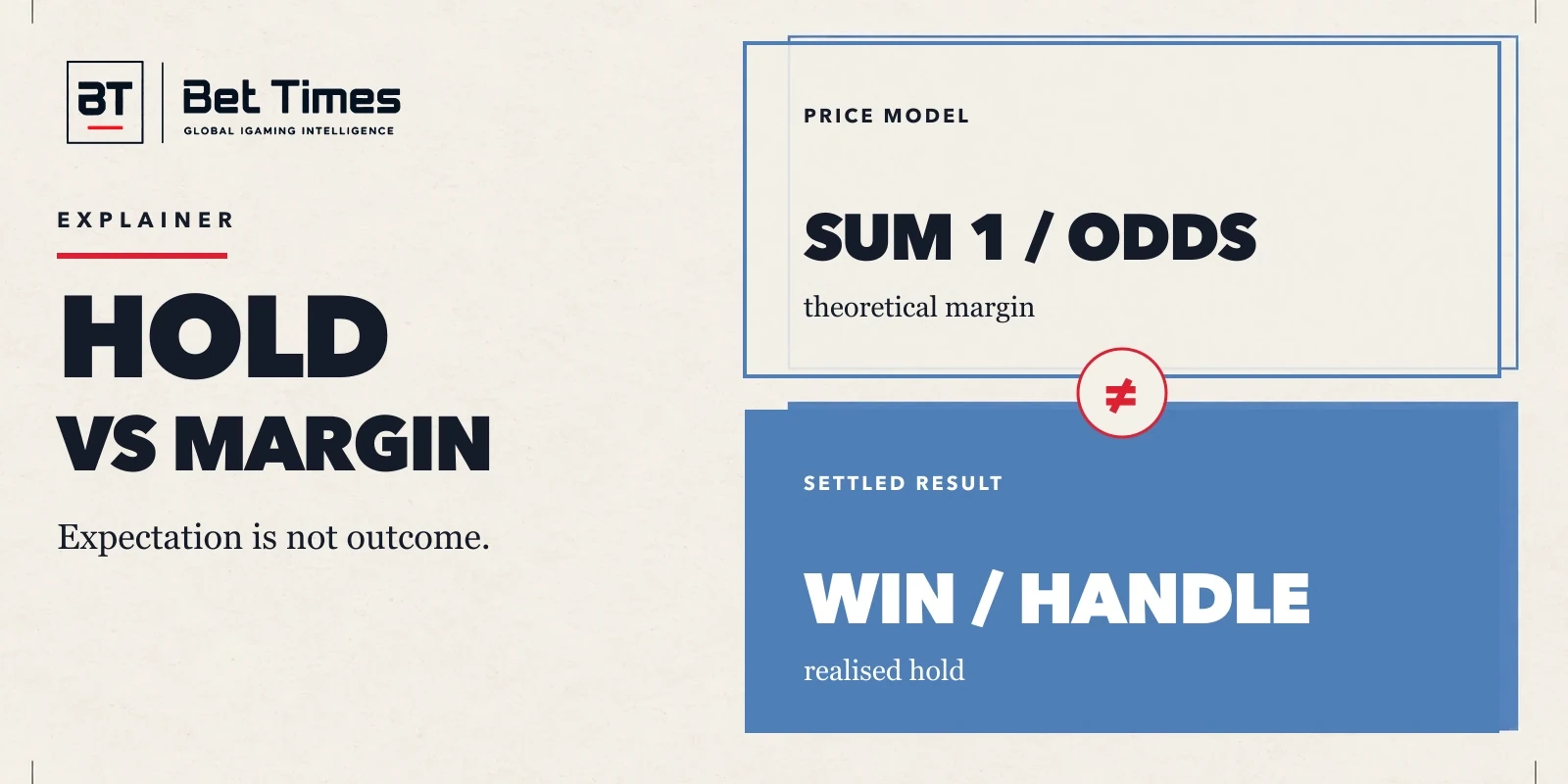
Sportsbook hold is the share of settled wagering volume retained after customer payouts. Theoretical margin is an estimate built from offered odds, probability models and the expected mix of bets before results are known. They may converge over a large, stable sample, but they are not the same measurement.
This distinction matters to operators, suppliers, investors and market analysts. A price can contain a positive theoretical margin while the sportsbook records negative hold for a day or month. Conversely, a strong reported hold does not prove that every market was priced with the same margin.
Sportsbook hold, overround and theoretical margin compared
| Role | What it means | Where to verify |
|---|---|---|
| Handle or turnover | Wagering volume within a defined period and accounting scope. | Whether wagers are placed or settled, and whether promotional stakes, voids or future events are included. |
| Sportsbook win or GGR | Stakes retained after the relevant payouts, before any further deductions defined by the reporter. | The exact revenue definition, settlement basis and treatment of bonuses, taxes and adjustments. |
| Realised hold | Sportsbook win divided by the matching handle. | That numerator and denominator cover the same products, events, dates and currency. |
| Book percentage | The sum of the implied probabilities derived from every offered outcome in one complete market. | The same timestamp, bookmaker, market and outcome set. |
| Overround | Book percentage minus 100%. | Whether the source calls this overround, margin, vig, juice or hold. Terminology is not standardised. |
| Theoretical hold | A modelled retained share derived from prices and stated assumptions, or a broader operator forecast incorporating product mix. | The formula, stake-distribution assumption, model horizon and whether promotions are included. |
The GGR, GGY and NGR explainer covers the wider revenue vocabulary. Here the focus is narrower: how a sportsbook moves from prices to expected economics, then from settled bets to a reported result.
What is sportsbook hold?
The simplest sportsbook hold formula is:
Realised hold = sportsbook win ÷ handle × 100
The American Gaming Association's sports-betting definitions describe handle as the amount wagered, gaming revenue as the amount retained after prizes, and hold percentage as gaming revenue divided by handle. That definition is useful, but a published dataset can narrow or adjust each component.
Consider a calculated illustration rather than a company result. A sportsbook settles £1,000,000 of wagers and pays £940,000 in customer returns, including returned stakes. Its sportsbook win is £60,000 and its realised hold is 6%. If payouts instead reach £1,020,000, sportsbook win is negative £20,000 and hold is negative 2% for that period.
This is a revenue ratio, not profit margin. It does not deduct every operating cost, gambling duty, supplier fee, payroll expense or marketing cost. The gambling operator explainer maps the broader operating responsibilities that sit around the bet ledger.
What is theoretical margin in sports betting?
At market level, theoretical margin begins with the offered odds. Decimal odds of 2.10 imply 47.62%; 3.40 implies 29.41%; and 3.60 implies 27.78%. Across a complete three-outcome market, those implied probabilities sum to 104.81%.
The excess above 100% is an overround of 4.81 percentage points. Smarkets' margin guide demonstrates the same method: convert each price to an implied probability and add every possible outcome. The calculation describes the price set, not what customers actually bet or what the event will return.
Some analysts convert the book percentage into an equal-payout theoretical hold. If B is the 1.0481 book, the calculation is 1 − (1 ÷ B), or about 4.59%. This assumes stakes are distributed so that every outcome creates the same total payout. Raw overround is 4.81% because it is measured against a fair 100% book; the reciprocal margin is 4.59% because it is expressed against the enlarged book.
Both labels are used inconsistently in the industry. A document may call the 4.81% excess “margin”, while another may call the 4.59% reciprocal result “theoretical hold”. Record the formula rather than relying on the label.
Why actual hold diverges from theoretical margin
The offered price is only one input. Realised hold is created after customers choose stakes and results settle. Five mechanisms can move it away from the price-derived estimate.
- Results and liability concentration: the sportsbook may take more money on one outcome than another. A result carrying concentrated liability can overwhelm the margin priced into the market.
- Bet mix: straight bets, multiples, in-play wagers and propositions do not necessarily carry the same embedded margin or variance.
- Timing: wagers may be placed in one reporting period and settled in another. A handle figure and its related payouts must be aligned before calculating hold.
- Promotions and adjustments: free bets, odds boosts, cashback and voids can be included or excluded at different stages of gross, adjusted or net revenue reporting.
- Sample size: a small number of events or large wagers can dominate a short period; a modelled long-run margin is not a promise for one week or quarter.
DraftKings states in its 2025 Form 10-K that fixed odds are intended to provide a theoretical margin, while betting patterns and individual event outcomes can create short-term volatility. The filing separately defines sportsbook handle as settled customer wagers and sportsbook net revenue margin as sportsbook revenue divided by handle. Those definitions belong to DraftKings' reporting and should not be silently applied to every dataset.
Super Group's 2025 annual filing similarly distinguishes theoretical win-rate models from actual hold. It says actual results can vary within a statistical range, especially over short periods. This supports the conceptual boundary; it does not establish a universal expected margin for all sportsbooks.
How product mix changes the portfolio result
A sportsbook does not settle one perfectly balanced market repeatedly. It settles a portfolio. The result reflects both pricing and the proportion of turnover assigned to each product.
A simple two-way market priced at 1.91 on both sides has a 104.71% book and an equal-payout theoretical hold of 4.50%. If more handle moves into products with different pricing, correlation or payout structures, the weighted portfolio expectation changes. The combined result cannot be reconstructed from a single headline line without turnover weights and liability data.
Kambi's Q4 2025 report reports operator trading margin for both the quarter and the full year. The two periods produce different figures, illustrating why the measurement window must travel with the metric. These are figures from Kambi's operator network, not a market-wide benchmark.
The same scope discipline applies to technology. A Player Account Management system may hold wallet and settlement records, while an iGaming platform joins those records to products, bonuses and reporting. The percentage in a board deck remains unverifiable until its source ledger and calculation policy are identified.
Why reporting basis can invalidate a hold comparison
Regulators do not always publish the same numerator or denominator. The Gambling Commission's current GGY guidance requires Great Britain licensees to report GGY using defined stakes, other accruals and prizes. It also gives specific treatment to free bets, bonuses and loyalty schemes. That is a regulatory-return definition, not a universal synonym for every operator KPI.
New Jersey provides a particularly clear warning. The Division of Gaming Enforcement's sports-wagering reporting note explains that its tax return historically included future-event wagers when received and deducted certain payouts when redeemed. It explicitly warned that total tax-basis gross revenue divided by total handle did not produce a relevant win percentage and was not directly comparable with Nevada's accrual-basis win.
The lesson is broader than either jurisdiction: never calculate hold merely because two columns are labelled revenue and handle. First confirm that the amounts mature on the same settlement basis. The New Jersey market profile and Brazil fixed-odds authorisation guide show why market rules belong in the evidence chain.
A worked bridge from market price to reported hold
Use this calculated scenario to keep the layers separate:
- A three-way market is offered at 2.10, 3.40 and 3.60. Its book percentage is 104.81%, overround is 4.81%, and equal-payout theoretical hold is 4.59% under the stated balancing assumption.
- Customers do not follow that assumed distribution. They stake £420,000 across the three outcomes, with a large concentration on one result.
- The event settles. Add this market to every other settled sportsbook wager in the reporting period.
- The period records £1,000,000 of settled handle and £940,000 of customer payouts. Realised sportsbook win is £60,000 and hold is 6%.
- After promotions or other permitted deductions, a company may publish a separate adjusted or net revenue margin. That number needs its own reconciliation.
The 6% result does not prove that the original market had a 6% theoretical margin. It is the realised outcome of all settled wagers in the chosen scope. Equally, the 4.59% price-derived estimate cannot predict the period result without the stake mix, true outcome probabilities and reporting adjustments.
A sportsbook margin review checklist
Use the following checklist when reading a regulator release, supplier report or operator filing:
- Name the metric: hold, win percentage, trading margin, GGR, GGY or net revenue margin.
- Copy the formula: record the published numerator, denominator and adjustment sequence.
- Match the population: identify brand, product, channel, market, currency and period.
- Check maturity: determine whether handle covers placed wagers, completed events, redeemed tickets or settled customer wagers.
- Separate price from result: keep market overround and modelled theoretical margin apart from realised revenue.
- Trace promotions: establish whether free bets, boosts, cashback and loyalty costs affect handle, gross revenue or a later net measure.
- Inspect variance: note event results, large liabilities, product mix and sample size without converting them into an unsupported causal claim.
- Preserve provenance: save the original report, publication date, update date and any later restatement.
Sportsbook hold vs theoretical margin is ultimately a comparison between outcome and expectation. Theoretical margin describes the economics embedded in prices under stated assumptions; realised hold describes what the sportsbook retained across a defined set of settled bets. A reliable analysis preserves both numbers and the bridge between them.
Frequently asked questions
Is sportsbook hold the same as profit margin?
No. Sportsbook hold usually compares gaming win or revenue with betting handle. It is calculated before many operating expenses and can precede taxes, supplier charges or promotional deductions, depending on the source. Profit margin uses an accounting profit measure and a revenue denominator, so it answers a different business question.
Is overround the same as theoretical hold?
Not always. Overround is the amount by which all implied probabilities exceed 100%. Some sources call that percentage margin or hold. A reciprocal theoretical-hold calculation divides the excess by the full book percentage, producing a slightly smaller number. Always retain the formula and assumptions beside the label.
Can actual sportsbook hold be negative?
Yes. If customer payouts exceed the matching settled stakes for a defined period, sportsbook win and realised hold can be negative. That can occur even when the underlying odds contain a positive theoretical margin. The result describes the selected sample and should not be treated as proof that the pricing model has no edge.
Why can two reports show different hold percentages?
They may use different products, currencies, channels, periods, settlement bases or promotional treatments. One report may divide gross win by settled handle, while another presents a net revenue margin after promotional reinvestment. Compare the definitions and reconciliation first; identical labels do not guarantee comparable calculations.
Does a higher theoretical margin guarantee higher revenue?
No. A higher embedded margin can raise expected retained value under the model, but revenue also depends on turnover, stake distribution, results and customer behaviour. Price changes can also affect demand and product mix. A margin forecast therefore needs a volume assumption and variance range, not just a larger percentage.