
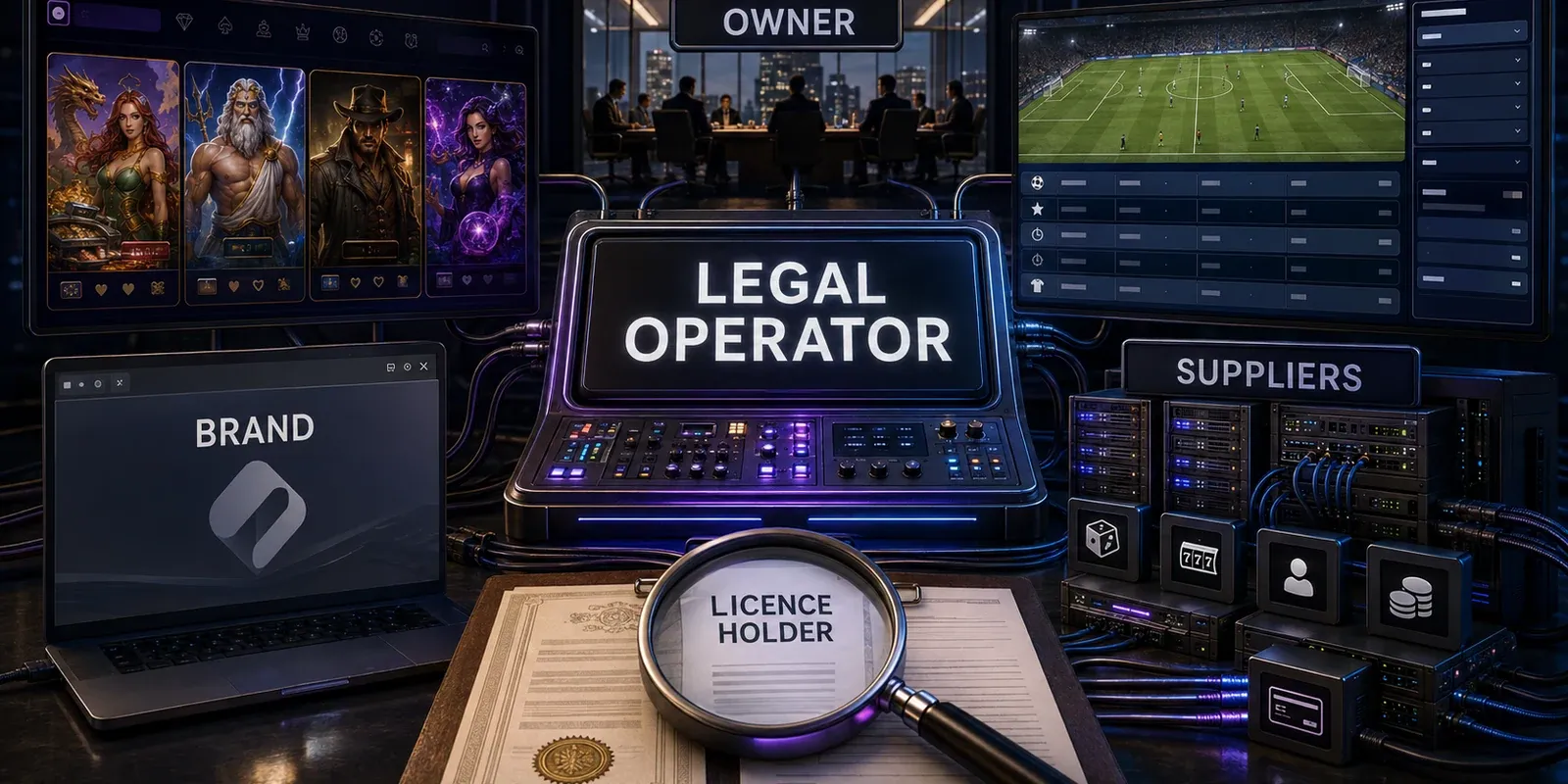
An online gambling operator is the legal entity that provides gambling services to customers and carries the regulatory obligations attached to that activity. The name on the website or app may be only a trading brand. A parent company can own the wider group without holding the local operating licence, while separate suppliers provide games, odds, account systems or other technology. For analysts, journalists, partners and compliance teams, the useful question is therefore not simply "Who owns this brand?" but "Which entity operates this exact product in this market?"
What does gambling operator mean?
A gambling operator is the business that provides the gambling activity. In Great Britain, for example, the Gambling Commission describes operating licences by the activity they authorise, including remote betting on real events, virtual events, pool betting and betting intermediary services. The product and delivery channel matter because an entity can be authorised for one activity without being authorised for another.
The operator is normally the entity that enters into the customer relationship, accepts or arranges wagers, maintains player accounts and answers to the regulator for the licensed service. The exact legal definition varies by jurisdiction. BETTIMES therefore treats "operator" as a sourced, market-specific relationship rather than a permanent label attached to a brand worldwide.
Brand, operator, licence holder and owner are different records
A single gambling product can involve several names. They may appear together on a website, but they describe different roles:
| Role | What it means | Where to verify |
|---|---|---|
| Brand | The name used on the website, app and advertising. | Website, app listing and trademark records. |
| Operator | The legal entity providing the gambling service in a defined market. | Customer terms and official regulator register. |
| Licence holder | The entity named on the relevant regulatory authorisation. | Licence certificate and official register. |
| Owner | The entity that controls the operator through corporate ownership. | Company filings and transaction documents. |
| Supplier | A business providing games, software, data, payments or other services. | Supplier register, contracts and company disclosures. |
Regulatory registers often preserve these distinctions. The British public register separates an account name from trading names and domain names. It also records licence and domain status. The Australian Communications and Media Authority publishes trading name, licence holder, URL and licensing authority in separate columns. These structures are a useful warning against treating the logo as the legal identity.
Why the same brand can have more than one operator
A brand can use different operating entities in different regulated markets. Local incorporation, licensing conditions, tax, product scope or a market-specific partnership can all affect the structure. The entity named in one country's terms and conditions should not be copied into a global profile without checking the target jurisdiction.
The relationship can also run in the other direction: one licensed operator may provide several customer-facing sites. The iGaming Ontario operator directory lists legal operator entities alongside their regulated gaming websites and product categories. The Malta Gaming Authority Licensee Hub lets users search by licensee name, authorisation status, URL or gaming service. Both examples show why entity, domain and product should be checked together.
Corporate transactions add another layer. A parent company may acquire a group while existing subsidiaries continue to hold local licences. A rebrand may leave the legal entity unchanged, while a migration to a new operator may leave the consumer brand unchanged. Ownership and operating responsibility need separate dates and sources.
Operator, supplier and betting intermediary are not synonyms
An operator supplies the regulated gambling service to the customer. A supplier usually provides part of the system used to deliver that service. The General Commercial Gaming Regulatory Authority in the United Arab Emirates, for example, lists gaming operators and gaming-related vendors as separate licence categories. The Malta Gaming Authority likewise has a specific critical gaming supply authorisation for defined business-to-business services.
A betting intermediary has another role. The British regulator distinguishes a business that is a party to a bet from one that brings betting parties together without taking liability for their bets. The latter activity is commonly associated with a betting exchange. A company described loosely as a betting operator may therefore hold a more specific intermediary authorisation.
White-label structures create a separate source of confusion. Under Gibraltar's 2012 technical and operating standard for white labels, the licensed operator provides the remote gambling service through a third party's brand and retains regulatory responsibility. That is a jurisdiction-specific example, not a universal definition or a statement about current rules elsewhere. It shows why the footer, terms and regulator record must be read together.
How to verify who operates a gambling brand
Use a reproducible check. Save the evidence as you work so another researcher can repeat the result later.
- Define the market and product. A sportsbook, online casino, poker room and betting exchange may require different authorisations.
- Record the exact customer domain. Similar brand names, country domains and mobile apps can point to different entities.
- Read the footer, terms and privacy notice. Capture the legal entity, company number, registered address and any stated licence number.
- Search the official regulator's register by legal entity, trading name and domain. Confirm product scope and the current status of both the licence and domain where those fields exist.
- Classify the result with a date and source URL. Record a conflict or missing field instead of resolving it by assumption.
Do not start with an affiliate review, a licence logo or a search snippet when an official register is available. Those sources can help locate the claim, but the final match should rest on the regulator's own record and the operator's contractual disclosure. A register outage is also not evidence of an absent licence. It is a failed check that needs to be repeated.
What an operating licence tells you
A licence can establish that a named entity has authorisation from a named regulator for defined activities and, where the register exposes it, a current status. It may also link approved trading names or domains and show regulatory actions. The British register, for example, distinguishes active, suspended, revoked, surrendered and other status states rather than reducing every record to licensed or unlicensed.
A licence does not automatically establish who owns the wider corporate group, whether a different domain is covered, or whether the entity can offer the same product in another jurisdiction. It also does not replace operational due diligence on payments, customer funds, complaints, technology or commercial counterparties. Keep the conclusion no broader than the record supports.
Common research errors
- Searching only the brand name and stopping when it does not appear.
- Matching a licence number without matching the legal entity and exact domain.
- Treating a parent company, platform supplier or game studio as the customer-facing operator.
- Copying an operator relationship from one country into another market.
- Calling a brand unlicensed when the register is unavailable or the search terms were incomplete.
- Keeping a historic entity relationship without a verification date.
These errors usually come from collapsing several records into one label. A stronger profile keeps the brand, legal entity, domain, market, product, licence and verification date as separate fields.
How BETTIMES records operator relationships
BETTIMES uses status labels that describe the evidence, not the reputation of the brand. "Registry matched" means the reviewed sources connect the entity or domain to a regulator record. "Operator-stated" means the relationship currently rests on the company's own disclosure. "No licence record found" describes the result of a documented search; it is not a universal legal conclusion. "Conflicting source records" keeps incompatible evidence visible, while "Review required" marks an unresolved or stale record.
Each BETTIMES company profile carries a verification date and source list. The source policy explains why primary records take priority and why unresolved differences remain visible. Readers can use those links to reproduce the check instead of relying on an unexplained editorial verdict.
Frequently asked questions
What is the difference between a gambling brand and an operator?
The brand is the name customers see. The operator is the legal entity that provides the gambling service and carries the obligations attached to the relevant authorisation. One operator can use several brands, and one brand can use different operating entities across markets, so the domain and jurisdiction must be checked.
Can one gambling operator run several websites?
Yes. Official registers may list several trading names or domains under one operator record. That does not mean every similarly named site belongs to the same licence. Match the exact domain and product to the current register entry rather than inferring the relationship from design, branding or a shared platform.
Is the parent company always the licence holder?
No. A parent company can own licensed subsidiaries without holding the operating licence used for a particular market. Corporate ownership and regulatory authorisation are separate relationships. Record the parent from a company filing or transaction source, then record the local licensee from the regulator and customer contract.
Does one gambling licence cover every country?
No. A licence comes from a particular authority and covers defined activities under that authority's jurisdiction. The same group may need different entities or licences elsewhere. Check the market, product and delivery channel before applying a licence claim to a customer-facing site.
What should I save when verifying an operator?
Save the legal entity, trading name, exact domain, product, regulator, licence or account number, status, source URL and access date. Note the search terms and any conflict. This turns a one-off lookup into a reproducible record that can be reviewed when a licence, domain or corporate structure changes.
The practical rule
A gambling operator is a legal and regulatory role, not a logo. Start with the exact market and domain, then connect the customer-facing brand to the entity named in the contract and the relevant official register. Keep ownership, licensing and technology supply as separate relationships. When the evidence does not connect cleanly, record the gap and return to it later.