
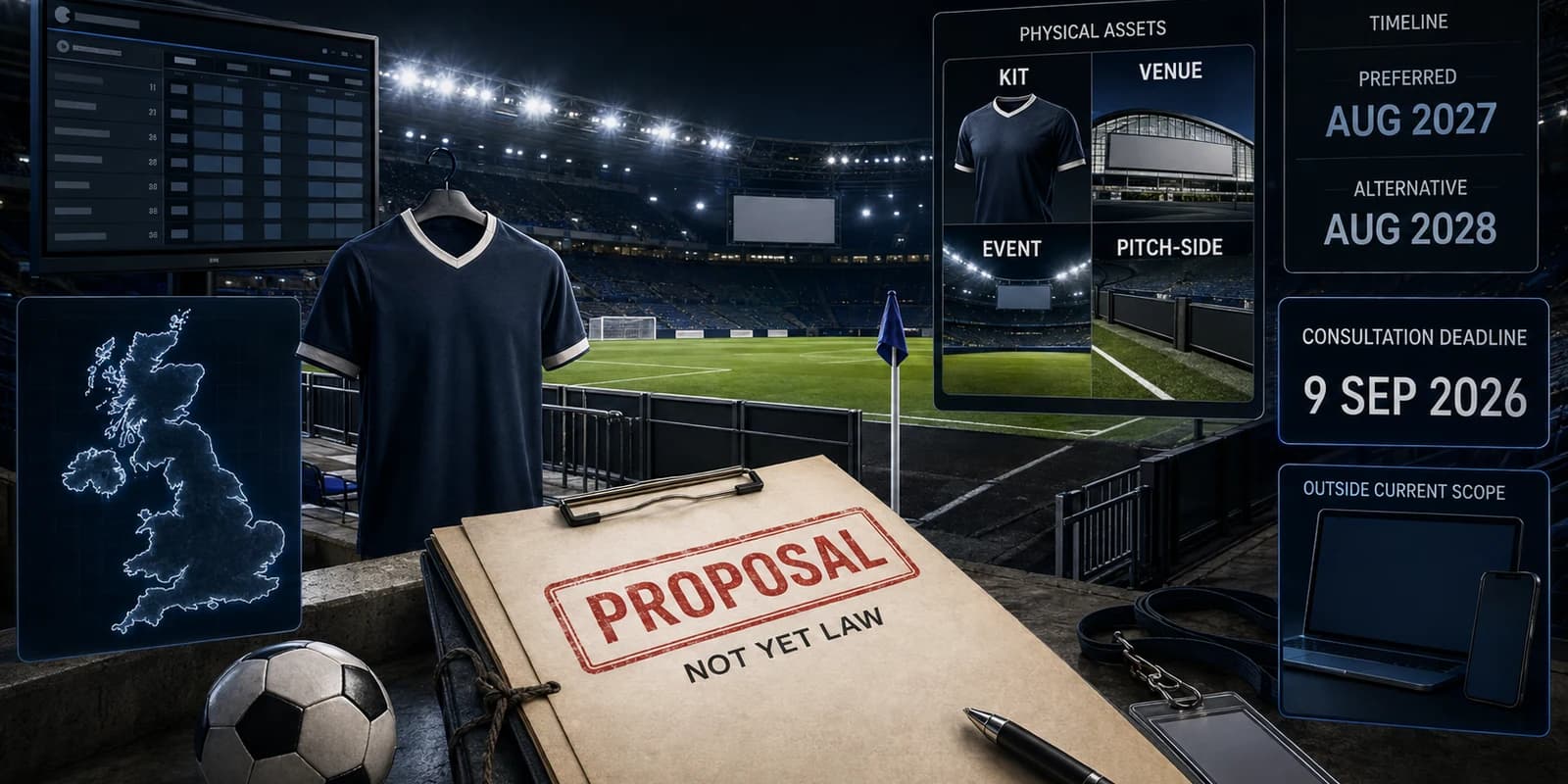
The UK government has proposed banning physical sponsorship and advertising by gambling operators that do not hold a Gambling Commission licence. The consultation closed on 9 September 2026 and its page is now marked closed. It covers all sectors in Great Britain and names August 2027 as the preferred start date. No government response or final legislation was published on the consultation page when BETTIMES rechecked it on 19 September 2026.
This article is for gambling operators, sports organisations, sponsors, commercial advisers and researchers who need a sourced summary of the proposal. It explains what is in scope, what remains outside the current draft and which commercial relationships need closer checking. It does not predict Parliament's decision or provide legal advice.
What the UK government has proposed
The Department for Culture, Media and Sport consultation proposes using secondary legislation under section 328 of the Gambling Act 2005 to prohibit sponsorship and advertising by gambling operators that are not licensed by the Gambling Commission. The measure would apply across all sectors in Great Britain, not only professional football. If taken forward, the legislation would be subject to Parliamentary approval.
The legal distinction matters. An operator can lawfully serve customers outside Great Britain without holding a British licence, but it cannot legally offer gambling services to consumers in Great Britain. Existing sports sponsorship guidance allows a British organisation to work with such an operator if the organisation assures itself that the gambling website cannot be accessed from Great Britain. The government argues that virtual private networks can weaken that safeguard and wants the sponsorship itself to be prohibited.
The consultation was published on 15 July 2026 and closed on 9 September 2026. The government said responses would be reviewed before any possible legislation was laid and planned to respond later in 2026. Until a response and legislation are published, descriptions such as "the UK has banned unlicensed sponsorship" are premature.
Which sponsorship assets are in scope
The proposed ban is aimed at physical sponsorship and advertising. The consultation identifies assets that would be covered:
- Team kit and sporting equipment.
- Matchday programmes and other printed material.
- Pitch-side, ground-side and field-side advertising.
- Venue infrastructure and other physical surfaces.
- Naming rights for leagues, competitions, events and venues.
The proposal would apply at every level, including grassroots activity, and to overseas teams or competitors while they take part in events in Great Britain. It is broader than a football shirt restriction. A venue name, perimeter board or competition title can create the same regulatory question even when no logo appears on a player's kit.
Online and digital advertising are not included in the current proposal. The government asks consultees whether the restriction should be extended to digital channels, so that boundary is still open. A contract that combines physical branding, social media posts, broadcast assets and hospitality would need to be separated by asset rather than classified as one undivided sponsorship package.
Why the proposal follows TGP Europe's exit
The immediate policy background is the 2025 departure of white-label provider TGP Europe from the British market. On 16 May 2025, the Gambling Commission said TGP Europe had surrendered its licence after being told it would need to pay a £3.3 million penalty and make improvements. The regulator identified failures involving checks on business partners and anti-money laundering controls.
The licence surrender left several football sponsorship partners without a licensed British operator behind their brands. Under the current model, clubs could continue a sponsorship if the overseas gambling service was blocked in Great Britain. The proposed ban would remove that route for physical sponsorship by operators that lack a Gambling Commission licence.
DCMS estimates that about 40% of Premier League clubs had sponsorship or advertising arrangements with operators not licensed in Great Britain during the 2025/26 season. That figure is the government's estimate in the consultation, not an independent count by BETTIMES. The consultation also says reliable public contract values are unavailable, which limits any confident estimate of the proposal's financial effect.
How white-label agreements are treated
The consultation draws a line between an unlicensed operator and a white-label brand delivered through a Gambling Commission licensee. In a white-label arrangement, the licence holder provides the regulated gambling service while a commercial partner supplies or promotes the customer-facing brand. The government says those arrangements are not expected to be included in the proposed ban because the operating provider holds a British licence.
That exclusion does not remove the licensee's responsibilities. The Gambling Commission's third-party guidance says accountability for a white-labelled site rests with the licence holder and cannot be transferred to another party. Its April 2025 risk assessment also identifies white-label and other third-party relationships as a high-risk area requiring checks on matters such as jurisdiction, beneficial ownership, source of funds and activity outside Great Britain.
The practical result is that two visually similar gambling sponsors could be treated differently. One may be an overseas operator without a British licence; the other may be a brand whose service is legally provided by a licensed white-label operator. Confirm the legal entity and exact domain through the BETTIMES licence verification process before assigning either label. Our guide to gambling operators and brands explains the entity distinction in more detail.
The two proposed implementation timelines
DCMS presents two transition options rather than a settled commencement date:
- Preferred option: a fixed start in August 2027, before the 2027/28 football season, covering new and existing arrangements.
- Alternative option: apply the restriction to new contracts after the legislation takes effect, while allowing existing agreements to run only until August 2028.
A fixed date would create one clear changeover point but could interrupt contracts signed before the policy was announced. The alternative would reduce immediate disruption while allowing different end dates for new and existing agreements. The consultation asks respondents to provide evidence on implementation costs and the effect of either approach.
What remains undecided after the consultation
Several material points remain undecided. The consultation sought evidence on whether digital advertising should be added, whether the proposed physical scope is clear, how long organisations need to unwind affected contracts and whether the rules could produce unintended consequences. It also asked about the treatment of white-label arrangements.
The response period ended at 11:59pm on 9 September 2026. The government may amend, delay or decline the proposal after reviewing submissions. Any secondary legislation would then need Parliamentary approval. A current contract review should therefore distinguish the closed consultation text from any later government response or final rule and retain the version and date of every source used.
What clubs, operators and sponsors should check now
A preliminary evidence review can be useful before the policy is final. The following steps describe a research workflow, not a legal opinion:
- Identify the legal entity providing the gambling service, not only the name displayed in the sponsorship.
- Check the exact domain and current Gambling Commission licence status in the official public register.
- Classify the relationship as a licensed operator, a licensed white-label arrangement or an operator without a Great Britain licence.
- Map each contract asset separately, including kit, perimeter boards, venue naming, print, broadcast, social media and other digital placements.
- Record expiry, renewal and termination dates against both proposed transition options.
- Preserve dated evidence of geoblocking and the due diligence required by the current sports sponsorship guidance.
BETTIMES maintains separate directories for companies, markets and licences. The separation helps prevent a brand, corporate owner and licence holder from being treated as the same record when commercial structures change.
Frequently asked questions
Is the UK unlicensed gambling sponsorship ban already law?
No. The consultation closed on 9 September 2026, but closure did not make the proposal law. DCMS proposes using secondary legislation under section 328 of the Gambling Act 2005. The measure still needs a final government decision and Parliamentary approval; no response or final legislation was published on the consultation page when checked on 19 September 2026.
Does the proposal ban all gambling sponsorship?
No. It targets sponsorship and advertising by gambling operators that do not hold a Gambling Commission licence. Sponsorship by licensed operators is not the stated target. The current proposal focuses on physical assets across all sectors in Great Britain, including kit, venues, events and pitch-side advertising.
Are white-label gambling brands included?
Not under the government's current approach when the gambling service is provided by a Gambling Commission licensee. The licence holder remains responsible for the white-labelled site and its third parties. The consultation welcomes evidence on this treatment, so the final wording should still be checked.
When could the sponsorship ban start?
The preferred date in the closed consultation is August 2027, before the 2027/28 football season. An alternative would restrict new contracts once legislation takes effect and let existing agreements continue only until August 2028. Neither option is final until the government responds and Parliament approves any resulting secondary legislation.
Does the proposal cover online advertising?
Not in its current form. The draft scope covers physical advertising and sponsorship assets. DCMS specifically asks whether online and digital advertising should be included, which means that part of the policy is unresolved. Mixed contracts should be reviewed asset by asset rather than assigned one blanket classification.
What happens next
The consultation closed on 9 September 2026. DCMS said it would review the evidence and decide whether to proceed with secondary legislation, which would require Parliamentary approval. Until a response, final text and commencement date are published, the reliable description is a proposed ban with two transition options, not a completed change in British gambling law.
BETTIMES will update this page when the government publishes its response or lays legislation. Readers can use our source policy to see how regulatory claims are verified, dated and revised.