
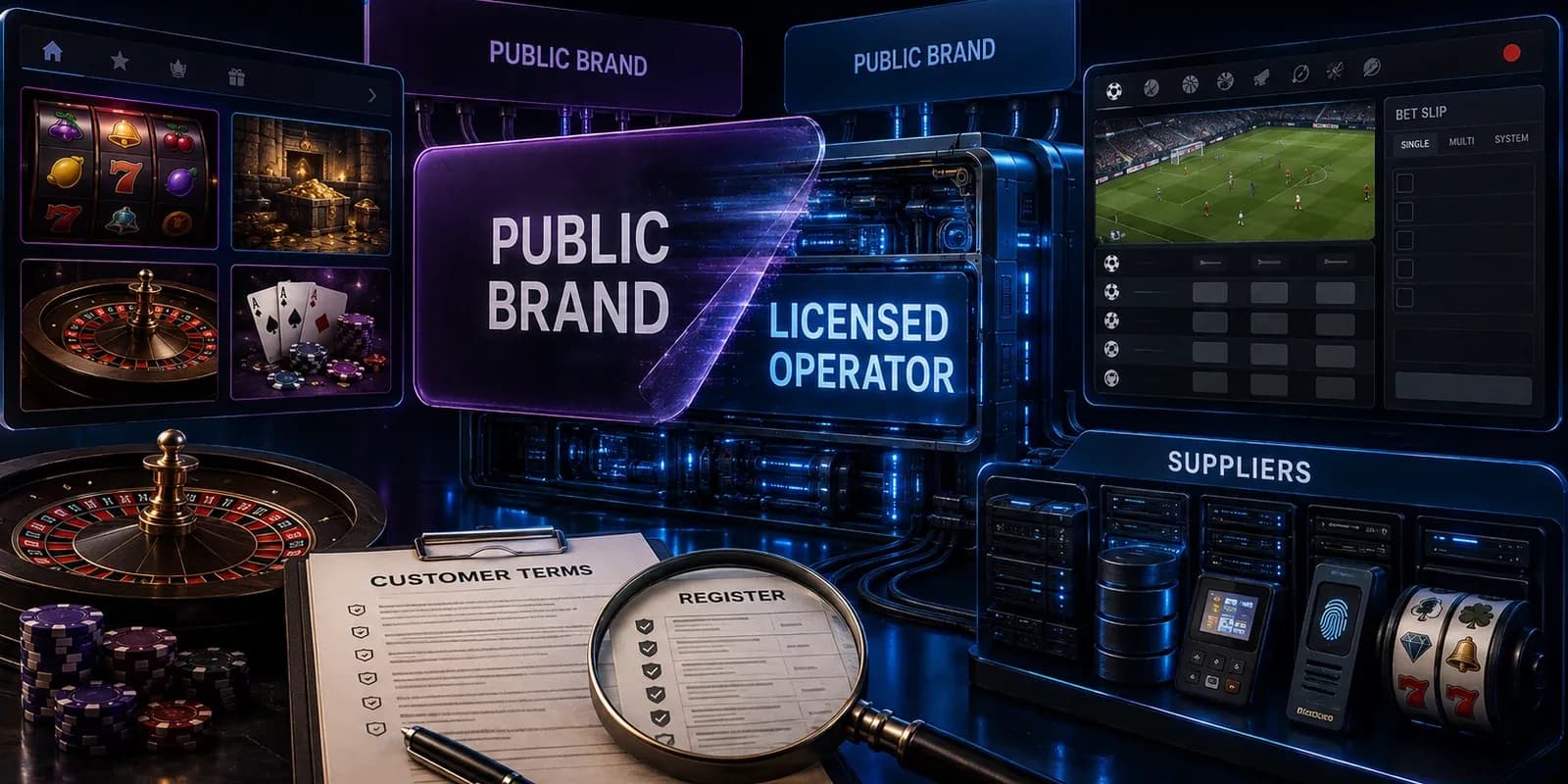
White-label gambling is a commercial arrangement in which a licensed operator provides a regulated gambling service under a brand supplied by a third party. In the Great Britain model, the licensee contracts with customers and remains responsible for compliance. The brand partner may supply the name, audience and marketing, but it does not replace the licensed operator. Rules and terminology differ across jurisdictions, so the same description cannot be copied from one market to another.
This article is for industry researchers, commercial teams, journalists and readers who need to identify the legal operator behind a white-label casino or sportsbook. It explains the roles and verification steps. It does not compare platform vendors, quote launch costs or offer advice on entering a regulated market.
What does white-label gambling mean?
The phrase describes a regulated service presented under another party's brand. The UK government's 2023 gambling white paper says "white label" is not a statutory term. In its description of the Great Britain market, a licensee offers remote gambling under a third-party brand, contracts with customers and provides the facilities for gambling required by the Gambling Act 2005.
The brand partner can make the site look like a separate consumer business. The footer and terms may identify a different legal entity as the operator. That is why a logo, domain name or sponsorship alone does not establish who holds the licence or who is legally responsible for the gambling service.
Commercial suppliers sometimes use "white label" more broadly for packaged software, games, payments or managed services. Those descriptions explain what a vendor sells, not necessarily which entity provides regulated gambling in a particular country. BETTIMES uses the term only after matching the brand, operator, domain, market and regulator record.
The three roles in a white-label arrangement
A basic white-label structure separates the regulated operator from the public brand and the companies supplying technology or other services.
| Role | What it means | Where to verify |
|---|---|---|
| Licensed operator | The entity authorised to provide the gambling service in the market. In Great Britain, it contracts with customers and remains accountable for compliance. | Official regulator register, customer terms, domain record and current licence status. |
| White-label partner | The third party whose brand is used for the customer-facing product. Its permitted work depends on the jurisdiction and contract. | Website ownership notices, commercial disclosures, company filings and statements from the licensee. |
| Technology or service supplier | A company providing software, games, payments, identity tools, hosting or another part of the operating stack. | Supplier disclosures, regulator records where required, contracts and product documentation. |
One company can perform more than one role, but the roles should still be recorded separately. A platform supplier can also hold the consumer-facing operating licence. A brand owner can hold its own licence in another country. Neither fact proves that the same entity operates the site in the market being researched.
How a white-label gambling site works
The Great Britain model can be followed as a five-part relationship:
- A licensed operator and a brand partner enter a commercial agreement.
- The gambling website or app uses the partner's customer-facing brand and an identified domain.
- The licensed operator provides the facilities for gambling and contracts with customers.
- The partner or other suppliers perform only the activities allocated to them under the contract and applicable rules.
- The licensee oversees those third parties and remains answerable to the regulator for the licensed activity.
The commercial agreement can divide marketing, customer interaction, technology and administrative work in different ways. Regulatory accountability does not move merely because a contractor performs a task. The Gambling Commission's third-party guidance says licensees must ensure contracted parties act as if they were bound by the same licence conditions and codes when carrying out licensed activities on the licensee's behalf.
What the licence holder remains responsible for
For Great Britain, the Gambling Commission states that responsibility for all operating gambling websites, including white-labelled sites, sits with the licence holder and cannot be transferred. The licensee needs sufficient oversight and controls over third parties, including due diligence on whether a partner is competent and reliable.
The Commission's archived 2019 to 2020 white-label compliance report gives more detail on the controls it expected at that time. These included checking ownership and source of funds, maintaining access to records, training staff, monitoring partner activity and ensuring contracts allow prompt termination where a partner threatens the licensing objectives or breaches the Licence Conditions and Codes of Practice.
That report is historical guidance, not a substitute for the current rulebook. It remains useful as a record of the failure patterns the regulator has investigated. Current obligations should be checked against the latest Gambling Commission guidance, licence conditions and any market-specific legal advice.
White label does not mean unlicensed
A white-label gambling brand and an unlicensed gambling operator are not the same category. In the British model, the white-labelled service is provided by a Gambling Commission licensee even though the consumer sees a third party's brand. An unlicensed operator independently providing gambling facilities to British consumers lacks that operating authorisation.
The distinction appears in the UK government's 2026 sponsorship consultation. The government proposes restricting physical sponsorship by operators without a Gambling Commission licence, but says it does not currently expect the measure to cover white-label arrangements delivered by a British licensee. Our regulatory update on the proposed sponsorship ban follows the consultation timetable and unresolved questions.
The label still needs verification. A brand that once operated under a licensee can lose that relationship, change provider or use different operators in different countries. Historic announcements and old licence logos do not establish current status.
What the TGP Europe case shows
TGP Europe shows why the provider behind the brand matters. On 16 May 2025, the Gambling Commission announced that TGP Europe had surrendered its licence after being told it would need to pay a £3.3 million penalty and make significant improvements to continue trading in Great Britain. The regulator cited failures in business-partner checks and anti-money laundering controls.
TGP Europe had previously been fined £316,250 in 2023. Its 2025 exit meant that several sites which had operated under its licence could no longer lawfully offer gambling facilities to consumers in Great Britain. A customer-facing brand did not carry the licence independently once the provider relationship ended.
The case does not show that every white-label business is non-compliant. It shows that the licensing relationship is operational, not decorative. When the licence holder changes status, the status of the connected domains and brands must be checked again.
How common are white-label arrangements?
The UK government's April 2023 white paper reported around 750 active white-label arrangements across nearly 40 Gambling Commission licensees at that time. It also said most were provided by a small number of licensees. Those figures describe the market when the paper was published; they are not presented here as a current 2026 total.
The concentration matters for research because one licence event can affect many brands and domains. It also means that counting logos is a poor way to count operators. A directory needs separate records for the brand, legal operator, licence, domain and effective dates of the relationship.
How to verify a white-label gambling brand
Use the same evidence order each time so the result can be repeated later:
- Set the jurisdiction and product before searching. A relationship valid for a British casino site may not cover a sportsbook or another country.
- Record the exact domain, including the country version used by customers.
- Read the customer terms, footer and privacy notice for the legal operator, company number, address and licence details.
- Search the official regulator register by legal entity, trading name and domain.
- Confirm that the licence and domain are active and cover the relevant gambling activity.
- Record the brand partner and technology suppliers separately from the licensed operator.
- Save the source URLs and verification date. Recheck after a licence surrender, acquisition, domain move or terms update.
The Gambling Commission public register separates account names, trading names, domains and regulatory status. Our detailed seven-step gambling licence verification guide explains how to preserve that evidence. The broader operator and brand explainer covers the difference between operators, owners and suppliers.
Frequently asked questions
Is white-label gambling legal in Great Britain?
Yes, when the gambling service is provided by a Gambling Commission licensee in accordance with British law and licence conditions. The customer-facing partner does not replace the licensee. The exact domain and product still need to appear within the licensed relationship, and rules in other jurisdictions may differ.
Does a white-label brand have its own gambling licence?
Not necessarily. In the British model described by the government, the licensed operator provides the gambling facilities under a third party's brand. The brand owner may hold another licence or authorisation elsewhere, but that separate status does not prove it operates the reviewed domain in Great Britain.
Who is responsible for customers on a white-label site?
In Great Britain, the licensee contracts with customers and remains responsible to the Gambling Commission for the operating website. Contractors may perform customer-facing tasks, but regulatory accountability remains with the licence holder. The site's terms and privacy notice should identify the relevant contracting entity and data roles.
Can one licensed operator run several gambling brands?
Yes. The UK government reported around 750 active white-label arrangements across nearly 40 licensees in April 2023. The figure is historical, but it shows the one-to-many structure. Each brand and domain still needs its own current register match rather than an assumed connection to the provider.
How can I find the operator behind a white-label casino?
Start with the casino's customer terms and exact domain, then search the official regulator register for the named legal entity, trading name and domain. Match the product and current status. Save the source and date, and record the brand owner separately from the licensed operator.
The research rule
White-label gambling separates the consumer brand from the licensed entity providing the regulated service. In Great Britain, the licence holder contracts with customers and retains compliance responsibility. Verify the domain and legal operator in the official register, then record the brand partner and suppliers as separate relationships. Repeat the check for every jurisdiction and after any material licence or contract change.
BETTIMES keeps these relationships separate across its company directory, licence records and dated source packs. The BETTIMES source policy explains how conflicts and unavailable records are handled.