
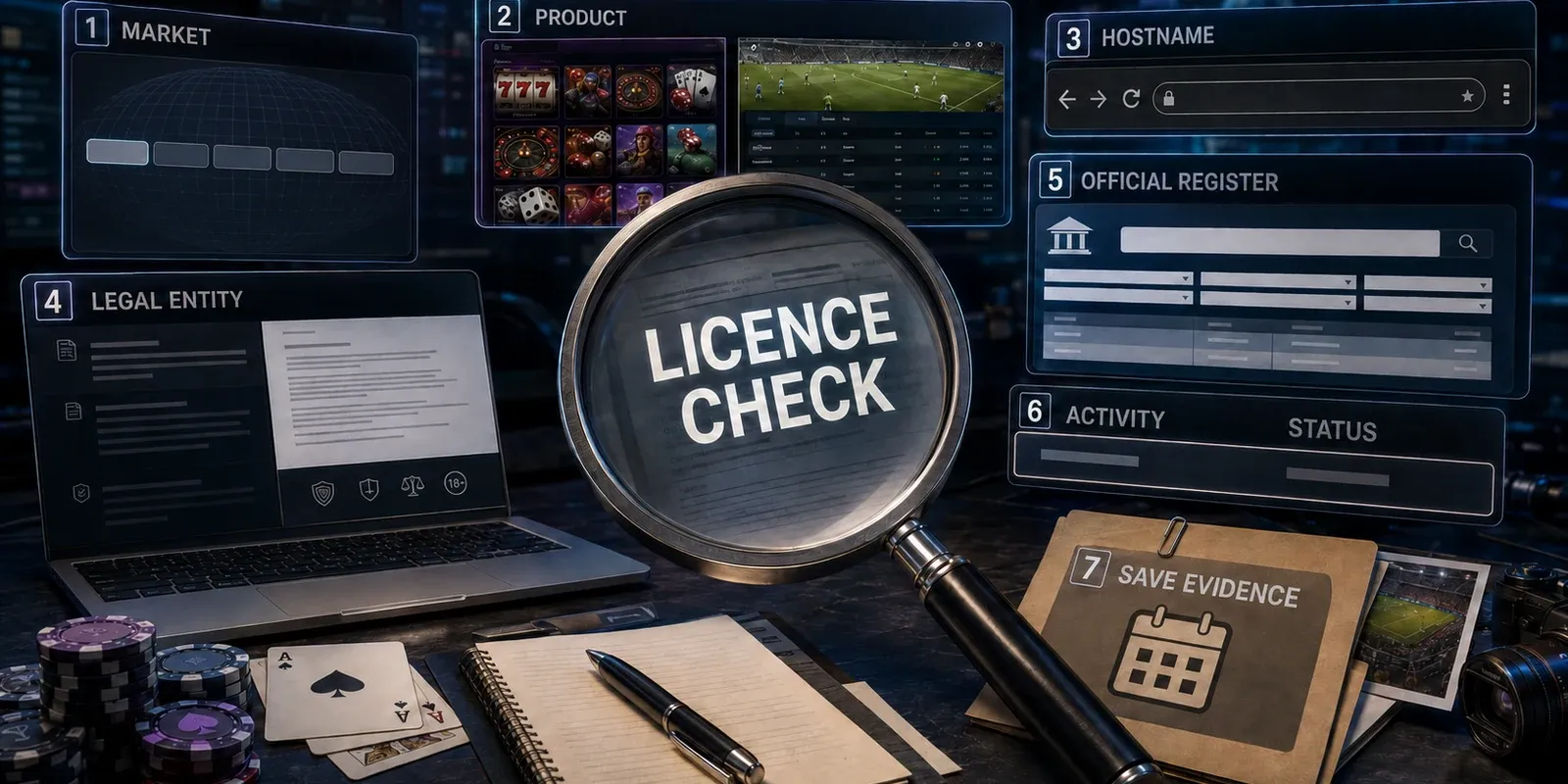
To verify an online gambling licence, start with the exact market, product and hostname you are checking. Take the legal entity and licence identifier from the site's contractual pages, then search the responsible regulator's own register. A useful match connects five fields: jurisdiction, legal entity, exact hostname, authorised activity and current status. A licence badge or matching brand name is only a lead. If one of those five fields is missing, narrow the conclusion and record the gap. This seven-step guide is for journalists, analysts, commercial teams and compliance researchers who need a reproducible gambling licence check, not a legal opinion or a consumer-safety guarantee.
Method and scope
BETTIMES reviewed public registers and licensing guidance from Great Britain, Malta, the Netherlands, Spain, Sweden, Australia and Ontario on 4 September 2026. These examples were selected because their public records expose different combinations of entity, website, activity and status data. They illustrate a verification method; they do not create a universal legal test, and they are not an exhaustive list of gambling authorities.
The method follows the same entity discipline used in our guide to gambling operators, brands and licence holders. The output should be a dated evidence record. It should not stretch a market-specific authorisation into a claim about every country, product or domain used by the wider corporate group.
The seven-step gambling licence check
The sequence matters. Starting with a brand name and stopping at the first familiar result is the fastest way to connect the wrong legal entity or the wrong market.
1. Fix the market, product and hostname
Write down the country or regulated market, the product and the exact hostname before opening a register. A sportsbook, online casino, poker product and betting exchange may sit under different authorisations. Country domains, mobile apps and alternate brand domains can also point to different operating entities. The question is not whether the group holds a licence somewhere. It is whether the named entity is authorised for this service in this market.
- Market: the jurisdiction in which the service is being offered.
- Product: sportsbook, casino, poker, bingo, lottery or another regulated activity.
- Hostname or app: the exact customer-facing address, including the country suffix where relevant.
2. Extract the operator's own licence claim
Check the website footer, terms and conditions, privacy notice and account pages. Capture the full legal entity name, company number, registered address, regulator and licence or account number exactly as displayed. Keep a screenshot or dated note. This is the operator-stated claim you will test, not the final proof.
Display rules vary. In Great Britain, covered remote operators must show a licensed-status statement, their account number and a link to the Gambling Commission's current record under LCCP Condition 8.1.1. That makes the website a useful starting point, but the regulator link remains the stronger source.
3. Find the official register independently
Open the regulator's site independently instead of trusting a badge link or a copied URL. The Malta Gaming Authority Licensee Hub supports searches by licensee, authorisation status, URL and gaming service. The Dutch Kansspelautoriteit register supports company, website, app and licence-number searches. Different registers expose different routes to the same underlying match.
If you cannot determine which authority is responsible, stop and resolve the jurisdiction first. A record from a respected regulator does not answer whether the service is authorised in a different local market.
4. Search more than one identifier
Run separate searches for the legal entity, trading brand, hostname and licence or account number. Record the query that produced the match. This catches spelling differences, historic names and registers that index one identifier but not another. Spain's Dirección General de Ordenación del Juego operator search accepts an operator name or website and lists declared domains. Australia's licensed-provider register separates trading name, licence holder, URL and licensing authority.
5. Apply the BETTIMES five-field match
A credible result connects all five fields below. The model is deliberately stricter than matching a logo or brand because those signals do not establish the entity, scope or current state of the authorisation.
| Role | What it means | Where to verify |
|---|---|---|
| Jurisdiction | The market to which the authorisation applies. | Confirm that the regulator is responsible for the market being checked. |
| Legal entity | The business that holds the authorisation for the service. | Match the entity in the customer contract to the regulator record. |
| Hostname or app | The exact customer-facing service under review. | Match the hostname or app to the licensee where the register exposes it. |
| Activity | The product and delivery channel covered by the authorisation. | Confirm that the record covers the product and channel being reviewed. |
| Current status | The regulator's displayed state for the authorisation. | Read the live record and preserve its original status label and date. |
Ontario's regulated operator directory demonstrates why this combined check matters: it places legal operator entities beside their customer-facing gaming websites and product categories. A match on only one column would leave part of the operating relationship unverified.
6. Read the status and scope, not just the name
Open the full record and read the status, authorised activities, effective dates, domain or trading-name entries and published regulatory actions. Status labels are jurisdiction-specific. The British register of gambling businesses distinguishes active, pending, suspended, revoked, expired, surrendered, forfeited and lapsed records, among other displayed states. Do not translate all of them into a simple yes or no without preserving the original label.
Also separate licence status from domain status. A business record can exist while a particular trading name, website or activity is inactive or outside the scope you need. Where a regulator does not publish one of these fields, mark it as not exposed rather than treating silence as confirmation.
7. Save a reproducible evidence record
Save the regulator, record URL, legal entity, licence identifier, matched hostname, activity, displayed status, search terms and access date. Add the operator's contractual page and note any inconsistency. A later reviewer should be able to repeat the same searches and see exactly why the conclusion was limited or accepted.
- Registry matched: the official record connects the relevant entity or hostname to the claimed authorisation.
- Operator-stated: the claim appears in company-controlled material but is not yet matched in the register.
- No record found: the documented searches returned no match; this is a search result, not a universal legal conclusion.
- Conflicting records: two current sources point to incompatible entities, domains, activities or statuses.
- Review required: a source is unavailable, stale or too incomplete for a firm classification.
How to interpret common licence statuses
Use the regulator's definition whenever one is published. In ordinary research language, active generally means the authorisation is currently in force, pending means it is not yet an active grant, suspended means the authority has temporarily interrupted it, revoked means the authority has withdrawn it, and surrendered means the holder has given it up. Expired, lapsed and forfeited can reflect different legal events. These summaries are navigation aids only; the source record and jurisdictional definition control.
A historic certificate, cached search result or licence badge cannot establish current status on its own. Record the date of the live register check. If a regulator publishes enforcement or regulatory-action records separately, check those records as a second source before describing the operator's current position.
What if the licence search returns no record?
Do not jump straight from no result to unlicensed. First test the legal entity rather than the brand, remove punctuation and corporate suffix variations, search the exact hostname, try the licence identifier and check whether the register is working. Then confirm that you selected the correct jurisdiction and type of register. Some authorities publish only current holders, while others retain historic or pending records.
If those checks still fail, report the narrow result: no matching record was found in the named register using the listed identifiers on the stated date. That wording is auditable. A broader legal conclusion may require regulator contact, specialist counsel or evidence that is not publicly available.
Why one licence cannot answer every market question
Public-register design reflects local law and regulatory practice. Sweden's Spelinspektionen licence register lists holders with valid licences or permits and includes website addresses for online gambling and betting licensees. Spain maps operators to declared domains. Great Britain adds detailed status, activity and regulatory-action fields. Malta provides several search dimensions. Australia shows the state or territory licensing authority beside the provider.
These differences are the reason BETTIMES does not use a single badge-based rule. The five-field match stays constant, but the available evidence and permitted conclusion change with the jurisdiction. A field that is absent from a public register remains unknown until another primary source resolves it.
How BETTIMES uses the result
A completed check can support a licence record, an operator relationship or a dated note in a BETTIMES company profile. The licence directory keeps regulator and jurisdiction context visible, while the source policy explains the priority given to official records. We keep conflicts and missing fields visible because an unexplained clean answer is less useful than a precise incomplete one.
This workflow verifies what the reviewed sources support on a given date. It does not rate an operator, recommend gambling services, replace legal due diligence or certify that every operational obligation has been met.
Frequently asked questions
Can I verify a gambling licence from the logo in a website footer?
No. A regulator logo or licence badge is a useful lead, but it can be outdated, copied or linked to the wrong record. Use it to identify the claimed regulator and licence number, then open the regulator's site independently and match the legal entity, exact hostname, activity and current status.
What if the brand name does not appear in the official register?
Search the legal entity named in the terms, the exact domain and the licence or account number. The customer-facing brand may be recorded as a trading name, or several brands may sit under one licensee. If none of the identifiers matches, record the searches and keep the result unresolved rather than guessing.
Does an active licence cover every website owned by the company?
Not necessarily. The authorisation may be limited by market, activity, channel, entity or declared domain. Match the exact customer-facing hostname or app where the public record provides that field. If it does not, use the narrowest conclusion supported by the licence and operator disclosures.
Is a licence number the same as an operator or account number?
Not always. Regulators use different identifiers and may distinguish a stable business or account number from individual licence references. Preserve the label used by the authority. Do not rename every identifier a licence number, because that can break later searches or point to the wrong record.
How often should an online gambling licence be checked?
Check again before publication, after a reported corporate or regulatory change, and whenever the stored source is no longer current enough for the decision being made. There is no universal interval. The practical control is a visible verification date and a workflow that flags stale or conflicting evidence for review.
The practical rule
A gambling licence check is complete only when the evidence connects the right jurisdiction, legal entity, hostname, activity and current status. Start with the operator's claim, verify it in the official register, preserve the regulator's own terminology and save the search trail. If the five fields do not connect, make the conclusion smaller instead of making the evidence look stronger.