
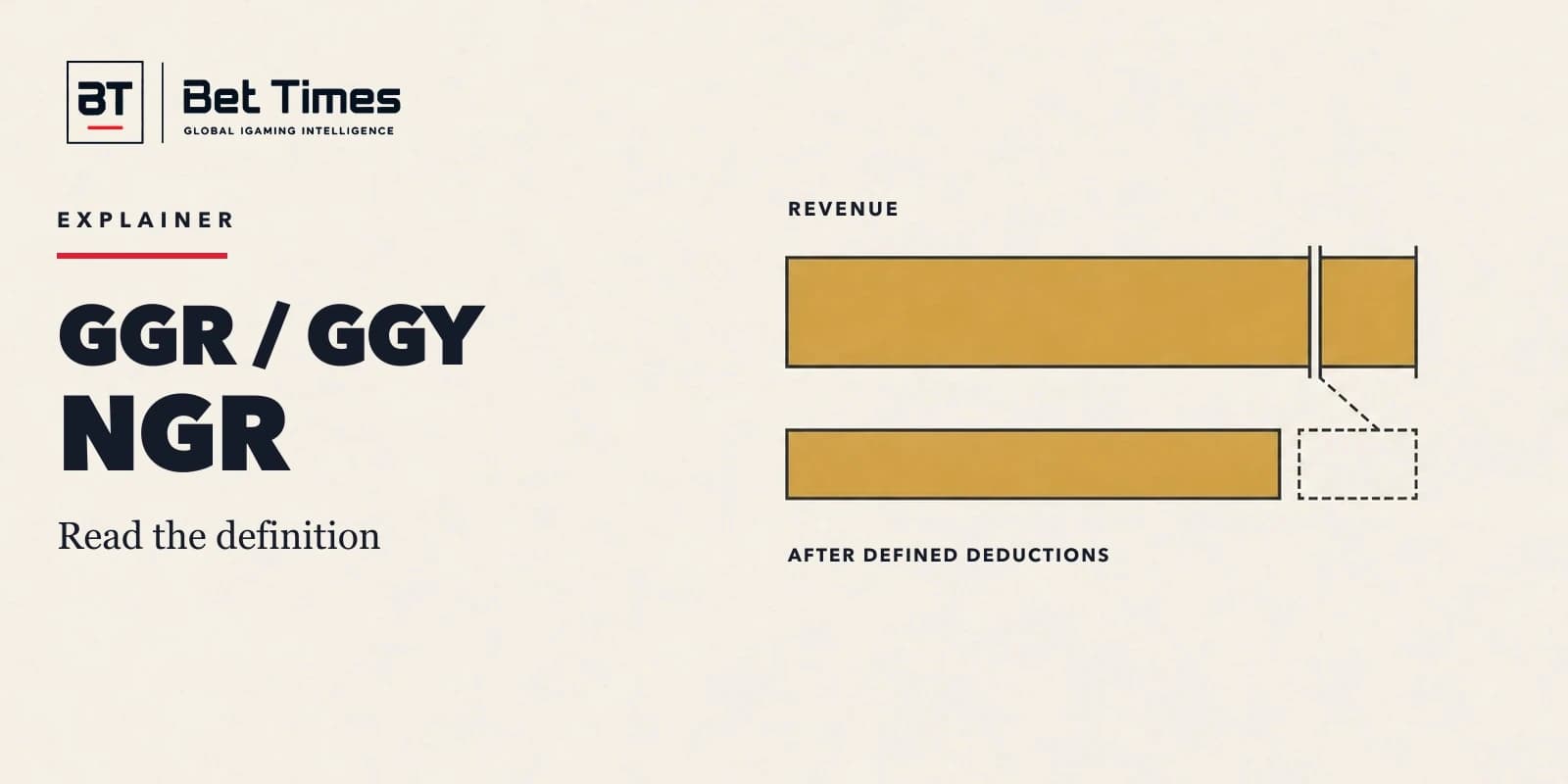
GGR, GGY and NGR measure gambling revenue under different definitions. GGR commonly starts with stakes less player winnings. GGY follows a regulator's prescribed calculation. NGR applies the reporting entity's specified adjustments. None of the three should automatically be treated as deposits, profit or cash available to spend.
The distinction matters when reading a market report, comparing operators or checking a revenue-share calculation. Two numbers can describe the same business activity at different points in the accounts. Conversely, two companies can both report NGR while deducting different items. The definition and reconciliation explain what the headline number actually measures.
GGR, GGY and NGR at a glance
| Role | What it means | Where to verify |
|---|---|---|
| GGR: gross gaming revenue | Generally, stakes less player winnings before specified further deductions; product and reporting rules can change the detail. | The regulator's methodology or the operator's accounting definition. |
| GGY: gross gambling yield | A regulatory measure with defined inclusions, exclusions and reporting scope. | The applicable Gambling Commission return and calculation guidance. |
| NGR: net gaming revenue | A measure calculated using the reporting entity's stated deductions or adjustments. | The financial statement note, non-GAAP reconciliation or contract definition. |
| Handle, stakes or wagers | Betting volume under the source's rules; not automatically fresh customer cash or revenue. | Settlement basis, promotional-wager treatment and product coverage. |
These terms belong to different reporting systems. GGY is not an intermediate deduction between GGR and NGR. A useful comparison translates definitions first, then compares the resulting figures.
Why wagers are not deposits or revenue
A deposit transfers money into a player account. A wager uses an account balance to participate in a game or bet. A withdrawal transfers money out. Counting one as another can multiply or shrink the apparent size of a business.
Consider a hypothetical account with no opening balance, bonuses or adjustments. A customer deposits £100, places a £100 wager and receives a £90 payout. They wager that £90 and receive £80, then withdraw the £80. Total deposits are £100, settled wagers are £190, payouts are £170 and withdrawals are £80. The simple wagering margin is £20. The same money has supported more than one wager.
Now change only the timing: leave the £80 in the account at the reporting date. Deposits minus withdrawals becomes £100, but the wagering margin remains £20. The remaining £80 is still a customer balance. This is why a payments summary cannot replace the game and betting ledger. The Player Account Management explainer describes the account and transaction records behind that distinction.
What does GGR include?
Gross gaming revenue commonly describes the amount left from wagering after player winnings. It is a broad concept, not permission to ignore the definition attached to a particular data series.
For example, iGaming Ontario's FY 2023-24 market report measures gaming revenue from cash wagers, including rake, tournament and other fees, less winnings from cash wagers. Its wagering figure excludes promotional wagers. The reported revenue does not deduct operating costs or other liabilities.
That is a dated methodological example, not the latest market total. It shows why a dataset's explanatory notes are essential: adding bonus stakes to a denominator that expressly excludes them produces a different ratio. Likewise, customer money circulating through repeated bets should not be described as an equivalent amount of fresh spending.
Product structure matters too. For a betting intermediary, the Gambling Commission's financial guidance measures commission and other directly related accruals, excluding VAT. The intermediary's income is not the full value of the bets it helps customers place. Identify whether the business takes the wager or facilitates it; the gambling operator guide explains the underlying roles.
How is GGY calculated in Great Britain?
The Gambling Commission's regulatory returns guidance specifies GGY = A + B - C. In condensed form, A covers stakes, B covers other qualifying accruals directly connected to licensed activity excluding VAT, and C covers prizes or winnings for the relevant period.
The Commission explicitly distinguishes its GGY returns from GGR reporting. A similarly named internal dashboard field is therefore not enough to establish that a return follows the required calculation.
Bonus treatment is particularly easy to misread. The guidance counts a free bet or bonus only where the customer can choose an unrestricted cash equivalent. It separately excludes loyalty cashback and rakeback from the calculation. Those rules prevent a blanket instruction to subtract every promotional expense from GGY.
The Commission's industry-statistics definitions also distinguish lottery GGY-equivalent figures and revenue-share GGY. Preserve the product and licence context alongside the amount. The Great Britain licence guide provides the corresponding entity and activity checks.
Why NGR needs its own definition
Net gaming revenue is often introduced as GGR after deductions. That is a useful question to ask of a report, but not a complete accounting rule. Published examples show why there is no reliable universal formula such as GGR minus bonuses, tax, payment fees and all supplier costs.
Entain: NGR before VAT and sales taxes
In its 2025 full-year results, Entain defines NGR as net revenue before VAT and sales taxes. It reports £5,325.4 million of NGR and £5,259.4 million of revenue. The £66.0 million difference illustrates that this NGR figure sits above the reported revenue line.
Entain identifies NGR as a non-GAAP measure and provides a reconciliation. Reading only the word net would miss the relevant treatment of taxes. Neither amount is the group's profit.
iGaming Ontario: a different reporting entity
iGaming Ontario's 2024-25 annual report defines its net gaming revenue as gaming revenue less operator payments. Its financial summary shows C$2,901.5 million of gaming revenue, C$2,327.4 million of operator payments and C$574.1 million of net gaming revenue, using rounded figures.
Here, the reporting entity is iGaming Ontario. Its NGR is not a figure that can be substituted for the combined net revenue of the operators serving that market. The Ontario registration and operating-agreement guide explains the institutional structure behind these records.
Codere Online: reconcile non-IFRS measures
Codere Online's second-quarter 2026 results filed with the SEC report €64.4 million of revenue and €69.4 million of NGR. The company classifies NGR as a non-IFRS measure and includes a reconciliation.
The preliminary, unaudited release identifies recognition differences, Mexico service-fee VAT and Argentina inflation accounting among the adjustments. This is another concrete reason to retain the reconciliation rather than treating NGR as one fixed step below accounting revenue.
A worked GGR-to-NGR example
The following figures are invented solely to explain the arithmetic. They are not a market benchmark, an operator result or a regulatory filing template.
Assume £1,000,000 of settled cash wagers and £940,000 of player payouts, with returned stakes included in payouts. There are no other gaming fees or adjustments. On that specified basis, GGR = £1,000,000 - £940,000 = £60,000.
Now assume an illustrative contract defines NGR as that GGR less £10,000 of qualifying promotional costs and £5,000 of specified additional deductions. Under that contract only, NGR = £60,000 - £10,000 - £5,000 = £45,000. Another contract or reporting policy may produce a different number from the same wagers.
If a supplier's contractual share is 10% of this illustrative NGR, its fee is £4,500. Applying 10% to GGR instead would produce £6,000. The £1,500 difference comes from the agreed base, not from a different percentage. Check whether the fee itself is already included in any deduction to avoid double-counting it.
Even the £45,000 figure does not establish profit. Further costs may remain outside the stated calculation. The contract also needs to address negative periods, corrections and when a result becomes final before anyone can infer a payment due.
How revenue connects to hold and RTP
Using the same illustrative wagers and payouts, gross hold is £60,000 divided by £1,000,000, or 6%. The corresponding actual return is £940,000 divided by £1,000,000, or 94%. They add to 100% because this simplified example uses the same settled transactions and has no other components.
The Gambling Commission's RTP calculation guide distinguishes observed return from designed RTP and explains the relevance of volatility and sample size. A short reporting period can depart from the theoretical percentage.
Consequently, a published game RTP is not the operator's net margin. The paytable mathematics guide covers expected payouts; casino volatility covers their distribution. Operating revenue also depends on the actual activity recorded, while profitability depends on the relevant costs.
How to compare two reported revenue figures
Before combining amounts in a market table or company comparison, record six things:
- Entity: one brand, one licensed operator, a corporate group or a market authority. Avoid counting the same activity at multiple levels.
- Period: exact start and end dates, calendar or financial year, and whether unsettled bets are included.
- Product and territory: casino, sportsbook, poker, retail or online, plus the jurisdiction covered.
- Measurement: the full metric name, formula, promotional treatment and every disclosed adjustment.
- Currency: denomination, scale and whether growth is reported or calculated at constant exchange rates.
- Evidence: the original report, relevant note, revision date and whether figures are audited or preliminary.
If one source reports GGR and another reports NGR without a reconciliation, leave them separately labelled. There is no defensible conversion factor that recovers undisclosed deductions. The Regulated Market Monitor provides jurisdiction context; financial comparisons still need their own metric definitions.
Frequently asked questions
Are GGR and GGY the same thing?
They describe related concepts but should not be treated as interchangeable reporting fields. GGY has a prescribed Gambling Commission calculation, while a source using GGR may apply a different methodology. Check which transactions, fees, bonuses and prizes the source includes before deciding whether two figures are comparable.
Does NGR mean casino profit?
No. NGR follows the deductions or adjustments stated by the reporting entity. Expenses may remain outside that calculation. To assess profit, locate the relevant profit line and its accounting notes. A positive NGR figure alone does not establish positive operating profit, net income or cash flow.
Can GGR be negative?
Yes, under a stakes-minus-payouts definition, payouts can exceed stakes for a particular product or reporting period. For example, £100,000 of settled stakes and £110,000 of payouts produce negative £10,000 of GGR. That isolated result does not establish the outcome for the entire business or year.
Are bonuses always deducted from gambling revenue?
No. The treatment depends on the metric and the nature of the promotion. A regulatory return, a financial statement and a revenue-share contract can use different rules. Read whether the amount is a cash stake, restricted promotional balance, cashable prize or separate business expense before applying a deduction.
How do you calculate a gambling revenue margin?
Divide the stated revenue measure by the matching wagering base and multiply by 100. State whether the numerator is GGR, GGY or NGR and preserve the period and product scope. Comparing ratios with different bonus treatment or settlement timing can create an apparent margin difference that is only methodological.