
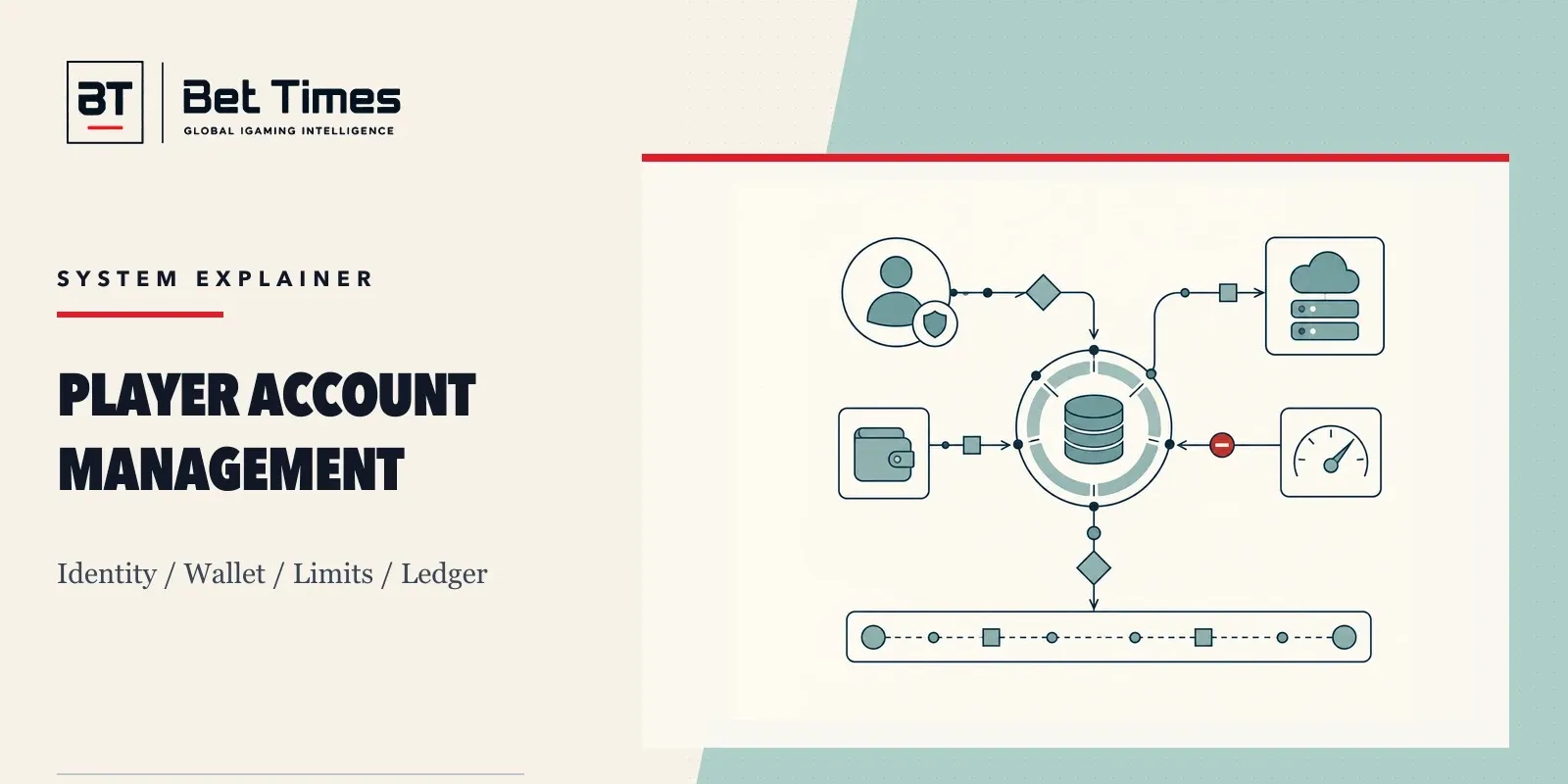
A Player Account Management system is the account control layer of an iGaming operation. It manages player identity, authentication, status, balances, transaction records, limits and account history while coordinating external payment, verification, game and betting services through controlled integrations.
PAM is an industry product category, not one universal regulatory definition. Its exact boundary varies by supplier and operator. This guide uses GLI submission standards and regulator requirements to separate the functions a PAM commonly owns from the systems it may connect to.
What does PAM mean in iGaming?
PAM means Player Account Management. GLI's Composite Submission Requirements describes PAM components as the primary interface through which a player can register, log in and out, change account information, deposit and withdraw funds, request activity statements and close the account. It also includes player-facing wagering pages outside the actual game or bet screen.
That definition is wider than a customer database. A regulated account has identity attributes, permissions, status, money, limits, exclusions, transaction history and a record of changes. Each event can affect what the player may do next. A successful identity check can permit activation; a self-exclusion must prevent gambling; a deposit can change both balance and a financial-limit counter.
The BETTIMES iGaming explainer maps the broader industry. PAM is one control layer inside that system, not the whole online gambling business.
The account lifecycle a PAM controls
A useful PAM model begins before registration and ends after closure or dormancy. Typical lifecycle states include applicant, pending verification, active, restricted, self-excluded, suspended, inactive and closed. The labels vary, but every transition should have defined conditions, permissions and evidence.
GLI-19 section 2.5 covers registration, identity verification, player access, account information, limitations, exclusions and financial transactions. It says an interactive gaming system should not activate the account until required age, identity, exclusion and registration checks are complete under the applicable jurisdiction.
In Great Britain, LCCP condition 17.1.1 requires relevant remote licensees to obtain and verify identity information before the customer is permitted to gamble. The PAM may call an external verification service, but it still needs to store the resulting state and enforce what that state allows.
PAM, platform, wallet, RGS and CRM compared
Industry sales language often uses these terms loosely. The most reliable distinction is the system's primary record and decision responsibility.
| Role | What it means | Where to verify |
|---|---|---|
| PAM | Player identity, account status, permissions, limits, balances and account-facing history. | Authoritative fields, state transitions, audit trail and jurisdiction configuration. |
| Wallet and ledger | Monetary and promotional balances plus the record of every movement. | Double-entry or equivalent controls, idempotency, reconciliation, reversals and currency rules. |
| iGaming platform | Wider operating stack that may bundle PAM, payments, content, back office, reporting and integrations. | Which modules are native, licensed, outsourced or optional in the deployed version. |
| RGS | Hosts and runs remote casino games, receives wagers and returns game results under integration rules. | Game versions, session and wallet protocol, result recovery and market approval. |
| Game aggregator | Provides one integration route to content from multiple studios or RGS environments. | Supplier chain, games, markets, technical routing and settlement responsibility. |
| CRM and marketing automation | Segmentation, communications and campaign workflows based on permitted data. | Consent, suppression, exclusion propagation and whether decisions write back to PAM state. |
The iGaming platform guide, RGS explainer and casino game provider guide examine the adjacent layers in more detail.
Wallet, ledger and transaction state
The displayed balance is an output. The ledger is the evidence behind it. A PAM should record deposits, withdrawals, wagers, returns, bonuses, adjustments and transfers with unique references, timestamps and status changes. It must also survive retries without posting the same event twice.
The Gambling Commission's RTS 1 customer account information requires current balance visibility and access to account and gambling history for British deployments. RTS 2 addresses the value and content of the gamble at the point where the customer commits.
Those requirements expose a practical boundary. The game or sportsbook may create the wager and settlement event, but the PAM and ledger must turn it into a consistent account record. Pending, accepted, rejected, voided, reversed and settled are not cosmetic labels. Each state determines whether funds are available and what the statement should show.
KYC, AML and risk integrations
A PAM commonly orchestrates identity, age, sanctions, fraud, AML and payment checks. It does not automatically perform every check itself. A specialist service may return a score or decision, while the PAM records the request, response, evidence reference and account restriction.
This separation matters when reviewing KYC in online gambling and AML controls. The provider result is one input. The operator remains responsible for a lawful decision, the customer journey and any follow-up required in its market.
The same distinction applies to transaction monitoring and source-of-funds versus source-of-wealth review. A PAM should supply reliable account events and enforce restrictions, but a rules engine, case-management tool and human reviewer may sit outside it.
Limits, exclusions and player protection
Limits and exclusions must operate on the correct scope. A limit set at account level cannot be enforced reliably if casino, sportsbook and bingo each maintain an isolated counter. A self-exclusion cannot depend on a marketing database receiving a nightly export after the customer has already tried another brand.
GLI-19 requires the interactive gaming system to implement player or operator limitations and exclusions as required by the regulatory body. In Great Britain, the RTS 12 wording effective 30 September 2026 requires financial-limit facilities at account level as a minimum and defines how customer-led changes take effect.
Malta provides a useful cross-account example. The MGA Gaming Authorisations and Compliance Directive addresses linked accounts, duplicate-detail detection, holistic activity, limits and self-exclusion across a licensee's accounts. It shows why identity resolution and scope are architectural controls, not just front-end preferences.
Back office, permissions and audit trails
The back office exposes PAM power to support, payments, compliance, finance and operations teams. A good interface should show why an account is restricted and which events produced the current balance without giving every user permission to change those records.
Role-based access, approval thresholds and separation of duties are therefore part of the control model. A support agent may view an identity status but not override it. A payments reviewer may approve a withdrawal but not edit the underlying wager. Manual balance adjustments should identify the user, reason, amount, approval and linked case.
GLI's submission requirements request descriptions of production account classes and privileges. Its PAM submission section also asks how player information and authentication are protected. An impressive dashboard without a permission matrix and immutable audit history is not enough.
Security and data protection
PAM data can include names, addresses, dates of birth, authentication information, payment references, balances and detailed behaviour. It is both sensitive and operationally critical. Security design should cover encryption, secrets, session management, access reviews, monitoring, backups, recovery and the supplier connections around the account.
The Gambling Commission's RTS security requirements identify systems that process sensitive customer information and account balances as critical systems. The listed control areas draw on ISO/IEC 27001:2022 and include identity management, authentication, supplier security, logging, cryptography, secure development and security testing.
A certificate for a hosting provider does not prove that the PAM deployment is secure. Architecture, configuration, privileged access and the operator's processes still need review.
Integration boundaries and failure handling
A PAM is valuable because many services converge on one account. That also makes integration failure a first-class design problem. Payment callbacks can arrive twice, a game settlement can be delayed, identity services can time out, and messages can be delivered out of order.
For every integration, the operator should document the source of truth, event identifier, retry policy, timeout state, reconciliation process and customer-facing message. If the RGS says a round settled but the wallet never records it, teams need a recoverable queue and a traceable exception, not a manual guess.
The online casino game testing guide explains why the tested interface and production configuration both matter. PAM acceptance testing should include degraded and duplicate events, not only successful happy paths.
How to evaluate a PAM system
- Map ownership. List the system that owns identity, balance, ledger, limits, exclusions, bonuses and each status transition.
- Trace one transaction. Follow a deposit, wager, settlement, withdrawal and reversal from external event to statement and report.
- Test scope. Confirm that account-level controls apply across every brand, product, currency and channel required by the market.
- Inspect auditability. Verify timestamps, user actions, reason codes, source references and before-and-after values.
- Review resilience. Test duplicate messages, timeouts, partial outages, late settlements, reconciliation and recovery.
- Check configuration. Separate product capability from the exact jurisdiction, version and deployment being assessed.
- Plan migration. Reconcile opening balances, active limits, exclusions, pending withdrawals, open wagers and historical records.
- Measure operations. Define alert queues, service levels, exception ownership and evidence retention before launch.
A PAM feature matrix is useful only after those control questions are answered. The gambling operator explainer shows why the licensed entity remains accountable even when several technology companies supply the stack.
What a PAM does not prove
The presence of a PAM does not prove a casino is licensed, fair, solvent or well controlled. “Certified” can refer to a product version, a laboratory report, a security framework or a jurisdiction decision. The claim needs a document, scope, version, date and authority.
GLI states that its standards are starting points which jurisdictions may adapt. Regulatory requirements differ, and the same platform can be configured differently for two operators. A buyer should match the tested components and market configuration to the production system rather than relying on the product name.
Use the BETTIMES licence verification guide to check the legal entity and activity separately. Use the responsible gambling guide for support and control information relevant to players.
Frequently asked questions
Is a PAM the same as an iGaming platform?
Not necessarily. A PAM is the player-account control layer. An iGaming platform can bundle PAM with payments, content, reporting, back office and other modules. Suppliers use the terms differently, so buyers should identify which deployed component owns each account state, balance record and compliance action.
Is the wallet part of the PAM?
Usually, but product boundaries vary. The wallet tracks available balances, while the ledger records why every balance changed. A complete PAM also manages identity, authentication, account status, limits, exclusions, history and administrative controls. A wallet API alone does not provide the full account lifecycle.
Does a PAM perform KYC and AML checks?
It may perform some checks directly, but it often orchestrates specialist services. The PAM should record requests and decisions, connect them to the correct player, and enforce resulting restrictions. The operator must still ensure that the overall process satisfies the rules and risk model for its market.
What should be migrated when changing PAM systems?
A migration can include identity records, verified status, balances, ledger history, active limits, exclusions, consents, bonuses, pending withdrawals, open wagers, case references and audit logs. Opening balances alone are insufficient. Teams need reconciliation rules and evidence that active restrictions survived the cutover correctly.
How can an operator verify a PAM claim?
Ask for the exact product version, component list, architecture, test report, jurisdiction scope, security evidence and production configuration. Then run end-to-end tests covering registration, deposits, wagers, settlements, limits, exclusions, withdrawals, reversals and failures. A supplier brochure cannot establish how a live deployment behaves.
The practical definition
The simplest useful definition is that PAM is where a player's identity, money and permissions become one enforceable account state. It connects external services, but its real value lies in consistent decisions, reconciled records and evidence that the right control operated at the right time.