
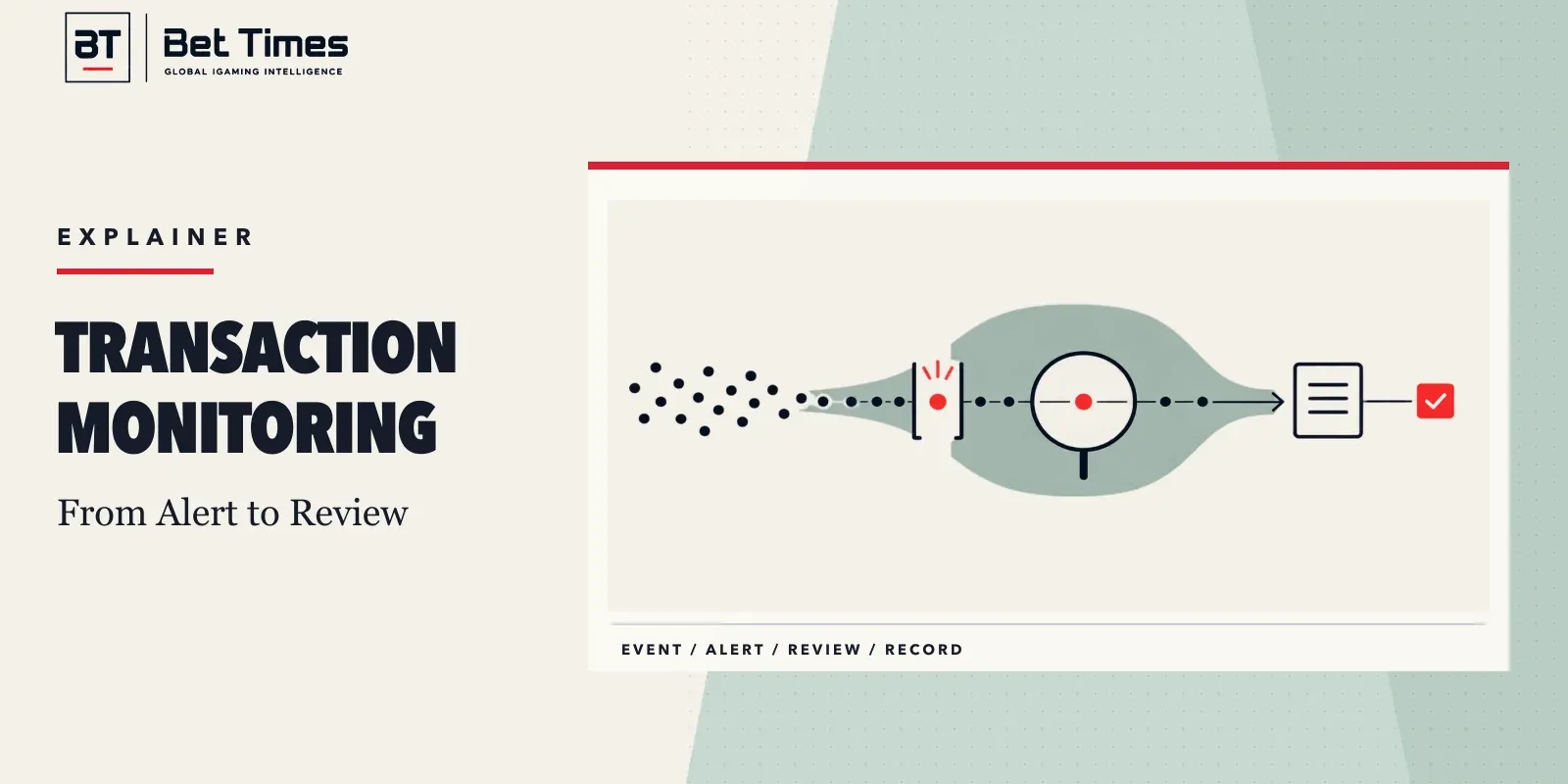
Transaction monitoring in online gambling is the ongoing, risk-based review of deposits, withdrawals, payment instruments, play and related account activity to identify unusual or potentially suspicious patterns. It compares activity with the customer profile, product context and operator controls, then sends relevant cases for review.
An alert is not a finding of money laundering or other wrongdoing. It is a signal that needs context. The reviewer may close it with a recorded rationale, request information, restrict activity, escalate an internal case or make a report required by the applicable jurisdiction.
What transaction monitoring means
The UK Gambling Commission defines ongoing monitoring as scrutiny of transactions throughout a business relationship to ensure that activity is consistent with what the operator knows about the customer, the customer’s business and risk profile, including source of funds where necessary. Its ongoing-monitoring guidance also requires customer due-diligence records to be kept current.
In an online gambling system, that scrutiny can cover deposit size and velocity, withdrawal timing, payment ownership, product movement, peer-to-peer transfers, account links, location changes and whether activity matches the known purpose and source of funds. The relevant data differs by operator model and jurisdiction.
The word “transaction” should not be read as a bank payment only. A deposit may look ordinary in isolation but become significant when combined with minimal play, a fast withdrawal request, a newly changed payment method or related accounts. Monitoring joins those events into a reviewable pattern.
Transaction monitoring vs KYC
Know your customer and transaction monitoring are connected controls, but they answer different questions. KYC establishes identity, verifies required information and supports a risk assessment. Monitoring asks whether later activity remains consistent with that information and with the operator’s risk rules.
| Role | What it means | Where to verify |
|---|---|---|
| KYC and customer due diligence | Who is the customer, and what initial risk should be assigned? | Identity evidence, age, address, ownership, occupation or business context where required. |
| Transaction monitoring | Does activity over time fit the known profile and expected use of the account? | Deposits, withdrawals, payment instruments, play, account links, locations and event sequences. |
| Investigation and reporting | Does the reviewed context require action or a report under applicable rules? | Alert history, customer explanation, source evidence, analyst rationale and escalation records. |
KYC is not finished forever after onboarding. Monitoring can reveal information that requires the risk rating or due-diligence record to be updated. The reverse is also true: a higher-risk profile may justify closer or more frequent monitoring.
How the monitoring workflow works
A mature process has five distinguishable stages. Separating them prevents an automated rule from being treated as a final decision.
- Event.* The system receives a deposit, withdrawal, wager, payment-method change, login, transfer or other relevant activity.
- Alert.* A rule, scenario, model or manual observation flags the event or a sequence of events for review.
- Review.* An analyst adds customer, payment, product, location and historical context and checks whether the activity has a reasonable explanation.
- Decision.* The operator closes the alert, changes monitoring, requests evidence, restricts activity or escalates the case according to its policy and legal duties.
- Record or report.* The rationale and evidence are retained. If the legal test is met, the appropriate function submits a suspicious transaction or suspicious matter report to the relevant authority.
The UKGC’s customer-monitoring guidance expects operators to monitor deposits and withdrawals across products and platforms, not in isolated product silos. It also describes escalation and suspicious activity reporting in the British framework.
Rules, models and human review
Monitoring systems commonly combine deterministic rules with broader behavioural models. A rule might detect a large change in deposit velocity or the use of several payment instruments. A model might compare a sequence with the customer’s previous activity or a peer group. Manual referrals from payments, fraud, customer support or safer-gambling teams can enter the same case-management layer.
Automation is useful for scale and consistency, but it does not remove the need for trained judgement. The UKGC’s 2025 casino casework review says automated controls can increase efficiency while trained AML staff remain necessary to identify and review risks.
Poorly designed automation creates two opposite problems. Rules that are too broad overwhelm analysts with false positives and delay material cases. Rules that are too narrow miss activity split among smaller events, products or linked accounts. Calibration therefore needs both quantitative testing and documented expert review.
Common indicators in online gambling
No finite list proves that activity is suspicious. Indicators are prompts to examine context. AUSTRAC’s casino-sector indicators expressly state that a single indicator is not necessarily suspicious and that the list is not exhaustive.
Examples an online operator may consider include:
- deposits followed by withdrawal attempts with little or no genuine play;
- sudden activity inconsistent with the customer’s known profile or history;
- frequent changes of payment instrument, especially where ownership is unclear;
- several accounts, devices or identities linked by payment, network or behavioural data;
- peer-to-peer play or transfers that may move value between customers;
- equal and opposite betting or coordinated patterns that reduce normal gaming risk;
- attempts to divide activity into smaller amounts to avoid a control;
- false, stolen or inconsistent identity information;
- unusual use of e-wallets, virtual assets or cross-border payment routes in the relevant risk context.
The UKGC’s risk-assessment guidance identifies risks including deposit-and-withdrawal activity with little play, peer-to-peer value transfer and opposite equivalent bets. These examples help define scenarios; they do not justify accusing a customer without review.
Why there is no universal alert threshold
A transaction value can be relevant without being suspicious, and suspicious activity can occur below a published threshold. Risk depends on the customer, payment method, product, geography, sequence and explanation as well as amount.
The FATF Recommendations apply customer-due-diligence and suspicious-transaction measures to casinos. FATF also uses a USD/EUR 3,000 designated threshold for certain casino transactions in its international framework. That figure is not a universal monitoring-alert threshold and should not be copied into an operator system without checking local implementation.
FATF Recommendation 20 says suspicious transactions, including attempted transactions, should be reported regardless of amount. Jurisdictions translate that standard into their own laws, reporting channels and timing rules. A global operator therefore needs market-specific control mappings rather than one worldwide number.
Linking activity across products and systems
Fragmented data is a recurring control weakness. A customer may deposit through one payment service, play casino products, move to sports betting and withdraw through another approved route. If each system sees only its own events, none may identify the whole pattern.
Useful monitoring design gives an authorised reviewer a coherent timeline with customer identifiers, payment ownership, product events, account links, device or network signals where lawful, previous alerts and the current risk rating. Access should be role-based because the same dataset can contain sensitive personal and financial information.
The gambling operator remains responsible for understanding how outsourced payment, platform, game and monitoring components fit its licensed control environment. A vendor can generate alerts or host a case tool, but responsibility cannot be reduced to buying software.
Transaction monitoring and source of funds
Monitoring can expose a gap between observed activity and the information already held. The operator may then need more context about how the gambling is funded. Source of funds and source of wealth are related but different enquiries: one addresses the origin of money used for specific activity; the other addresses the broader origin of a person’s accumulated wealth.
The request should be proportionate to the identified risk and the applicable rules. Collecting documents without analysing whether they explain the activity is not an effective control. The review record should show what question was asked, what evidence was considered, what remained unresolved and why the resulting decision followed.
This distinction also prevents a threshold from becoming a substitute for judgement. A lower-value pattern can require attention when behaviour is unusual, while a larger transaction may have a documented, consistent and lawful explanation.
AML monitoring vs safer-gambling monitoring
AML transaction monitoring and safer-gambling monitoring can use overlapping events such as rising deposits, rapid spend or changes in behaviour. Their purposes are different. AML controls focus on money laundering, terrorist financing and related financial-crime risks. Safer-gambling controls focus on indicators of harm and customer interaction.
One alert can legitimately reach both functions, but the questions, legal bases, decision criteria and records should remain clear. A customer can present a harm risk without presenting an AML concern, an AML concern without an obvious harm indicator, both, or neither after review.
Data governance should define what can be shared, who can see it and how conflicting actions are resolved. The goal is coordinated risk management without collapsing distinct obligations into one vague risk score.
What happens after an alert?
The reviewer first checks data quality: duplicate events, delayed feeds, currency conversion and payment reversals can create misleading signals. The next step is contextual analysis across the customer relationship. Prior alerts, account changes, linked parties and explanations can strengthen or weaken the concern.
If the activity is reasonably explained, the case can be closed with a documented rationale. If uncertainty remains, the operator may request information, increase monitoring or escalate to a specialist. Where the legal suspicion test is met, the designated reporting process applies. Staff must also avoid inappropriate disclosure that could prejudice an investigation, subject to local law.
AUSTRAC’s suspicious-matter guidance is an Australian implementation example: it expects alerts to be reviewed promptly and unusual transactions and behaviour to be monitored, with a suspicious matter report filed when the statutory test is met. Other markets use different names, authorities and deadlines.
How monitoring controls are tested
An operator should be able to show that relevant data reaches the monitoring system, rules run as designed, alerts enter the correct queues, investigators can see adequate context and required decisions are recorded. Testing only whether software is online is not enough.
A practical assurance programme can include:
- mapping regulatory and enterprise risks to specific scenarios;
- tracing source-system fields through transformations into alerts;
- replaying known test cases and checking expected outcomes;
- measuring alert volumes, aging, closure reasons and repeat activity;
- sampling closed cases for decision quality and record sufficiency;
- reviewing false positives and known misses before changing thresholds;
- documenting model versions, approvals, overrides and change control;
- confirming that market-specific reports and escalation deadlines are supported.
Independent review is especially important after a platform migration, new payment method, product launch or change to customer-risk methodology. Each can break a data feed or make an old scenario incomplete without producing an obvious system error.
Records and governance
Monitoring records should let a later reviewer reconstruct what the operator knew, when it knew it and why it acted. That normally includes the triggering events, customer context, evidence obtained, analysis, decision, reviewer, timestamps and any escalation or report reference permitted in the record.
Governance should name owners for scenario design, model validation, investigations, suspicious-activity reporting, data quality and change approval. It should also define quality assurance and training. A high alert-closure rate is not evidence of success if weak rules generated the wrong alerts or analysts lacked the information needed to investigate them.
Retention and customer-access rules vary by jurisdiction and data category. Operators should map local AML, gambling, privacy and recordkeeping requirements rather than applying a single retention period to every market.
Common misconceptions
- “A threshold breach proves money laundering.” It creates a signal, not a conclusion.
- “KYC at registration is enough.” Ongoing activity can change the risk picture.
- “Only deposits matter.” Withdrawals, payment changes, play and linked accounts can supply essential context.
- “More alerts mean a stronger programme.” Unreviewable volume can conceal important cases.
- “The vendor owns the risk.” Outsourcing a tool does not remove the operator’s licensed responsibility.
- “One global rulebook is sufficient.” FATF sets standards, while local laws control implementation and reporting.
- “AML and safer gambling are the same workflow.” They can share data but serve different purposes.
Frequently asked questions
What is transaction monitoring in online gambling?
It is the ongoing, risk-based review of deposits, withdrawals, payment methods, play and related account activity. The aim is to identify unusual or potentially suspicious patterns, compare them with the known customer profile and send relevant cases for contextual review, decision and any report required by local law.
Is transaction monitoring the same as KYC?
No. KYC establishes and verifies customer information and supports an initial risk rating. Transaction monitoring examines later activity against that profile and the operator’s risk scenarios. Monitoring can reveal changes that require refreshed due diligence, a new risk rating, further evidence or an internal investigation.
Does a transaction-monitoring alert mean a customer broke the law?
No. An alert identifies activity that met a rule or model condition. Data errors, legitimate changes and incomplete context can all produce false positives. A trained reviewer should examine the evidence and record a decision. Any legal suspicion test and reporting duty comes from the applicable jurisdiction.
What gambling transactions can trigger review?
Examples include rapid deposits and withdrawals with little play, unusual payment-method changes, activity inconsistent with the known profile, linked accounts, peer-to-peer value transfer and attempts to avoid controls. None is automatically suspicious. Amount, timing, product, geography, ownership and customer explanation all affect the assessment.
Is there one transaction-monitoring threshold for every casino?
No. FATF provides international standards and designated thresholds for particular obligations, but countries implement them through local law. Monitoring alerts are normally risk-based and can apply above or below a monetary figure. Operators need jurisdiction-specific rules, documented calibration and review rather than one copied global threshold.
The reliable way to understand the control
Transaction monitoring is a decision-support process, not a guilt engine. Its quality depends on complete data, risk-sensitive scenarios, trained review, documented reasoning and a clear route to regulatory reporting. KYC supplies the starting profile; monitoring asks whether activity continues to make sense.
For the wider framework, read the BETTIMES guides to AML in online gambling, KYC and source of funds versus source of wealth. Market rules change, so operators should verify current requirements with the relevant authority and obtain qualified legal advice for implementation.