
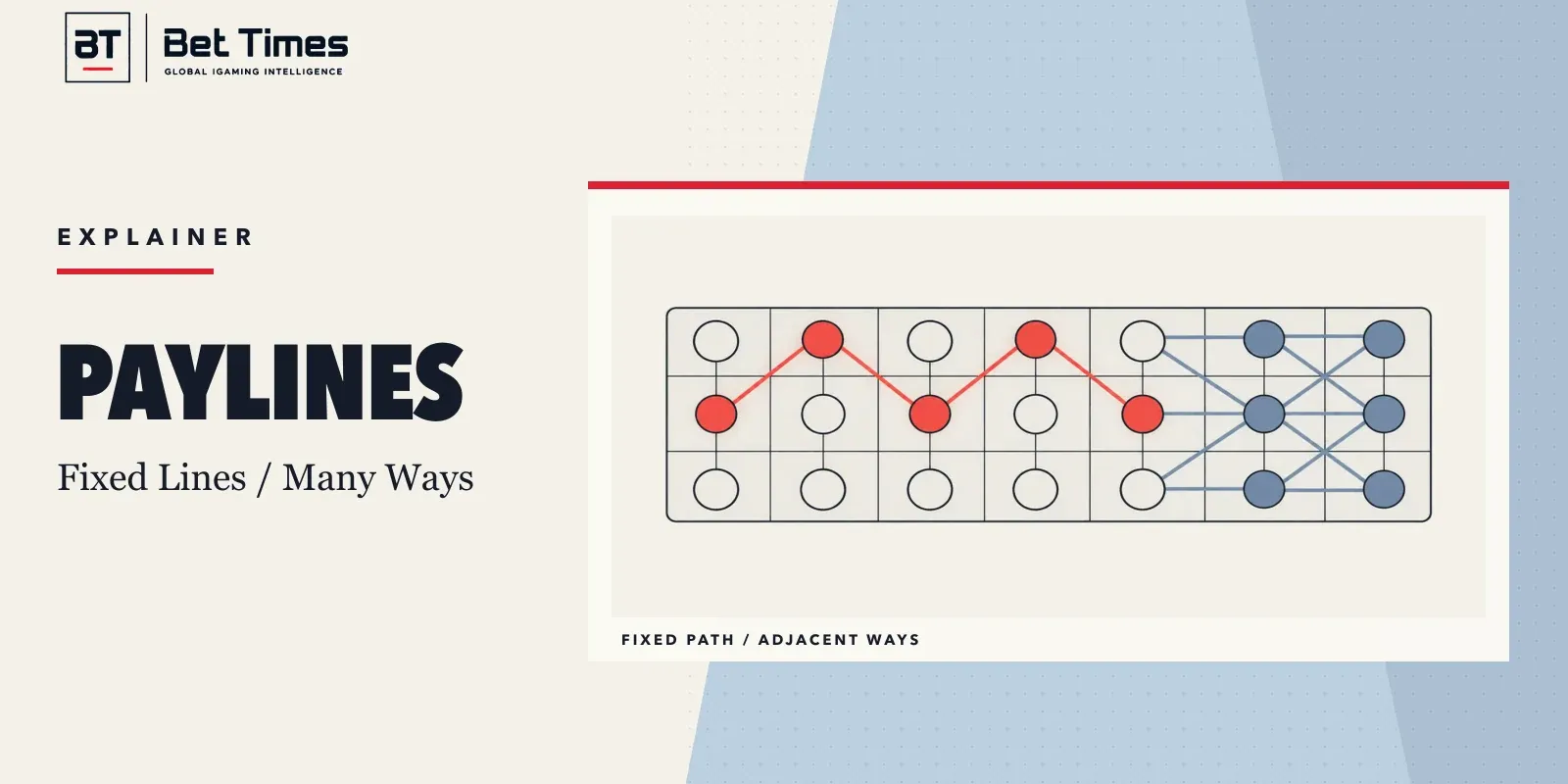
A slot payline is a predefined route across the reels on which matching symbols can form a prize. A ways-to-win system usually removes those fixed routes and instead counts matching symbols on consecutive reels, wherever they land within the eligible positions. The exact game rules always decide what counts.
The distinction sounds small, but it changes how a paytable is read. It does not change the basic fact that outcomes are generated under a defined mathematical model, and it does not make one format automatically higher in RTP or lower in volatility.
What is a slot payline?
A payline is a predefined sequence of reel positions. In a simple three-reel game, that route might be the centre row. In a five-reel video slot, it might run straight across, rise from left to right or zigzag among rows. A prize is awarded only if the required symbols land on an active route and satisfy the game’s rules.
PokerStars’ public slot rules describe paylines as lines crossing the reels on which winning combinations are formed. They also note that some games use a fixed number of lines while others allow a player to select how many are active. This is a useful example, not a universal specification: the individual help file is the authority for that title.
A 20-line game therefore has 20 defined routes, not every possible path through every visible position. If line 7 uses top, middle, bottom, middle and top positions, five matching symbols elsewhere on the grid do not form a line-7 win unless another rule, line or feature covers them.
What does “ways to win” mean?
A ways-to-win format usually pays matching symbols on consecutive reels without requiring them to occupy one predefined row pattern. If the rules say wins run left to right from reel one, an eligible symbol on reel one can combine with every eligible copy on reel two, then every copy on reel three, and so on for the length of the win.
That makes the visual reading different. On a payline game, the route is fixed before the spin. On a ways game, the occupied positions create the combinations after the result appears. “Ways” still does not mean that every symbol anywhere on the screen can connect. Consecutive reels, starting reel, direction and minimum match count are controlled by the rules.
Danske Spil’s rules for a classic 243-ways game provide a concrete implementation: all 243 ways are enabled, winning combinations use adjacent reels from left to right starting on reel one, and at least three matching symbols are required. Other games may use a different starting rule, number of reels or feature state.
Paylines, ways and cluster pays compared
These are three different methods for reading a result. They can share the same reel artwork, symbols and bonus features, so the game name or screen shape alone is not enough to identify the method.
| Role | What it means | Where to verify |
|---|---|---|
| Fixed paylines | Matching symbols must occupy the positions specified by an active line. | Number and shape of lines, direction, stake treatment and minimum match length. |
| Ways to win | Matching symbols are counted across eligible consecutive reels without one fixed row path. | Starting reel, adjacency, eligible positions, reel heights and feature changes. |
| Cluster pays | A prize is formed by a connected group of matching symbols rather than a left-to-right route. | Required cluster size, allowed connections, cascades and whether symbols are removed or replaced. |
The labels describe arrangement, not player value. Each format can be built with many different probability tables. A line game can have a high theoretical RTP and a ways game a lower one, or the reverse. The number printed beside “ways” cannot settle that comparison.
Why five reels and three rows produce 243 ways
Imagine five reels with three eligible positions on each reel. To count every full-length route, choose one position from reel one, one from reel two and continue through reel five. The multiplication rule gives:
3 × 3 × 3 × 3 × 3 = 3⁵ = 243.*
This is why the format is commonly called 243 ways. The number counts possible position paths across all five reels. It is not 243 guaranteed prizes, 243 independent spins or a statement that every path has the same chance of containing a winning symbol.
A three-symbol win across the first three reels can contain several ways within one displayed outcome. If the relevant symbol appears twice on reel one, once on reel two and three times on reel three, the combination count for that symbol is 2 × 1 × 3, or six ways, before any game-specific multiplier or stake rule is applied.
How 117,649 ways are calculated
Some variable-reel games change how many symbol positions are active on each spin. If a six-reel layout can show seven eligible positions on every reel, the maximum number of full-length position paths is:
7 × 7 × 7 × 7 × 7 × 7 = 7⁶ = 117,649.*
Big Time Gaming uses that figure on official pages for Monopoly Megaways and Max Megaways. “Up to” matters. When reel heights vary, the active total for one result is the product of the positions actually shown on its reels, so many rounds can present fewer than the advertised maximum.
The same multiplication principle works for unequal reel heights. A result with 2, 4, 3, 5, 2 and 6 eligible positions has 2 × 4 × 3 × 5 × 2 × 6, or 1,440 full-length position paths. Whether any of those paths wins still depends on which symbols landed and the paytable rules.
Does every way have the same probability?
Not necessarily. Counting screen positions is different from calculating symbol probability. Virtual reel strips can contain different numbers and distributions of symbols, and a variable-height feature can alter the number of visible positions. Wilds, mystery symbols, upgrades and bonus states can add further conditions.
To calculate the probability of a particular prize, an analyst needs the approved reel strips or probability tables, the rule for selecting reel heights, the symbol mapping and every relevant feature condition. The public ways number alone supplies none of those inputs.
This is also why multiplying the number of ways by a stake does not reveal the chance of winning. Some interfaces describe a total stake “per spin”; others show a coin value multiplied by lines. The help file must explain what the displayed stake covers before comparisons are made.
How wilds and scatters fit into the structure
Wild symbols commonly substitute for specified regular symbols, but their scope varies. A wild may substitute everywhere, only on certain reels or not for bonus symbols. It may expand, carry a multiplier or behave differently in a feature. Those properties can increase the number or value of combinations without changing the underlying definition of a line or way.
Scatter symbols often use a separate rule. They may pay according to how many appear anywhere on eligible reels, trigger a feature, or require particular reels despite their name. A scatter award should not be assumed to follow the ordinary payline or adjacent-reel calculation.
The safe reading order is: identify the standard win system, then read wild substitutions, scatter rules, feature changes and the stake definition. Treat every animated label as shorthand for the written rules, not as a complete mathematical description.
What the paytable and rules should tell you
The British Gambling Commission’s Remote Technical Standard 3 requires rules, prizes and relevant likelihood information to be available before a customer commits to gamble. The information must be accurate, intelligible and not misleading.
For a line or ways game, a useful help file should answer these questions:
- Which positions, reels or clusters are eligible for a standard prize?
- Do combinations start on a particular reel, and in which direction are they read?
- What is the minimum number of matching symbols?
- Are paylines fixed, selectable or affected by the total stake?
- How do wilds, scatters, multipliers, cascades and bonus states change the rule?
- Does the reel height vary, and is the displayed ways figure a maximum or the current total?
- Which RTP configuration and game version are being displayed?
If the interface shows only a large ways number without those answers, it communicates scale but not enough information to reconstruct how a prize is formed.
Do more paylines or ways increase RTP?
No general rule links a larger line or ways count to a higher RTP. Return to player is the long-run expected share of stakes returned as prizes across the complete game model. Developers can distribute that expected return among few routes or many routes and can change prize values and probabilities independently.
Activating more selectable paylines may cover more patterns in a given round, but it can also increase the total stake if the interface prices each line separately. That is an exposure change, not evidence that the house edge improved. A fixed-ways game normally includes all listed ways in its stated spin price, but the specific stake rule remains decisive.
The correct comparison uses the disclosed theoretical RTP for the exact version and bet configuration. It does not divide RTP by the number of ways or assume the largest grid offers the best return.
Do more ways mean lower volatility or more frequent wins?
Again, not by themselves. Casino volatility describes the spread of outcomes around expected return. Hit frequency describes how often the game records an outcome meeting its win definition. Both depend on symbol probabilities, prize values and features, not just on the number of routes that can be drawn through the grid.
A game can offer many ways while concentrating substantial value in rare symbols or features. Another can use a small number of lines and return smaller prizes more frequently. Even a published hit frequency needs context because some recorded wins can return less than the amount staked.
Lines and ways explain where matching symbols must appear. RTP explains the long-run average. Volatility explains dispersion. Hit frequency explains how often a defined hit occurs. Keeping those four questions separate prevents most comparison errors.
How an RNG and RGS relate to paylines
The random number generator supplies or supports the random selection used for the outcome. The remote gaming server applies the approved game logic, records the round and communicates with the wider platform. The line or ways evaluator then maps the result to the paytable.
This order matters because the displayed path does not choose the symbols. It explains why an already generated result receives a particular award. Previous non-winning paths do not make a line “due”, and showing more positions does not create a memory in an independent RNG.
How game testing checks lines and ways
The Gambling Commission’s testing procedure requires an approved test house to compare player-facing rules and displays with the game’s mathematics and implementation. The review can cover the mapping of random inputs to outcomes, prize evaluation and whether the displayed information agrees with the submitted design.
A line-game test can confirm that each route evaluates the intended positions and awards the correct paytable value. A ways-game test can verify adjacency, direction, symbol multiplicities, variable reel heights and feature-specific rules. Statistical testing then checks the random and mathematical behaviour at an appropriate scale.
BETTIMES’ game-testing explainer describes the wider chain. Certification applies to a defined build and configuration; it is not a permanent statement about every later version carrying the same title.
Common reading mistakes
- Treating 243 ways as 243 conventional drawn paylines.
- Reading a maximum ways figure as the active total on every variable-height spin.
- Assuming matching symbols anywhere on the screen form a prize.
- Using the number of lines or ways as a shortcut for RTP, volatility or hit frequency.
- Ignoring the effect of total stake when selectable lines are activated or removed.
- Assuming a wild, scatter or cluster follows the standard adjacent-reel rule.
- Believing an unused route becomes more likely to win after a sequence of losses.
Frequently asked questions
What is a payline in a slot?
A payline is a predefined route through reel positions. Matching symbols must land on the eligible positions of an active route and satisfy the game’s direction and minimum-match rules. The paytable or help file should show the route shapes and explain whether lines are fixed or selectable.
What does 243 ways to win mean?
In a common five-reel layout with three eligible positions per reel, 243 is the number of full-length position paths: 3 × 3 × 3 × 3 × 3. A win still requires the correct matching symbols on consecutive reels under that game’s rules. It does not guarantee 243 prizes.
What does 117,649 ways mean?
It is the maximum number of full-length position paths when six reels can each show seven eligible positions: 7⁶ equals 117,649. In a variable-height game, the active total can be lower on a particular round. The rules determine how matching symbols turn those positions into prizes.
Are ways to win better than paylines?
Neither structure is inherently better for player value. They are different methods for evaluating symbol positions. RTP, volatility, hit frequency, prize values and stake rules come from the full mathematical model. Compare those disclosed properties and the exact game version instead of relying on the number of routes.
Do more paylines increase the chance of winning?
More active lines cover more predefined patterns, but they may also increase the total stake when a game prices each line separately. The effect on hit frequency and return depends on the paytable and symbol probabilities. A larger line count alone cannot show whether the game offers better mathematical value.
The reliable way to read a slot grid
Start with the help file, not the headline number. Identify whether the game uses fixed lines, adjacent-reel ways or clusters; confirm the direction and minimum match; then check wilds, scatters, feature states, stake treatment and the exact RTP version.
The line or ways count tells you how positions can connect. It does not predict the next outcome and it does not replace the game mathematics. Anyone who chooses to gamble should set time and money limits independently of the grid size and use the controls in the BETTIMES responsible gambling guide.