
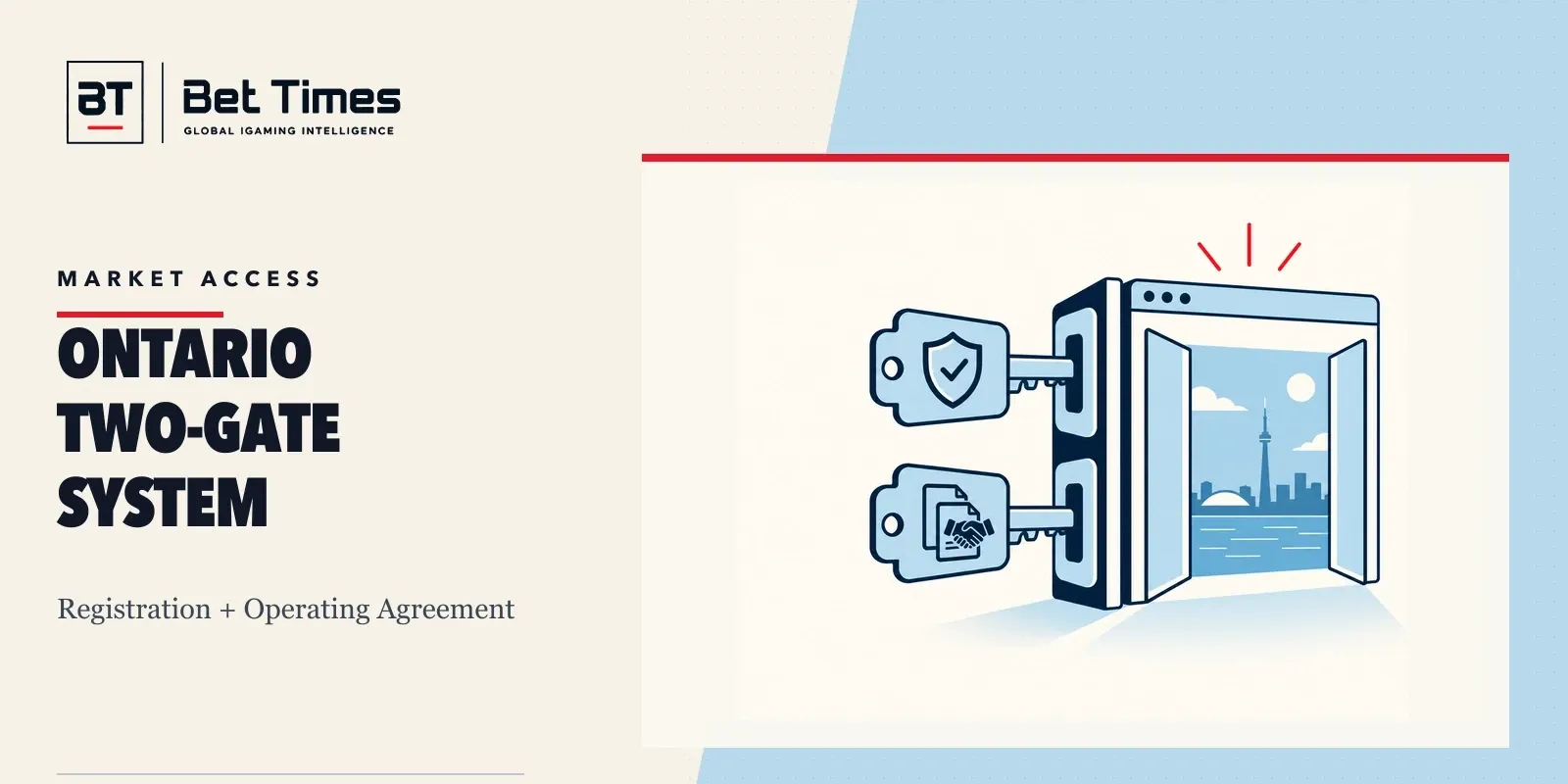
Private operators enter Ontario's regulated iGaming market through two linked gates: registration as an internet gaming operator with the Alcohol and Gaming Commission of Ontario, and an operating agreement with iGaming Ontario. Having only one of those records is not the complete market-access position.
This guide is for operators, suppliers, analysts, journalists and consumers resolving Ontario licence claims. It covers the competitive provincial iGaming model, public site checks and role allocation. It does not assess one operator, interpret confidential agreement terms, or cover every OLG and horse-racing product.
Why Ontario has two linked gates
Ontario's model separates the regulator from the entity that conducts and manages the provincial online gaming scheme. The Alcohol and Gaming Commission of Ontario, or AGCO, registers operators and sets regulatory standards. iGaming Ontario, or iGO, enters commercial operating agreements and oversees participation in its conduct-and-manage framework.
The iGaming Ontario explanation of its role states that private operators first register with AGCO and then execute an operating agreement with iGO. The second step is not a decorative contract beside a conventional licence. It is part of how private sites lawfully participate in the provincial model.
This is why calling the entire route an Ontario casino licence can hide a material distinction. A complete record should preserve both organisations, the registered operator, the operating relationship and the approved gaming sites.
AGCO registration and the iGO agreement compared
| Role | What it means | Where to verify |
|---|---|---|
| AGCO internet gaming operator registration | Establishes the registered operator within Ontario's regulatory framework and standards. | Legal entity, registration status, responsible roles and applicable standards. |
| iGaming Ontario operating agreement | Brings the operator into iGO's conduct-and-manage commercial model. | Agreement status, operator identity, approved brands and gaming sites. |
| Public operator directory | Gives consumers and researchers a current map of participating operators and sites. | Exact hostname, legal operator and the date the directory was checked. |
| Monthly market performance report | Reports aggregated market activity under the stated iGO scope and methodology. | Reporting month, revisions, exclusions, definitions and whether data is audited. |
The BETTIMES Ontario market profile uses these as separate evidence fields. Our licence profile applies the same two-part description rather than inventing a single certificate label.
What AGCO registration does
AGCO administers Ontario's gaming regulation and the Registrar's Standards for Internet Gaming. Registration identifies the company that has entered the regulatory system and must meet the applicable integrity, governance, player-protection, technology, anti-money-laundering and responsible-gambling expectations.
The standards are outcomes-based in important areas. That does not mean the duties are optional. It means operators must implement controls capable of delivering the required outcomes and retain evidence that those controls work in their own environment.
Registration should be checked at legal-entity level. A global parent or familiar international brand is not the complete answer because the Ontario relationship can be held by a specific subsidiary. The customer terms and the public directory help connect that entity to the product observed.
What the iGaming Ontario operating agreement does
iGaming Ontario is the provincial entity responsible for conducting and managing the competitive internet gaming scheme. Its operating agreement creates the commercial and operational relationship through which a registered private operator participates.
The agreement layer matters for revenue sharing, data, controls and the sites that operate within the scheme. Not every commercial term is public, so a public article should not convert the arrangement into a guessed tax rate or claim to know confidential economics.
The reliable public conclusion is narrower: participation requires the relevant registration and operating agreement, and the current directory identifies regulated operators and sites. Any deeper claim needs a published agreement, official statement or other appropriate evidence.
Which products sit inside the competitive market
Ontario's competitive iGaming market includes approved online casino products, sports and event betting, peer-to-peer poker, peer-to-peer bingo and betting exchange products where offered by participating operators. A company's actual product mix can be narrower than the full market scope.
The site and product should therefore be checked together. An operator listed for Ontario is not evidence that every product it offers elsewhere is live or approved in the province. Product navigation, terms and iGO records help resolve the local offer.
The BETTIMES guide to what iGaming is separates operator, platform, provider, payment and regulator roles. That entity map is useful in Ontario, where a brand can use several suppliers while one registered operator owns the customer relationship.
What falls outside the standard iGO figures
iGaming Ontario's public market reports define their own scope. The reporting framework excludes OLG.ca and pari-mutuel wagering on horse racing from the competitive-market totals. A headline described as the entire Ontario gambling market would therefore overstate what the dataset measures.
Market reports also label figures and can revise them. Researchers should record the reporting month, extraction date, definitions and revision status instead of combining numbers collected on different dates.
The BETTIMES regulated market monitor preserves these scope notes. A machine-readable total without its exclusions can be precise in format but wrong in meaning.
How to verify an Ontario operator and site
Begin with iGaming Ontario's current regulated operators and gaming sites directory. Search the brand or exact hostname and identify the legal operator associated with it. Then compare that result with the company named in the site's Ontario terms.
- Record the exact hostname and product being reviewed.
- Open the Ontario-facing customer terms and copy the legal operator name.
- Locate the operator and gaming site in the iGO directory.
- Confirm that the domain in the directory matches the domain used for registration and play.
- Resolve the operator's AGCO registration where the relevant public record is available.
- Note the verification date and any inconsistency in brand or entity naming.
- Recheck after mergers, migrations, suspensions or material product changes.
If the brand appears globally but not in the Ontario directory, do not infer approval from another jurisdiction. The product might use a different local hostname or entity, but that possibility requires evidence.
Location, age and account boundaries
Regulated private-operator sites serve eligible players who are physically located in Ontario when gambling. Geolocation is therefore an operating control, not merely a line in the terms. Operators can use technology suppliers to establish location, but the regulated operator remains responsible for the customer-facing outcome.
Age and identity controls also belong to the account relationship. The BETTIMES KYC explainer describes how identity evidence supports access decisions. It should not be confused with the separate location signal or with ongoing AML and safer-gambling monitoring.
A person who can view an Ontario website from outside the province has not established that wagering is available there. Access to marketing content, account creation and lawful gambling are different technical and legal states.
Player-protection duties
AGCO's standards require controls designed to reduce gambling-related harm. The regulator has published guidance on identifying and supporting players at risk, including expectations for timely and proportionate intervention.
Evidence can include account-risk indicators, intervention decisions, limit tools, self-exclusion handling and records showing how the operator responded. A policy that says the right words is not the same as an operating control that identifies and handles real cases.
Supplier systems can support those outcomes, but accountability must be mapped. A platform or analytics vendor provides tooling; the registered operator and the provincial framework determine who makes and records the customer decision.
Revenue reporting without inventing a tax rate
iGaming Ontario publishes a monthly market performance report with the definitions and caveats attached to that release. It is useful for tracking market activity, product mix and changes over time.
The operating model includes revenue sharing with the province. Public commentary sometimes translates that relationship into a single tax label. BETTIMES avoids doing that without a current, public source that supports the exact term and rate being used.
A disciplined analysis separates gross gaming revenue definitions, commercial revenue share, corporate taxes, regulatory fees and supplier costs. Combining them under one percentage can make comparisons with conventional licence markets misleading.
Common Ontario verification mistakes
- Describing AGCO registration alone as the full private-operator market-access route.
- Ignoring the iGaming Ontario operating agreement and conduct-and-manage structure.
- Matching a global parent company instead of the Ontario-facing legal entity.
- Treating a listed operator as approval for every global brand, domain and product.
- Including OLG.ca or pari-mutuel horse racing in iGO competitive-market totals without adjustment.
- Quoting an operator count or market figure without its date and reporting scope.
- Converting a commercial revenue-sharing relationship into an unsupported headline tax rate.
A reusable Ontario evidence record
Record the registered legal entity, operating-agreement relationship, consumer brand, exact gaming site, products observed, directory URL and verification date. Add location and eligibility notes when they affect the claim. Keep supplier entities in separate fields.
For market statistics, store the period, measurement definition, release date, revision note and exclusions. This makes the record updateable and prevents a current figure from becoming a permanent fact.
The BETTIMES operator licence tracker provides a compact research starting point, while the official iGO and AGCO records remain the sources for current decisions.
Frequently asked questions
Is AGCO registration the same as an Ontario iGaming licence?
AGCO registration is one required part of the route, but private participation also requires an operating agreement with iGaming Ontario. Calling registration the whole licence can conceal the conduct-and-manage relationship. Verify both the registered legal operator and the site listed by iGaming Ontario before describing market access.
What is iGaming Ontario's role?
iGaming Ontario conducts and manages Ontario's competitive internet gaming scheme and enters operating agreements with registered private operators. AGCO remains the regulator. The two bodies have linked but different functions, so a complete explanation should not merge them into one unnamed licensing authority.
Can an international brand use its existing licence in Ontario?
An approval from another jurisdiction does not replace the Ontario route. The business needs the required Ontario registration and operating relationship, usually through a defined local legal entity and listed gaming site. Global ownership can support entity research but is not itself proof of provincial permission.
Does the iGO directory prove every product is approved?
The directory is strong evidence that an operator and gaming site participate in the regulated scheme. Reviewers should still identify the product actually offered and the entity named in its terms. A site's product mix can change, and a brand's offer in another country may differ from Ontario.
Are Ontario market reports the whole provincial gambling market?
No. iGaming Ontario's competitive-market reports use a defined scope and exclude OLG.ca and pari-mutuel horse-race wagering. Always reproduce the period, definitions and exclusions. Combining the report with other datasets requires a documented method so overlapping or differently defined activity is not double counted.
The reliable conclusion
Ontario's private iGaming route is a two-part system: AGCO registration plus an operating agreement with iGaming Ontario. Verify the legal entity, brand and exact gaming site in current official records, keep products and suppliers separate, and attach dates and scope notes to both licence claims and market data.