
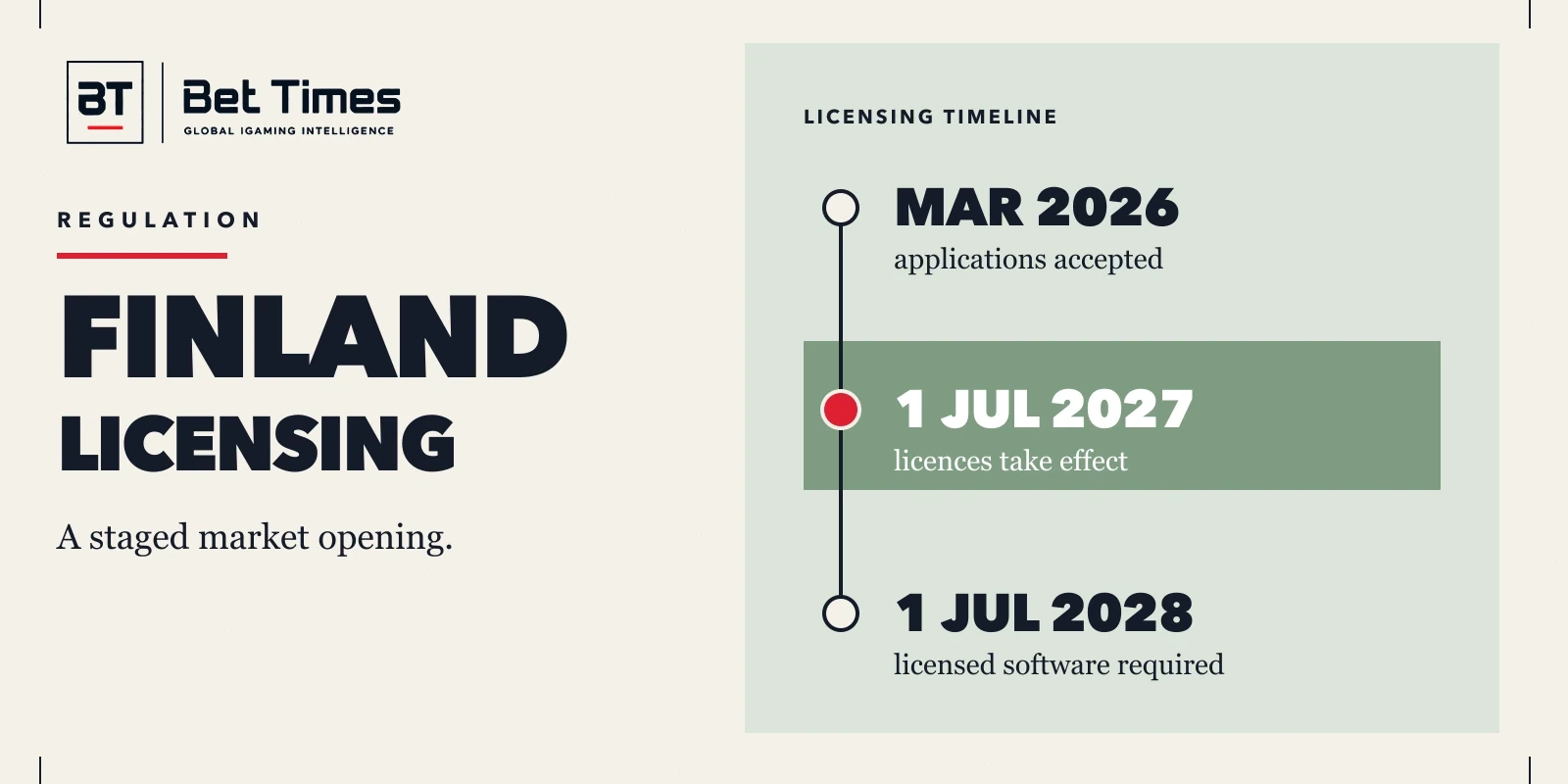
Finland's Gambling Act 10/2026 opens online betting, online casino games, online money bingo and online slots to licensed competition. Applications have been accepted since March 2026, but the first licences can take effect only on 1 July 2027.
The reform matters to every business that serves, or plans to serve, Finnish players. Operators must prepare an application in Finnish or Swedish, a 22% gambling tax, mandatory deposit limits and a closed list of marketing channels. Suppliers face a separate software licence. Several dates also moved while Parliament handled the bill, so guides written from the original proposal can carry the wrong timetable.
Finland's gambling licence timeline
| Role | What it means | Where to verify |
|---|---|---|
| Act adopted and approved | Parliament adopted the reform on 16 December 2025; the President approved Act 10/2026 on 16 January 2026. | That a guide relies on the enacted text, not the March 2025 government proposal with earlier dates. |
| Licensing provisions in force | Chapters 2 and 9 and sections 43(3), 44, 57, 63 and 64 took effect on 1 March 2026. The Police e-service accepted applications from 2 March 2026. | Application language, attachments and the fee that applies in the filing year. |
| Applications received | The National Police Board reported 50 applications on 8 June 2026. | The figure is dated and was not broken down by licence type or applicant. |
| Licensed market opens | The remaining provisions and the 22% tax rate apply from 1 July 2027, when the first licences can take effect. | Whether a named company has actually been granted a licence and for which gambling forms. |
| Software licence applications | Gambling software licence applications can be submitted from 1 July 2027. | Which entity in a supplier group applies, and for which software activities. |
| Mandatory licensed software | From 1 July 2028, licensed operators may use only software made, supplied, installed or adapted by software licence holders. | The contract chain from each game, platform or system supplier to the operator. |
The gambling licence explainer covers the general concept. This guide focuses on the Finnish model and the operational decisions it requires before July 2027.
What does Finland's Gambling Act open to competition?
Section 6 of the Gambling Act 10/2026 creates a gambling licence for six forms of gambling:
- fixed-odds betting;
- variable-odds betting;
- virtual betting;
- electronic casino games;
- electronic money bingo;
- electronic slot machine games.
Section 5 keeps a separate exclusive-licence model. No more than two exclusive licences can be granted: one for money lotteries and veikkauspelit, and one for slot machines and casino games. Under section 8, an exclusive licence must be granted to a limited company controlled by the Finnish state. An exclusive licence holder cannot also receive a gambling licence. If a company in the same group runs competitive games, that activity must be separated from the exclusive business and intra-group financial relationships must be arranged on market terms.
Veikkaus said in its January–June 2026 release that it set up two separate subsidiaries in May for the coming market and filed applications for both the exclusive activity and the competitive licensed market. That is a company statement. It does not show which licences have been granted.
The accurate summary is therefore narrower than "Finland ends the Veikkaus monopoly". The reform opens defined online gambling forms to licensed competition while keeping lotteries, veikkauspelit, slot machines and casino games inside a state-controlled exclusive model.
Which Finnish licence does a business need?
The Act distinguishes three permissions. Treating them as one "Finnish licence" hides important differences in scope, holder and duration.
- Exclusive licence: granted to a state-controlled limited company for the forms listed in section 5, for ten years at a time.
- Gambling licence: the B2C permission for the six competitive forms in section 6, granted for no more than five years at a time.
- Gambling software licence: under section 7, a licence to manufacture, supply, install or adapt gambling software used in licensed gambling, also for no more than five years.
Section 33 closes the supply chain from both sides. Licensed operators may not use software from anyone other than a software licence holder, and a software licence holder may not supply software to anyone offering gambling in Finland, or directing gambling to Finland, without the required licence. The casino game provider explainer shows why that clause can reach game studios, platforms and aggregators rather than only the consumer-facing brand.
Applicants established outside the European Economic Area need a representative domiciled in an EEA state, and that representative must meet the same reliability requirements. A licensee must provide its Finnish business identity code within three months of starting gambling operations.
The fit-and-proper look-back
Section 10 sets out when an applicant cannot be considered reliable and suitable. Two grounds matter directly to companies already targeting Finland. An applicant fails if, within the three years before assessment, it received a prohibition decision or penalty payment under the new Act for unlicensed gambling or marketing. It also fails if, within the two years before assessment but after 1 September 2024, it received a prohibition decision or penalty payment under the Lotteries Act for gambling or marketing that breached that Act.
This is not a general amnesty or a general ban. It is a dated test applied to specific enforcement decisions, so an applicant's enforcement history needs to be checked against those dates. The licence verification guide explains how to record a licence claim once decisions are published.
Application process, fees and supervision charges
The National Police Board is the competent authority until 30 June 2027. From 1 July 2027, the supervisory authority under section 57 is Lupa- ja valvontavirasto, the Finnish Supervisory Agency, which grants the licences under sections 5–7.
According to the Police licence page, gambling licence applications could be submitted through the e-service from 2 March 2026, only in Finnish or Swedish, with a target processing time of six months. On 8 June 2026 the Police Board reported 50 applications, estimated processing at about six months and confirmed that the first licences take effect on 1 July 2027.
The Ministry of the Interior's fee announcement set the 2026 application fee at €29,000 for an exclusive licence or a gambling licence, and €1,120 for a licence alteration or an international-cooperation authorisation. That fee decree is in force from 1 March to 31 December 2026, so a later filing should be checked against the fee rules then in force.
Licensed operators also pay an annual supervision fee under section 70. For a gambling licence it is set in eight bands of gross gaming revenue, defined in that section as total stakes less winnings paid to players. The lowest band is €4,000 for revenue below €100,000; the highest is €434,000 at €50 million or more. As a calculated illustration, a licensee with €3 million of gross gaming revenue would fall in the €2 million to €5 million band, which carries a €45,300 fee.
What changes for gambling tax?
The Lottery Tax Act amendment 14/2026 sets lottery tax at 22% of proceeds for games offered under exclusive rights and for games offered for play in Finland under a Finnish licence. It applies from 1 July 2027 and does not apply to games offered from Finland for play in another state. The Ministry's questions and answers describe the change as a rise from the current 12% to 22%.
The gambling tax is separate from the supervision fee and from corporate income tax. Market models should keep the three lines apart. The GGR, GGY and NGR explainer shows why revenue definitions must be matched before a tax or fee calculation is compared across jurisdictions.
Player protection rules operators must build
The Act turns several responsible-gambling expectations into fixed product requirements.
- Registration and identity: licensees must register players, who must be natural persons aged at least 18, and verify their identity.
- Residence: for electronic games, licensees may register only natural persons permanently resident in Finland, must verify residence regularly and must block play when a player is permanently resident abroad.
- No credit and limited incentives: gambling on credit is prohibited, as are free games, discounted play and combined offers. Moderate bonus money is permitted within an established customer relationship, cannot be exchanged directly for money and may carry a wagering requirement of no more than five times.
- Self-exclusion: a player can block all gambling that requires registration by notifying the supervisory authority. An indefinite block lasts at least one year, and removal takes effect three months after the request. Operators must also offer game-specific blocks and an immediate block lasting until the end of the following day.
- Deposit limits: at registration or, at the latest, before the first transfer, the player must set daily and monthly limits on transfers from a bank account to the gambling account. Increases take effect the next day or the next month; decreases apply immediately.
- Systems and testing: before launch, licensees must give the supervisory authority a testing body's report and approval covering their gambling systems, draw devices and draw procedures. Gambling systems must be located in Finland unless a regulator agreement or remote verification route applies.
Section 32 lets the Government set daily, monthly and annual loss limits by decree and lets the Ministry of the Interior set maximum stakes, wins and game-pace rules. On 10 June 2026 the Ministry sent four draft decrees for comment, including maximum stakes for online casino games and online slot features. Comments closed on 5 August 2026. No adopted stake or loss-limit figure was verified for this guide.
The mandatory limits invite comparison with Great Britain's gross deposit limit rules, while the testing duty links to the online casino game testing process. The obligations are not identical, so product teams should map each market separately.
Marketing: a closed list of channels
Section 51 permits marketing only if it is moderate in amount, reach, visibility and frequency. It then lists where licensed games and licensees may be marketed:
- the licensee's own website and own social media accounts, without interacting with consumers;
- television and radio;
- sports events and other public events;
- printed media and equivalent electronic publications;
- gambling points of sale, for the games available there;
- online search engines, when the search term relates directly to the licensee or its games.
Section 54 allows direct marketing only with a person's explicit consent and bans telemarketing. Marketing may not target a person who has blocked all gambling or who has not played the licensee's games in the previous two years. Section 55 requires marketing to state the legal age limit and where to find gambling-control tools and help services.
A channel list is narrower than a general advertising code. Any plan involving affiliates, influencers or other third-party promotion should be tested against the Act and future supervisory guidance rather than assumed to fit one of the listed channels.
Enforcement against unlicensed gambling
The Ministry of the Interior states that network-traffic and payment blocking were not proposed at this stage. The new Act instead relies on prohibitions, removal orders and administrative penalties.
Under section 76, the supervisory authority can prohibit gambling and marketing that breaches the Act. Section 78 allows it to order a service provider to remove online content concerning gambling or its marketing, and to order a domain registry or registrar to remove a domain name. Under section 85, a penalty payment imposed on a legal person can reach 4% of turnover, capped at €5 million, with a €10,000 minimum.
The software-licence rules add a supply-chain lever from 1 July 2028. Combined with the section 10 look-back, they mean enforcement history and supplier relationships can affect market access, not only fines.
Finland licence readiness checklist
- Map the product: assign each game to a section 6 form and confirm that none falls inside the exclusive model.
- Identify the applicant: record the legal entity, group structure, beneficial owners, management and any EEA representative.
- Check enforcement history: review prohibition decisions or penalties against the section 10 dates.
- Prepare the filing: use Finnish or Swedish, keep attachments current and budget for the fee in force when filing.
- Build player controls: residence checks, identified play, deposit limits, game-specific blocks and the immediate block.
- Audit the supplier chain: list every software supplier that will need a software licence before 1 July 2028.
- Reset marketing: remove channels outside section 51 and rebuild consent and suppression lists for section 54.
- Model the economics: separate 22% lottery tax, supervision fees, testing and system-location costs.
Finland's online gambling licences are best read as a staged transition. Applications began in 2026, operation begins in July 2027, and supplier-software obligations bite in July 2028. The dates, the dated enforcement test and the unused decree powers should travel with every Finnish market claim.
Frequently asked questions
When can licensed online gambling start in Finland?
The first gambling licences can take effect on 1 July 2027, when the remaining provisions of Gambling Act 10/2026 apply. Applications have been accepted since March 2026, but submitting an application does not authorise operation. A company should be described as licensed only after a licence decision covering the relevant gambling forms is confirmed.
Does the Veikkaus monopoly end completely?
No. The Act opens fixed-odds, variable-odds and virtual betting, electronic casino games, electronic money bingo and electronic slot machine games to gambling licences. Money lotteries, veikkauspelit, slot machines and casino games remain in the exclusive model, which allows no more than two exclusive licences for a state-controlled company.
What is Finland's gambling tax rate from July 2027?
The Lottery Tax Act amendment sets lottery tax at 22% of proceeds from 1 July 2027 for exclusive-right games and games offered for play in Finland under a Finnish licence. The Ministry of the Interior describes this as an increase from 12%. Supervision fees and corporate income tax are separate charges.
Do gambling software suppliers need a Finnish licence?
A gambling software licence covers manufacturing, supplying, installing or adapting software used in licensed gambling. Applications open on 1 July 2027. From 1 July 2028, licensed operators may use only software from licence holders, and a software licence holder may not supply operators offering gambling in Finland without a licence.
Can an operator already serving Finland without a licence apply?
It can file an application, but the fit-and-proper assessment examines enforcement history. An applicant is not considered reliable if it received a Lotteries Act prohibition decision or penalty payment for gambling or marketing within the two years before assessment and after 1 September 2024, or a comparable decision under the new Act within three years.