
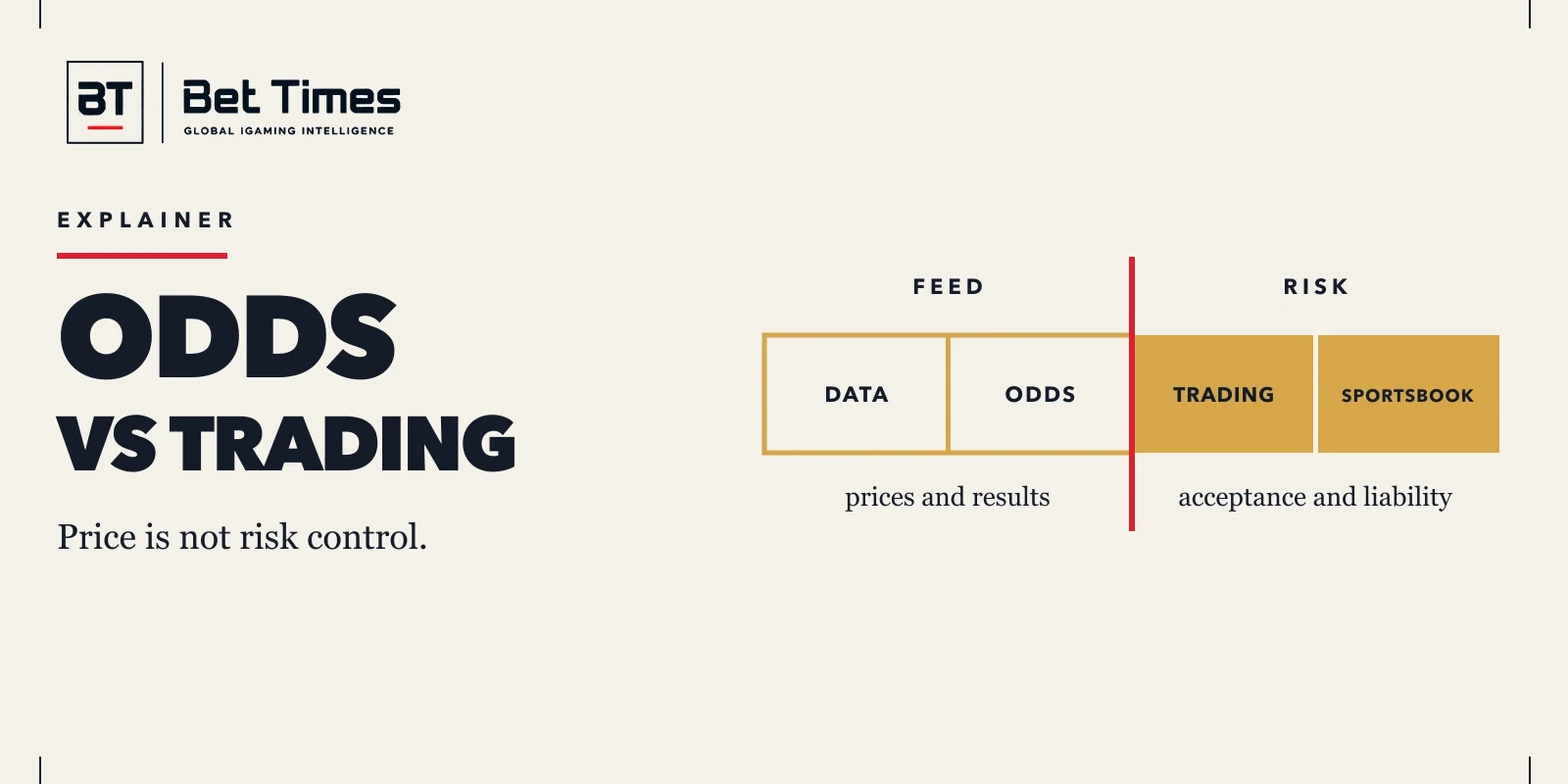
An odds feed supplies the prices, market status and often results messages a sportsbook uses to offer bets. A managed trading service goes further by applying liability rules, customer limits and bet acceptance decisions. Regulators still look first to the licensed operator, although some also license suppliers.
The distinction shapes contracts, integration work, regulatory approvals and revenue risk. Supplier marketing often presents pricing, trading and risk management as one continuous service. For due diligence, each layer needs its own answer to three questions: who makes the decision, who bears the economic result and who is accountable to the regulator.
Sportsbook supply layers compared
| Role | What it means | Where to verify |
|---|---|---|
| Sports data feed | Statistical information about sporting events, such as scores, performance metrics and outcomes. | Data source, latency, official-data status where required, and how outages are handled. |
| Odds feed | Prices and market status for betting markets; some products also send suspension, cancellation and settlement messages. | Who compiles and oversees prices, which messages are included, and who evaluates bet outcomes. |
| Trading tools | Software that lets the operator's own traders adjust prices, offering, limits and liability positions. | Which decisions remain with the operator's trading team and how changes are logged. |
| Managed trading service | Supplier-run trading, risk and liability management, which can include bet acceptance, customer limits and bet delays. | Who can accept, reject or override a bet, and whether the supplier shares revenue or losses. |
| Hosted or turnkey sportsbook | A sportsbook platform with trading and risk functions, sometimes hosted by the supplier for another operator's customers. | The host's licence, the customer contract and responsibility for regulatory returns. |
The sportsbook hold vs theoretical margin explainer covers what happens to prices once bets settle. This guide focuses on the step before: which party creates the price, controls exposure and decides whether a bet is taken.
What does a sportsbook odds feed include?
A raw data feed describes the event. Tennessee's Sports Wagering Council rules define a sports data feed as a technology system or software providing statistical information such as scores, player and team performance metrics and game outcomes. That definition does not include prices.
An odds feed turns event information into betting markets and prices. In Sportradar's Unified Odds Feed documentation, clients receive messages that change odds, stop betting and settle markets. The bet settlement message carries a certainty value that distinguishes a result reported live by scouts from a result sent after official confirmation. The same page states that the evaluation of bet outcomes is the responsibility of the client system.
That sentence captures the core boundary. A supplier can deliver the result data, but the sportsbook system still decides how that data changes each customer's bet and account. The Player Account Management explainer and iGaming platform guide explain where wallets, settlement records and customer balances normally sit.
Odds products can also move toward trading. Kambi's Annual Report and Accounts 2025 describes Odds Feed+ as a pricing service and says Kambi sees opportunities to extend it across the bet lifecycle, including greater influence over bet acceptance and risk management. Kambi presents that evolution as a move toward being a trading partner rather than solely a price provider. It is a company strategy statement, not an industry definition.
What does a managed trading service add?
Managed trading is where supplier decisions reach individual bets. Sportradar's FY2025 Form 20-F describes its Managed Trading Services as a trading, risk and liability management solution that natively embeds its odds services. The same filing says clients can manage odds-related liabilities according to rules and thresholds that they control.
The revenue note shows how the service works at bet level. MTS clients forward proposed bets, described as bet slips, to Sportradar for consideration. Sportradar states that it can accept or decline a bet slip and, if it accepts, receives a share of the revenue or loss made by the client on that bet.
Control is still layered. Sportradar's Bet Referral documentation describes a feature that lets a client's trading team manually review bets that would otherwise be rejected under four liability-based rejection codes. It states that the feature is for the client's internal trading team and that MTS traders do not review or manage referred bets.
Other disclosures show similar overlaps. Genius Sports' FY2025 Form 20-F says sportsbooks can outsource the collection of live sports data, oddsmaking, risk management and player marketing. It also says customers can take control of their own event at any time and adjust margins, offering or market position through its portal. Kambi's annual report describes a standalone trading and risk-management function incorporating event resulting, bet settlement, offering compliance and player profiling.
The Sportradar and Kambi company records provide wider context. Their product descriptions should not be treated as universal definitions for every supplier.
Control, economics and liability are separate questions
A managed trading contract can blur three issues that should be recorded separately.
- Decision control: which party sets prices, accepts or rejects bets, applies customer limits and can override those decisions.
- Economic exposure: whether the supplier is paid a fixed fee, a share of gaming revenue, a share of losses, or a combination.
- Regulatory accountability: which party holds the licence, contracts with the bettor, reports suspicious betting and answers for errors.
The audited filings disclose different economics. Sportradar states that MTS agreements typically specify an agreed minimum fee and revenue-share percentage, with the fee set at the higher of the two, and that most MTS contracts include a loss-participation clause at a percentage typically matching the revenue share. Genius Sports describes fixed-fee arrangements covering a minimum number of events, with overages, and profit-share arrangements. Kambi charges fixed fees, fees based on live events offered and a commission based on operators' gross gaming revenue less deductible costs.
As a hypothetical illustration, assume a 15% revenue share and a €20,000 monthly minimum fee. If a month's qualifying revenue is €400,000, the revenue share is €60,000, so the fee is €60,000. If qualifying revenue is €100,000, the revenue share is €15,000 and the minimum fee of €20,000 applies. These figures are not any supplier's contract terms, and the example does not model loss participation.
The GGR, GGY and NGR explainer matters here because a contract based on net revenue depends on which deductions the parties define. The filings reviewed do not state, for every model, which party is the legal counterparty to the bettor. That should be confirmed in the contract and licence documents rather than inferred from revenue sharing.
How regulators draw the line between supplier and operator
GLI-33, the Standards for Event Wagering Systems v1.1, is a testing-laboratory standard rather than law. It says it is not intended as a set of prescriptive requirements for every system and operator. Where adopted, it expects an operator's internal controls to describe all integrated third-party service providers and to use statistics or line data from a source allowed by the regulator. The game testing guide explains how laboratory standards become binding only through regulator adoption.
New Jersey separates determination from advice. Under N.J.A.C. 13:69J-1.2, entities that determine what wagers to accept or the odds to be offered for a sports pool operator must be licensed as ancillary casino service industry enterprises. An entity that offers non-public information or recommendations on wagers, odds or results must register as a vendor. The New Jersey market profile gives the wider permit structure.
Tennessee treats trading services as a registrable supplier activity and adds an approval step. Its rules list sportsbook risk-management or odds-making services and sports data feeds among vendor categories. Rule 1350-01-.10 allows a licensee to use global risk management only with Council approval, after submitting all written agreements related to that service.
Great Britain focuses on software and hosting. The Gambling Commission's definition of gambling software includes bet capture and matching, settlement and gambling records, while excluding performance analytics, affiliate and CRM tools. A separate remote betting host licence applies to a gambling software business that hosts a sportsbook used by customers of other operators, provided it does not contract directly with those customers. The guidance reviewed does not classify every odds feed or trading service by name.
When a supplier feed is wrong
An Illinois Gaming Board order of 27 November 2023 shows how responsibility can surface. DraftKings used a third-party data provider, Sportcast, to establish lines for same-game parlays. On 24 October 2023, Sportcast began feeding first-quarter lines that the DraftKings system interpreted as full-game lines.
DraftKings identified the error 11 minutes later, Sportcast disabled the feed and DraftKings suspended further wagering. DraftKings notified the Board the next day and voided 301 wagers with a combined Illinois stake of $19,048.60 on the ground of obvious error. The Board denied patrons' requests for review. The case is one decision, not a general rule, but it shows the licensed sportsbook dealing with the regulator and customers when a supplier feed caused the pricing error.
Odds feed and managed trading due-diligence checklist
- Name the layer: record whether the service is data, odds, trading tools, managed trading or a hosted sportsbook.
- Map decisions: document who sets prices, suspends markets, accepts bets, applies limits and overrides rejections.
- Separate results from settlement: confirm who supplies results and which system settles customer accounts.
- Check official-data rules: identify any market where specific wagers must use approved or official data.
- Read the economics: capture fixed fees, revenue share, profit share, minimums and any loss participation.
- Confirm licences: list the operator licence, supplier licence or registration, and any approval for outsourced risk management in each market.
- Plan failure handling: define feed outages, erroneous prices, void procedures, notices and customer communication.
- Keep evidence: retain configuration, rejection logs, override records and regulator notifications.
A sportsbook odds feed and a managed trading service can come from the same supplier and run on the same integration, but they answer different questions. The feed tells the sportsbook what the market looks like; trading decides how much risk the sportsbook will take. Contracts and compliance files should keep both answers visible.
Frequently asked questions
What is the difference between a sports data feed and an odds feed?
A sports data feed supplies statistical event information such as scores, performance metrics and outcomes. An odds feed converts event information into betting markets and prices, and may add market status, suspension or settlement messages. Pricing is therefore the key addition, but the exact message set depends on the supplier's product.
Does a managed trading service take the betting risk?
Not automatically. Control, economics and legal accountability can sit with different parties. Sportradar discloses that most of its MTS contracts include loss participation, typically at the revenue-share percentage. Other suppliers disclose fixed-fee, profit-share or revenue-share models. The contract and licence documents determine the arrangement for a specific sportsbook.
Who settles bets when an odds feed sends results?
Result data and account settlement are separate steps. Sportradar's feed documentation provides settlement messages but states that evaluating bet outcomes is the client system's responsibility. In a turnkey or managed model, the supplier may perform more of the settlement workflow, so the service description and contract should state which system updates customer balances.
Do odds feed suppliers need a licence?
It depends on the market and activity. New Jersey requires a licence for entities that determine odds or which wagers to accept, but vendor registration for non-public recommendations. Tennessee registers odds-making and risk-management vendors. Great Britain licenses gambling software and betting hosts; its guidance reviewed does not name every odds feed.
Can an operator override a managed trading decision?
Some services allow it. Sportradar's Bet Referral feature lets the client's internal trading team manually review certain liability-based rejections, and Genius Sports says customers can take control of their own events. The available overrides, audit trail and approval rights should be documented for each integration and market.