
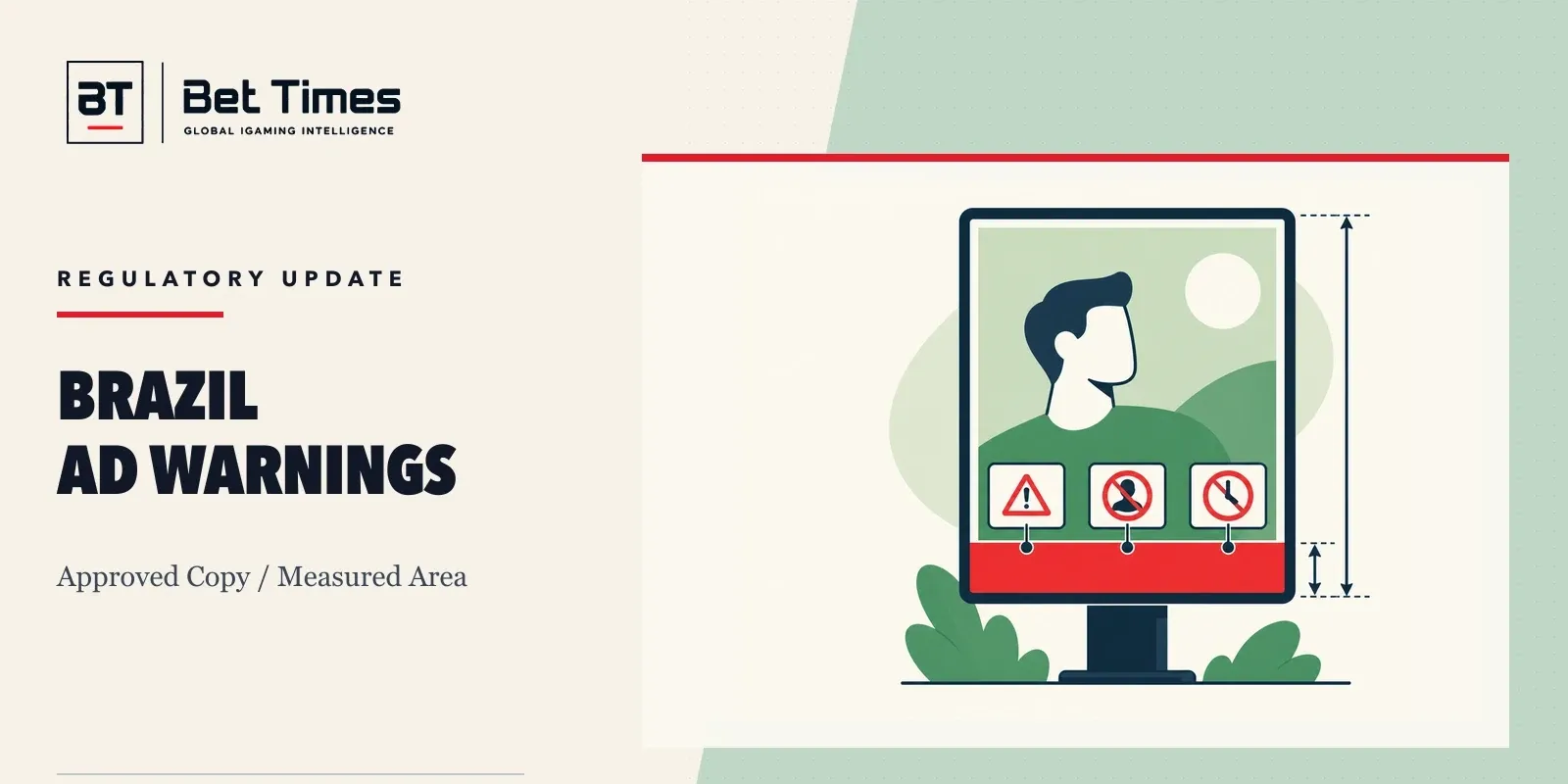
Brazil made risk warnings mandatory in fixed-odds betting advertising from 17 July 2026. Under SPA/MF Ordinance 1,964, an advertisement must show one of three approved warnings horizontally, clearly and legibly, using at least 10% of the advertisement's area.
This update is for authorised operators, agencies, affiliates, media owners and analysts checking the new rule. It summarises the Ministry of Finance announcement and the two July ordinances. It does not approve a campaign, classify every format, or replace current Brazilian legal and consumer-protection advice.
What changed
The Brazil Ministry of Finance announced two new ordinances published in July 2026. SPA/MF Ordinance 1,964 adds mandatory risk-warning presentation to fixed-odds betting advertising. Interministerial Ordinance 73 addresses the wider advertising chain and prohibited practices.
The Ministry published its news summary on 13 July and updated it on 15 July. It said the warning rules would enter into force on 17 July. Campaign records should preserve both the legal effective date and the creative approval date.
The change affects more than copy. The 10% area, horizontal placement, clarity and legibility requirements make layout and format part of compliance.
The three permitted warning messages
| Role | What it means | Where to verify |
|---|---|---|
| Addiction risk | Ministério da Fazenda adverte: Apostar pode causar dependência | The Ministry of Finance warns that betting can cause addiction. |
| Loss risk | Ministério da Fazenda adverte: Apostar faz você perder dinheiro | The Ministry of Finance warns that betting makes you lose money. |
| Investment claim | Ministério da Fazenda adverte: Aposta não é investimento | The Ministry of Finance warns that betting is not an investment. |
An advertiser must use an approved message rather than writing a softer substitute that changes the required meaning. The article reproduces the short official wording because exact campaign compliance depends on the legal text.
Translations can help international teams understand the rule, but the Brazilian creative should be checked against the required Portuguese form and any format-specific instructions.
How the 10% rule changes design
The Ministry says the message must appear horizontally, clearly and legibly and occupy at least 10% of the advertising area. That creates a measurable creative constraint rather than a generic instruction to include responsible-gambling language somewhere.
A production workflow should calculate the area for every exported aspect ratio. A warning that passes on a square design can become too small after cropping to a story, banner or video-safe frame. Resizing only the canvas without resizing the warning region can break the ratio.
Legibility also depends on contrast, type size, motion, duration and background. Meeting an area percentage does not cure text that is hidden by controls or impossible to read during playback.
Which advertising chain is affected
The Ministry says responsibility extends to authorised operators and all agents involved in dissemination. Interministerial Ordinance 73 is implemented across the Ministry of Finance, Ministry of Justice and Public Security, and the federal communications structure described in the announcement.
That means creative, media buying, publishing, influencer content, affiliate placements and operator approval cannot be treated as isolated activities. Each organisation should know which entity authorised the campaign, which .bet.br brand it promotes, and who verifies the final live rendering.
The BETTIMES Brazil authorisation guide explains the company, CNPJ, brand and domain check. A compliant warning does not make an unauthorised destination lawful.
Misleading promotion and unauthorised platforms
The government summary says advertising that can mislead consumers is prohibited. It also identifies promotion of unauthorised brands, applications, websites or profiles as prohibited conduct.
Campaign QA should therefore verify the exact landing hostname, not only the name in the artwork. Redirects, tracking links and app-store destinations need to resolve to the authorised brand and recorded .bet.br domain.
The BETTIMES licence verification guide provides a reusable hostname-first method. The Brazil licence profile links to the current SPA source set.
Limits on expert and commentator promotion
The Ministry's summary says expert or commentator remarks that encourage bets on a specific game or event are prohibited. That language matters for sports broadcasts, previews, social content and creator scripts.
An informational discussion of odds or a market is not automatically the same as a call to place a wager, but campaign teams should not invent a safe boundary from this summary alone. The exact legal text and consumer-protection interpretation govern the format.
Editorial content and paid promotion should also be distinguishable to the audience. This BETTIMES article is an independent regulatory report and contains no operator offer or betting recommendation.
Protection of minors
The announcement says advertising directed at people under 18 is abusive. It prohibits images, characters, language or other elements that appeal to minors and placements in environments predominantly attended by minors, such as schools and child-care locations.
Audience controls are part of the evidence, but they do not excuse child-appealing creative. Conversely, an adult-looking design does not cure distribution in an unsuitable environment.
Operators and publishers should retain creative files, audience settings, placement lists and approval records so a review can reconstruct both message and delivery.
A campaign QA checklist
- Confirm that the promoted legal entity, brand and .bet.br domain are in the current SPA register.
- Select one of the three exact warning messages authorised by the ordinance.
- Reserve at least 10% of every final advertisement area for the horizontal warning.
- Test contrast, legibility, duration and overlays in the live format.
- Review the creative for misleading claims, investment framing and event-specific encouragement.
- Check age targeting, placements and child-appealing elements.
- Archive the final asset, dimensions, landing URL, approval and publication dates.
This checklist supports review but does not replace the ordinances or a format-specific legal decision.
What the announcement does not answer
The Ministry news page does not provide a universal pixel size, video duration or typography safe harbour for every platform. It also does not decide how each borderline editorial, organic or commercial communication will be classified.
Teams should therefore read SPA/MF Ordinance 1,964 and Interministerial Ordinance 73 in full and preserve later official guidance.
BETTIMES will update this article if the authorities publish material format interpretations or enforcement examples.
Why this matters for SEO and affiliate pages
Search and affiliate landing pages can function as advertising when they promote an operator or offer. The warning, authorisation and misleading-claim rules should therefore be assessed at page and placement level, not only in paid social banners.
A site template can help enforce the 10% area and exact message, but a component is only effective if every relevant page uses it and if responsive layouts preserve its size. Automated screenshots can provide useful release evidence.
The BETTIMES operator licence tracker and regulated market monitor can support entity and market checks before a page goes live.
Frequently asked questions
When did Brazil's new betting ad warning rule start?
The Ministry of Finance announced that the mandatory warning requirements would take effect on 17 July 2026. SPA/MF Ordinance 1,964 is dated 3 July, and the government news summary was published on 13 July and updated on 15 July. Campaign records should preserve the effective date.
How large must the warning be?
The government summary says the warning must occupy at least 10% of the advertisement's area. It must also appear horizontally, clearly and legibly. Designers should calculate the requirement for every final aspect ratio and verify the live rendering after platform cropping, overlays or responsive changes.
Can an advertiser write its own warning?
The ordinance requires one of three approved messages addressing addiction, losing money or betting not being an investment. A softer paraphrase can change the legally required wording. International teams can use translations internally, but Brazilian campaign assets should be checked against the official Portuguese text.
Does a warning make any betting ad compliant?
No. The same announcement reinforces restrictions on misleading promotion, unauthorised platforms, event-specific encouragement by experts or commentators, and advertising directed at minors. The promoted operator, brand and domain must also belong to the authorised federal market. All relevant controls must be reviewed together.
Do the rules apply only to operators?
The Ministry says responsibility is broadened across those involved in disseminating fixed-odds betting advertising. Agencies, publishers, affiliates, creators and media intermediaries should map their role and approval evidence. The exact legal responsibility in a specific case depends on the ordinances and applicable consumer law.
The current position
From 17 July 2026, Brazilian fixed-odds betting advertising needs one approved horizontal warning occupying at least 10% of the ad area. That measurable requirement sits beside authorisation, misleading-claim, unauthorised-platform and minor-protection rules. Every final format and landing domain needs its own check.