
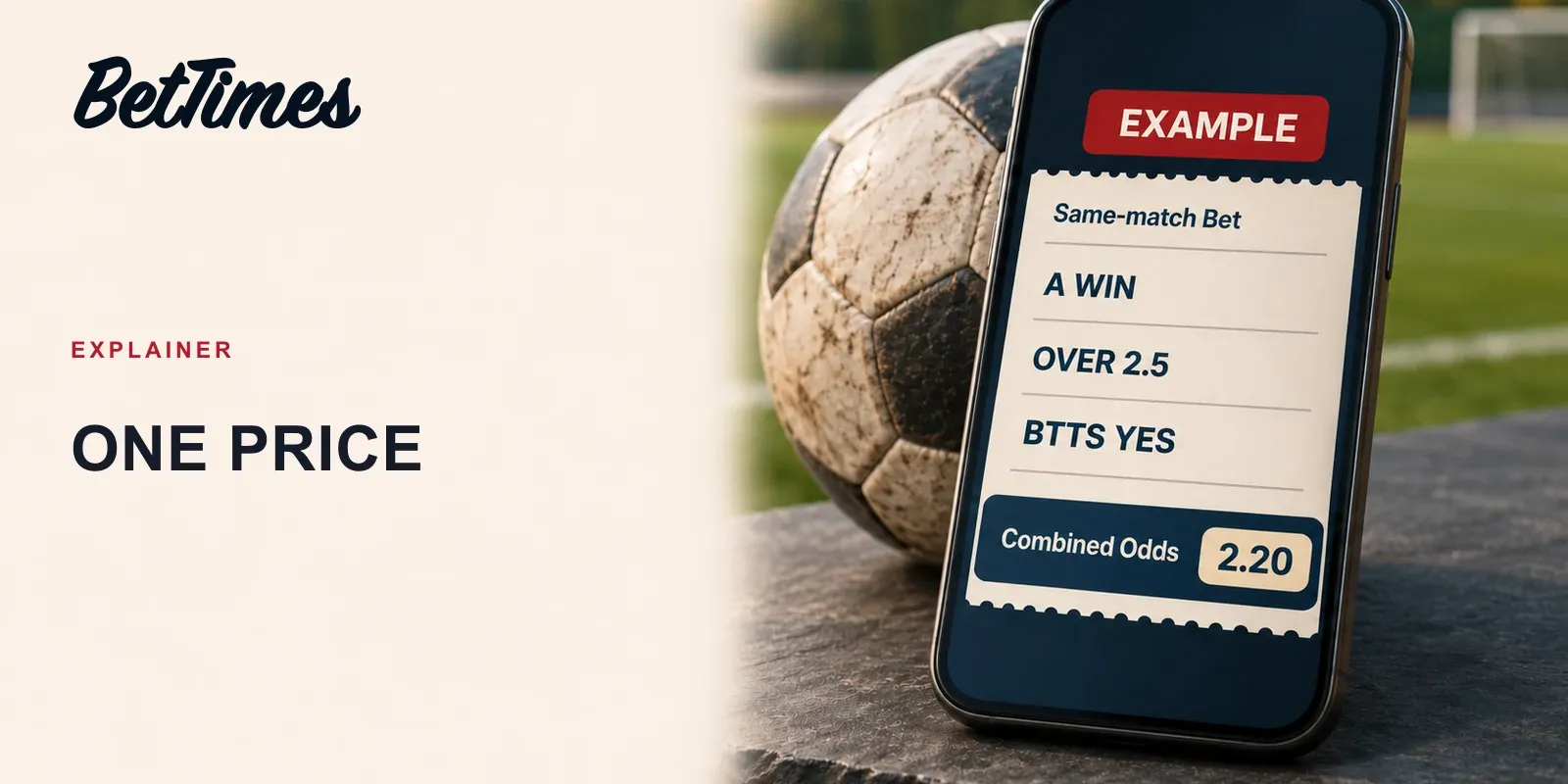
A bet builder combines several conditions from one sporting fixture into a single priced bet. The selections can depend on each other, so multiplying their separate prices may give the wrong combined price. Read the accepted combination, its quoted odds and each market's settlement period together.
For readers checking a betting receipt, this guide explains the product before any selection becomes void. It uses English-language Betfair, bet365 and Paddy Power help pages reviewed on 4 November 2026. The matches, probabilities and cash figures below are invented teaching examples. We have not tested an account, live pricing system or payout.
What does a bet builder combine?
A football ticket might require Team A to win, more than 2.5 goals in the match and both teams to score. Those are three conditions on one fixture. A single £10 stake on that combination does not create three £10 singles. It buys one bet whose return depends on the required combination being satisfied under its terms.
bet365's en-GB explanation describes a same-fixture product with a price calculated for the combined selections. It also distinguishes that component from a wider multiple containing other fixtures. The distinction matters when reconstructing how much was staked and what the quoted return actually covers.
Keep the product label. A receipt may contain separate singles, an ordinary accumulator, a same-fixture builder or a multiple containing a builder. Similar-looking rows can belong to different tickets. Our guide to sportsbook settlement records follows the connection between the accepted bet and the eventual account credit.
The period is part of each condition. Betfair's Bet Builder help page says its football bets apply to 90 minutes, while noting that some in-play markets, such as lifting the trophy, can extend beyond that scope. An extra-time result cannot silently replace the period on an accepted match-result selection.
Why bet builder odds do not simply multiply
Two selections are dependent when knowing that one happened changes the probability of the other. A team winning and the same team scoring are connected parts of the match. Having separate market names does not establish that their probabilities are independent.
bet365 says its builder pricing considers the individual markets and whether they affect one another. That describes the pricing principle; it does not publish a complete model from which a reader can recreate every quote. A displayed single price and a combined price therefore answer different questions.
Consider an invented probability model for just two conditions: Team A wins, and the match has more than 2.5 goals. Assign the following probabilities. These assumptions describe no real fixture, team or bookmaker's forecast.
| Hypothetical match outcome | Assumed probability |
|---|---|
| A wins and the match has over 2.5 goals | 40% |
| A wins and the match does not have over 2.5 goals | 10% |
| A does not win and the match has over 2.5 goals | 20% |
| A does not win and the match does not have over 2.5 goals | 30% |
The four rows sum to 100%. A wins in 50% of this model, and the goals condition succeeds in 60%. Multiplying 0.50 by 0.60 gives 0.30. Yet the table explicitly assigns 0.40 to both conditions happening together. Treating the events as independent would contradict the assumed model.
The conditional calculation explains the difference: among the outcomes in which A wins, the goals condition succeeds with probability 0.40 ÷ 0.50 = 0.80. Thus the joint probability is 0.50 × 0.80 = 0.40. This is arithmetic on declared assumptions, not an estimate of a match.
Ignoring margin and all other pricing adjustments, the reciprocal of 0.40 is decimal 2.50; the reciprocal of the incorrectly multiplied 0.30 is approximately 3.33. Neither number is an available offer. The example shows why a combined quote needs information about the relationship between the selections. Our odds-format explainer covers how decimal prices express a cash return.
Compatible conditions still need an offered price
Dependence and incompatibility are different issues. Team A winning and over 2.5 goals can both happen. Under 2.5 match goals and a player scoring three goals in that same match cannot both happen under ordinary goal counting.
Paddy Power's builder guide uses that latter example to explain a rejected combination. Betfair also says some markets are ineligible and some selections cannot be combined because their results conflict. A builder tab is a product-specific list of offered combinations, rather than a promise that every market on the fixture can be added.
Paddy Power's general rules, under Multiples, distinguish ordinary multiple bets from builders and restrict related contingencies outside the builder product. That is a named operator's rule. An accepted builder price should not be reconstructed by placing its conditions into an unrelated multiple-bet calculator.
Follow one stake through a completed ticket
Now use a separate invented cash ticket: £10 on Team A to win, over 2.5 match goals and both teams to score, at an accepted combined decimal price of 2.20. This price is a teaching input, unrelated to the two-condition probability model above. All three selections use the same 90-minute period including stoppage time. Assume the fixture completes normally, no selection is void, and no fee, promotion or payout adjustment applies.
| Fictional score, A first | A wins | Over 2.5 goals | Both teams score | Gross ticket return |
|---|---|---|---|---|
| 3-1 | Yes | Yes | Yes | £22 |
| 2-0 | Yes | No | No | £0 |
| 2-1 | Yes | Yes | Yes | £22 |
| 2-2 | No | Yes | Yes | £0 |
In either winning row, £10 × 2.20 gives a £22 gross return, including the original stake. Profit is £22 minus £10, or £12. In either losing row, the £0 return leaves a £10 loss. There is no separate £10 payment for each correct condition.
These are alternative score scenarios for one ticket, not four simultaneous bets or a forecast of how often the bet wins. The four scores are not equally likely merely because they occupy equal-sized table rows. A price calculation and a probability estimate must be kept separate.
A builder inside a multiple has two levels
A wider ticket can use the same-fixture builder as one component and add selections from other fixtures. Paddy Power describes its Bet Builder+ in those terms. The cited bet365 page permits builders within multiples, with the other selections outside that builder's fixture. Product names and permitted combinations need to be read on their own terms.
Suppose a second invented receipt expressly records a two-component cash double: a builder priced at 2.20 and an eligible separate-fixture selection at 1.50. If the receipt confirms combined decimal odds of 3.30 and a £10 stake, a completed winning ticket returns £33, giving £23 profit before other adjustments. This is a new example, not an extra return on the earlier £10 ticket.
The three conditions inside the builder have already contributed to its 2.20 quote. Multiplying their separate market prices into 3.30 again would count them a second time. Retain the receipt's component structure before checking the final arithmetic.
Voiding needs a separate rule check
Betfair's cited help page says a void builder selection leaves the bet running at the remaining combined price. bet365's cited page describes recalculation for selected pre-match player-market cases and whole-bet void or push treatment elsewhere. Those descriptions cannot be collapsed into one universal rule.
Our same-game parlay void-leg guide owns the detailed residual-price question. It explains why dividing the original quote by a standalone leg price can be unsupported. The completed-ticket table above supplies no method for repricing a changed combination.
Keep the combination with its price
For an auditable record, retain the ticket ID, the fixture, every accepted condition and its period, the combined decimal price, the cash stake and the applicable product rules. If the builder sits inside a multiple, retain that outer receipt too. A screenshot of the list of selections without its price and stake leaves the return calculation incomplete.
For a later settlement query, add each final selection grade and the account credit. Ask for the rule and pricing record behind any change to the accepted combination. That evidence is more useful than a fresh quote obtained after the match or a list of prices taken from unrelated singles.
A correct reading of a receipt does not make its stake safe. Gambling can cause financial harm; participation is restricted by age and local law. See our responsible-gambling information for further context.