
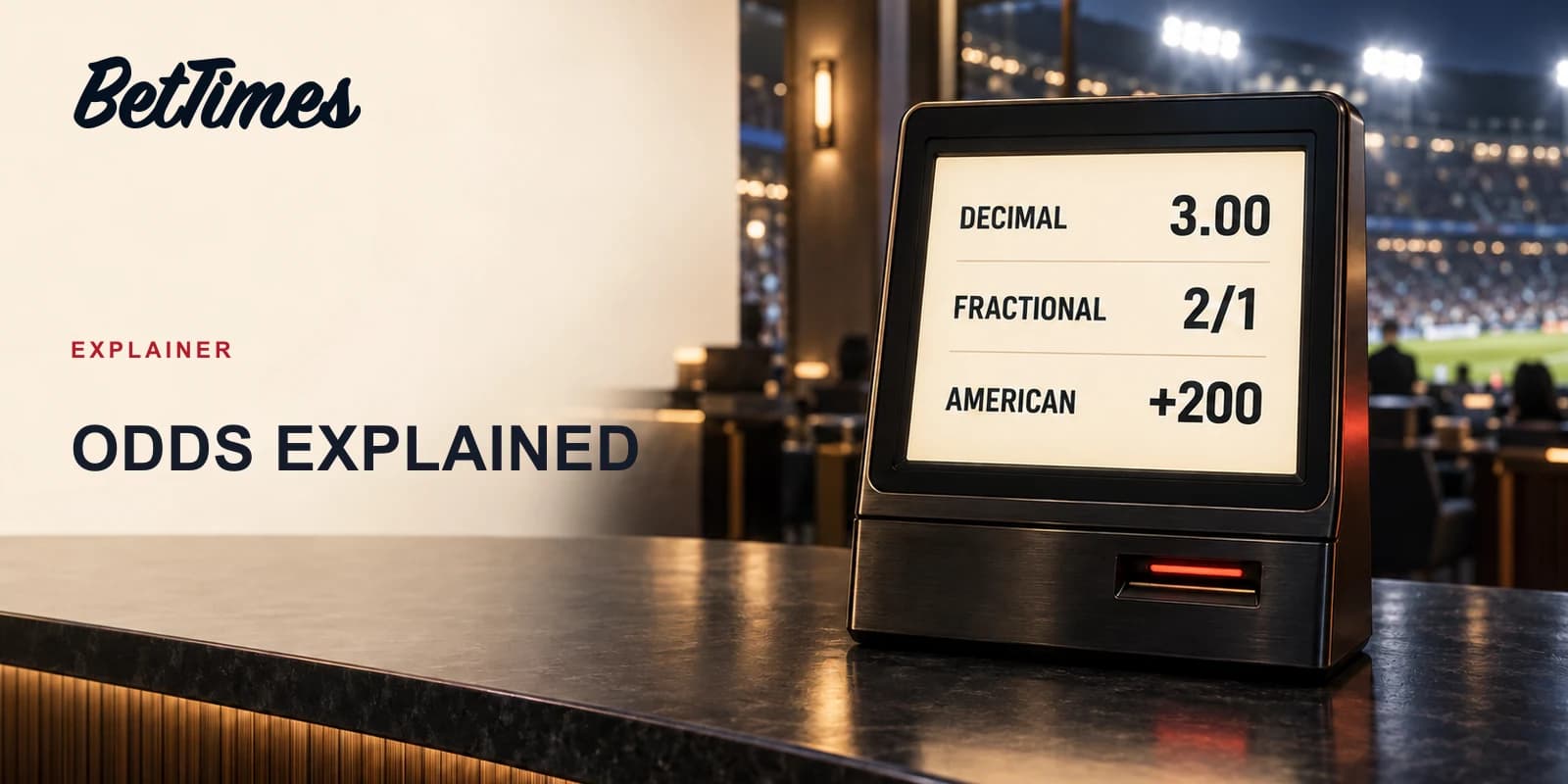
Betting odds describe the price of a bet and its return if it wins. Decimal odds include the original stake; fractional odds show profit relative to that stake; American odds express profit or stake against a reference amount of 100. Different formats can describe exactly the same price. DraftKings explains these three conventions.
For a reader comparing sportsbook displays, the useful question is: how much is profit, and how much is the total returned? At 3.00, 2/1 or +200, a hypothetical 10-unit winning stake earns 20 units of profit and returns 30 units altogether.
This guide covers an ordinary single back bet placed with cash: backing a selection to win, without fees, taxes or promotional adjustments. It does not calculate accumulator payouts, each-way bets, lay liability or special settlement cases. All examples are hypothetical, not current event prices or suggested stakes. A unit is simply one unit of the account's currency.
Profit and total return are different amounts
The stake is the amount committed to the bet. Profit is the gain after subtracting that stake. Total return on a winning bet is the profit plus the stake returned.
That distinction matters when a bet slip labels an amount as a payout, return or winnings. Read the label and its definition rather than assuming it means profit. Betfair's worked sportsbook examples separate profit from the stake included in a decimal return.
For the ordinary bet described here, a loss loses the stake: it does not produce the winning return shown below. Voids, deductions and other adjustments depend on the applicable bet-settlement rules.
The same price in three formats
Both rows use a hypothetical 10-unit stake and assume the bet wins without deductions.
| Decimal | Fractional | American | Stake, units | Profit, units | Total return, units |
|---|---|---|---|---|---|
| 3.00 | 2/1 | +200 | 10 | 20 | 30 |
| 1.50 | 1/2 | -200 | 10 | 5 | 15 |
The format changes how the price is written, not the underlying payout. In the second row, the minus sign does not mean a negative return or that 200 units must be staked. It is part of the American pricing convention.
How to read decimal odds
Decimal odds are a multiplier for the total return on a winning stake. If S is the stake and D is the decimal price:
- Total return = S × D.
- Profit = S × (D − 1).
At 3.00, the calculation is 10 × 3.00 = 30 units returned; subtract the 10-unit stake to get 20 units of profit. At 1.50, the return is 15 units and the profit is 5 units. The stake is included once, not added to the decimal return again.
How to read fractional odds
Fractional odds a/b express a profit ratio: a units of profit for each b units staked. The numerator, a, is the profit side; the denominator, b, is the stake side.
- Profit = S × a/b.
- Total return = S × (1 + a/b).
At 2/1, profit is twice the stake. At 1/2, profit is half the stake. Thus the 10-unit examples produce 20 and 5 units of profit respectively. DraftKings' fractional explanation uses this profit-to-stake convention.
How to read American odds
American odds, also called moneyline odds, use a signed number. A positive quote shows profit per 100 units staked. A negative quote shows the reference stake needed for 100 units of profit. These are ratios, not instructions to place a 100-unit bet. DraftKings' American-odds explanation describes both signs.
- At +200, profit is S × 200/100. A 10-unit stake therefore earns 20 units if it wins.
- At -200, profit is S × 100/200. The same stake earns 5 units if it wins.
Use the absolute value of a negative quote in the denominator: for -200, that value is 200. Then add the original stake to calculate total return.
Converting American and fractional odds to decimal
Converting to decimal puts all three formats on the same total-return basis:
- Fractional a/b: D = 1 + a/b.
- Positive American +A: D = 1 + A/100.
- Negative American -A, where A is the positive magnitude: D = 1 + 100/A.
The results are 1 + 2/1 = 3.00; 1 + 200/100 = 3.00; and 1 + 100/200 = 1.50. At evens, 1/1 and +100 or -100 correspond to decimal 2.00.
What implied probability does, and does not, tell you
Implied probability is a price expressed as a percentage. For decimal odds D, calculate 100/D. For fractional a/b, the equivalent calculation is 100 × b/(a + b). Smarkets publishes the implied-probability formulas for all three formats.
Our examples give 100/3 = approximately 33.33%, and 100/1.5 = approximately 66.67%. Those percentages come from the quoted prices. They are not independently measured chances or predictions of what will happen.
For an ordinary cash bet without deductions, that reciprocal is also the break-even win rate in a simplified repeated-bet calculation at that price. It does not establish that the actual win rate will meet it. A shorter price cannot make an outcome certain.
Why a complete market can add up to more than 100%
Consider a hypothetical two-outcome market quoted at decimal 1.90 on each outcome. Assume the outcomes are mutually exclusive and exhaust all possibilities, and both prices are recorded at the same time.
Each price implies 100/1.90 = approximately 52.6316%. Their sum is approximately 105.2632%. The excess above 100% is the overround: approximately 5.2632 percentage points, usually shown rounded to 5.26%. Smarkets explains summing the reciprocal prices across a market.
An incomplete selection list or prices taken at different times will not produce that same market snapshot. Overround is a property of the quoted prices, not a guarantee of realised bookmaker profit. Sportsbook hold and theoretical margin explains why actual revenue also depends on the bets accepted and their results.
Rounded displays can hide small differences
American -110 converts to 1 + 100/110 = 1.909090… in decimal, or 10/11 in fractional. A two-decimal display may show 1.91, but that rounded number is not the exact conversion. Calculating from 1.91 rather than the underlying quote can therefore produce a slightly different return.
Changing the display format is not the same as accepting a new price. Check the accepted ticket and the operator's rules on which format governs settlement and how amounts are rounded. In Great Britain, the Gambling Commission's RTS 2 transaction-display guidance lists accepted odds among relevant bet information and says the rules must identify the format that takes precedence in settlement. This is a British regulatory example, not a universal rule for every country.
Checks before relying on a displayed return
- Confirm the selected outcome, market and accepted price, not just the earlier screen price.
- Separate the stake, profit and total return. Check the account's currency and the labels used on the slip.
- Read applicable deductions, fees and settlement exceptions; our examples exclude them.
- Check whether the transaction is an ordinary back bet. An exchange lay bet creates a different liability, explained in betting exchange versus sportsbook.
The practical takeaway is the same in every format: translate the accepted price into profit and total return, then check the conditions attached to those amounts. Understanding the notation does not make a bet safe or profitable.
Frequently asked questions
What is +200 in decimal odds?
+200 equals decimal 3.00 and fractional 2/1. On a hypothetical winning 10-unit cash stake without deductions, profit is 20 units and total return is 30 units. The +200 figure describes profit per 100 units staked; it is not the total return.
Is -200 better than +200?
Neither sign makes a bet inherently better. They describe different prices: -200 equals decimal 1.50, while +200 equals 3.00. For the same winning stake, +200 returns more. Price alone does not establish the actual probability of either selection winning or make a recommendation appropriate.
Does implied probability predict the result?
No. It is calculated from the quoted odds. It can include the bookmaker's pricing margin and should not be treated as a verified forecast. Our hypothetical 1.90/1.90 market illustrates the distinction: the implied percentages total more than 100%, although its two outcomes are exhaustive.
Only adults of the legal gambling age in their location should gamble, and only where it is lawful. Gambling can lose money. These calculations explain notation; they are not betting advice or an income strategy.