
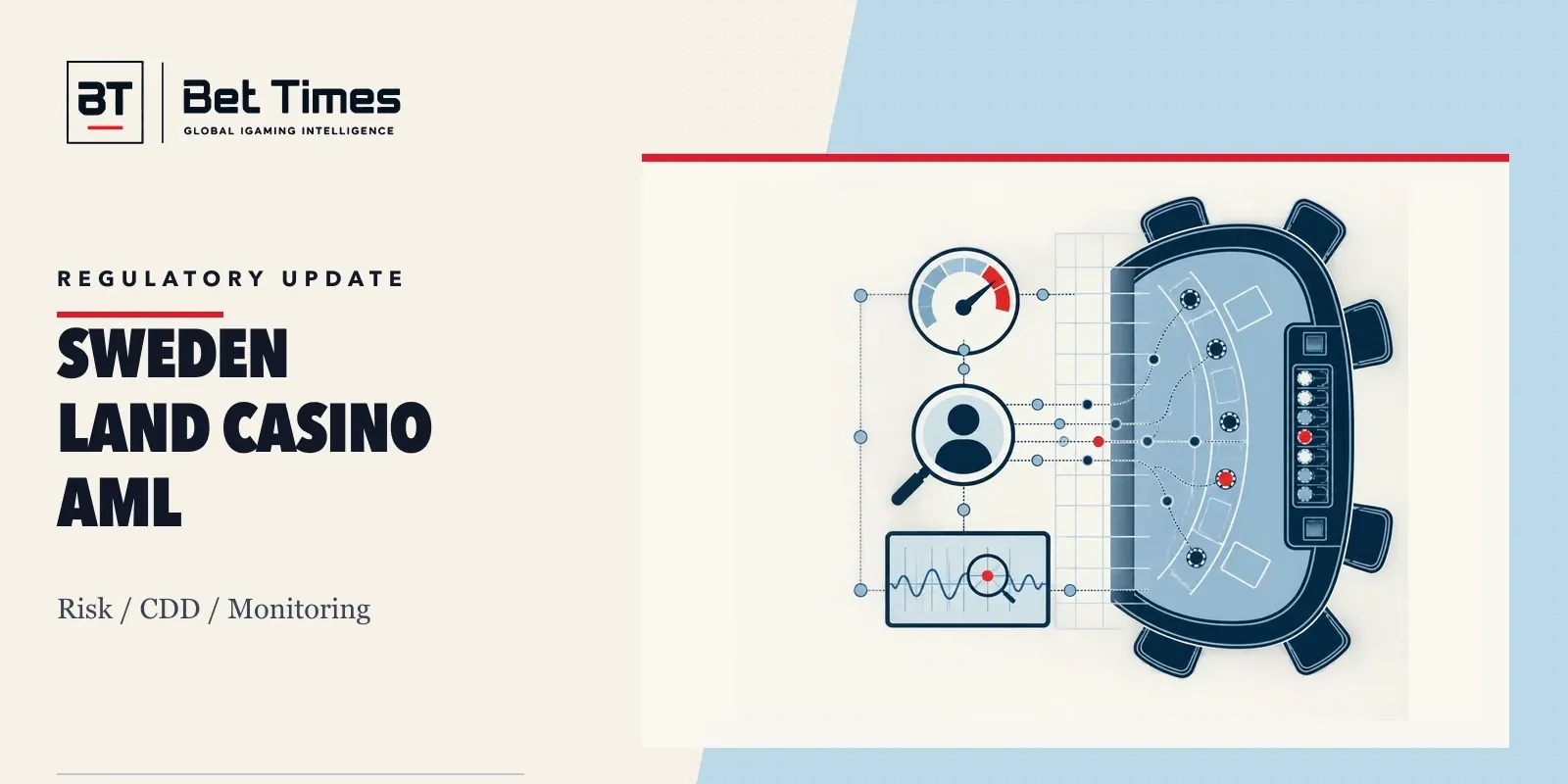
Sweden brought land-based commercial casino games under its anti-money-laundering framework from 1 September 2026. Spelinspektionen removed the product's previous exemption after an updated risk assessment concluded that its money-laundering risk could no longer be treated as low.
This update is for Swedish licensees, compliance teams, suppliers and analysts. It explains the new scope, the risk-based duties and the remaining player-registration exception. It does not assess a named venue, provide Swedish legal advice, or treat registration under gambling law and customer due diligence as identical.
What changed on 1 September
Spelinspektionen announced the change on 31 August 2026. The authority amended SIFS 2019:2, its regulations and general advice on measures against money laundering and terrorist financing.
The amendment removes the earlier exemption for land-based commercial casino games. The regulator said an updated risk assessment showed that the money-laundering risk in this product could no longer be regarded as low.
The effective date was the next day, so affected licensees needed controls ready by 1 September rather than only a future implementation plan.
Scope and continuing exceptions
| Role | What it means | Where to verify |
|---|---|---|
| Does the AML framework apply? | Yes, to land-based commercial casino games in the stated category. | The previous product exemption was removed. |
| Must the licensee assess business risk? | Yes. The authority lists a general risk assessment as a core duty. | The assessment should drive proportionate controls. |
| Is routine player registration under gambling law required? | The separate exception remains. | This does not remove AML customer-due-diligence needs. |
| Can customer information still be recorded? | Yes, where needed to meet AML obligations. | Gambling-law registration and AML identification are different legal functions. |
| Are online products the subject of this change? | No. The announcement specifically addresses land-based commercial casino games. | Online casino and betting were already part of wider AML guidance and supervision. |
This table prevents the most likely misunderstanding: removal of the AML exemption did not automatically remove every other product-specific exception.
Why the risk assessment changed
The regulator's announcement says its updated assessment no longer viewed the product's money-laundering risk as low. Land-based games can involve cash, repeated transactions, winnings and customer behaviour that require a current risk analysis.
A sector classification does not mean every customer or transaction is high risk. The purpose of a risk-based approach is to identify where exposure is higher and apply more extensive measures there.
The BETTIMES AML explainer describes the same general architecture in online gambling. The Swedish change shows that the control logic also depends on product and channel.
Duties listed by Spelinspektionen
The authority says affected licensees must make a general risk assessment, know customers and assess customer risk, establish procedures and guidelines, train staff, and maintain ongoing monitoring procedures.
These components form a system. The general assessment identifies how products, customers, distribution and geography can create exposure. Customer due diligence and monitoring then produce evidence and decisions at case level.
The official AML guidance also addresses records, model risk, internal control and reporting. The precise application should be checked against current law and regulations.
Registration versus customer due diligence
The regulator explicitly says the exception from player registration under gambling-law rules remains. It then explains that licensees may still need to register or record customers in another way to satisfy AML customer-due-diligence requirements.
This is not a contradiction. One rule concerns a general player-registration requirement for the product. The other concerns risk-based identification and knowledge needed to prevent money laundering and terrorist financing.
Systems and staff training should use clear labels for each purpose. Treating the exception as a blanket no-identification rule would miss the regulator's warning.
What a land-based control system needs
Land-based implementation has practical challenges that differ from a fully registered online account. A venue needs a way to recognise events, connect relevant activity, ask proportionate questions and retain evidence without assuming that every visitor follows one continuous digital identity.
Cash handling, chip or credit movement, repeated visits, prize payments and unusual play can all be relevant inputs depending on the business assessment. One indicator does not prove money laundering, but the system must support review and escalation.
The BETTIMES transaction monitoring guide maps event, alert, investigation and record. The same stages can inform design even though data capture differs by channel.
A practical implementation checklist
- Update the general risk assessment for land-based commercial casino games.
- Map cash, payment, play and prize events that can create AML exposure.
- Define when customer identification or additional due diligence is required.
- Train venue staff to recognise indicators and escalate without making accusations.
- Establish ongoing monitoring and link repeated or connected activity where lawful.
- Record decisions, reports, owners and review dates.
- Test the control after implementation and update it as risk changes.
The checklist is an operating aid, not a substitute for SIFS 2019:2, the Swedish AML Act or regulator guidance.
Relationship to Sweden's online market
The 31 August announcement concerns land-based commercial casino games. Swedish commercial online gambling and online betting already sit within the AML control environment addressed by Spelinspektionen's guidance.
Market reports should keep the channels separate. A rule change for land-based restaurant casino games should not be described as a new online-casino licence requirement.
The BETTIMES Sweden market profile gives the wider licensing context, while the Swedish commercial online gambling licence profile covers the online permission.
The 2027 EU AML framework
The authority notes that a new European AML framework is expected to apply from 10 July 2027, including the AMLA regulation, the directly applicable AML regulation and a new directive for national mechanisms.
The 2026 Swedish change should not be delayed in anticipation of 2027. Licensees need to comply with the current framework while tracking technical standards and implementation work for the later package.
The article records the future date as regulator-provided context, not as a complete summary of every transition or national amendment.
What remains unknown
The news release does not publish a list of every affected venue, prescribe one universal transaction threshold, or describe enforcement outcomes against a named licensee. It announces scope and core duties.
Implementation will vary with business size, activity, customer and payment risk. BETTIMES does not infer that one control design fits every venue.
Future supervisory decisions may show how the authority tests the new scope. Those decisions should be added with their own dates and facts rather than projected from the announcement.
Frequently asked questions
Which Swedish gambling product entered the AML framework?
The change applies to land-based commercial casino games under Chapter 9 of the Gambling Act. Spelinspektionen removed that product's previous exemption from the AML framework from 1 September 2026. The announcement is not a new licence rule for Swedish online casino or online betting.
Why did the regulator remove the exemption?
Spelinspektionen says an updated risk assessment concluded that the money-laundering risk in land-based commercial casino games could no longer be considered low. The risk-based framework requires licensees to identify and assess exposure and apply more extensive measures where the risk is higher.
Must every player now be registered?
The separate exception from routine player registration under gambling law remains. However, the regulator says a licensee may still need to record or identify customers in another way to meet AML customer-due-diligence requirements. The two legal purposes should not be treated as the same rule.
What controls must licensees have?
The authority lists a general risk assessment, customer knowledge and risk classification, procedures and guidelines, staff training and ongoing monitoring. Current Swedish law, SIFS 2019:2 and regulator guidance determine the full detail. Controls should be proportionate and documented rather than based on one universal threshold.
When does the new EU AML framework apply?
Spelinspektionen says the new European package is expected to begin applying from 10 July 2027. The package includes a new EU authority and harmonised regulation and directive elements. Swedish licensees still need to comply with the current expanded scope from 1 September 2026.
The current position
Land-based commercial casino games in Sweden are now inside the AML framework. Licensees need risk assessment, customer-due-diligence, procedures, training and monitoring while preserving the distinction between routine gambling-law registration and identification required for AML. The effective date is 1 September 2026.