
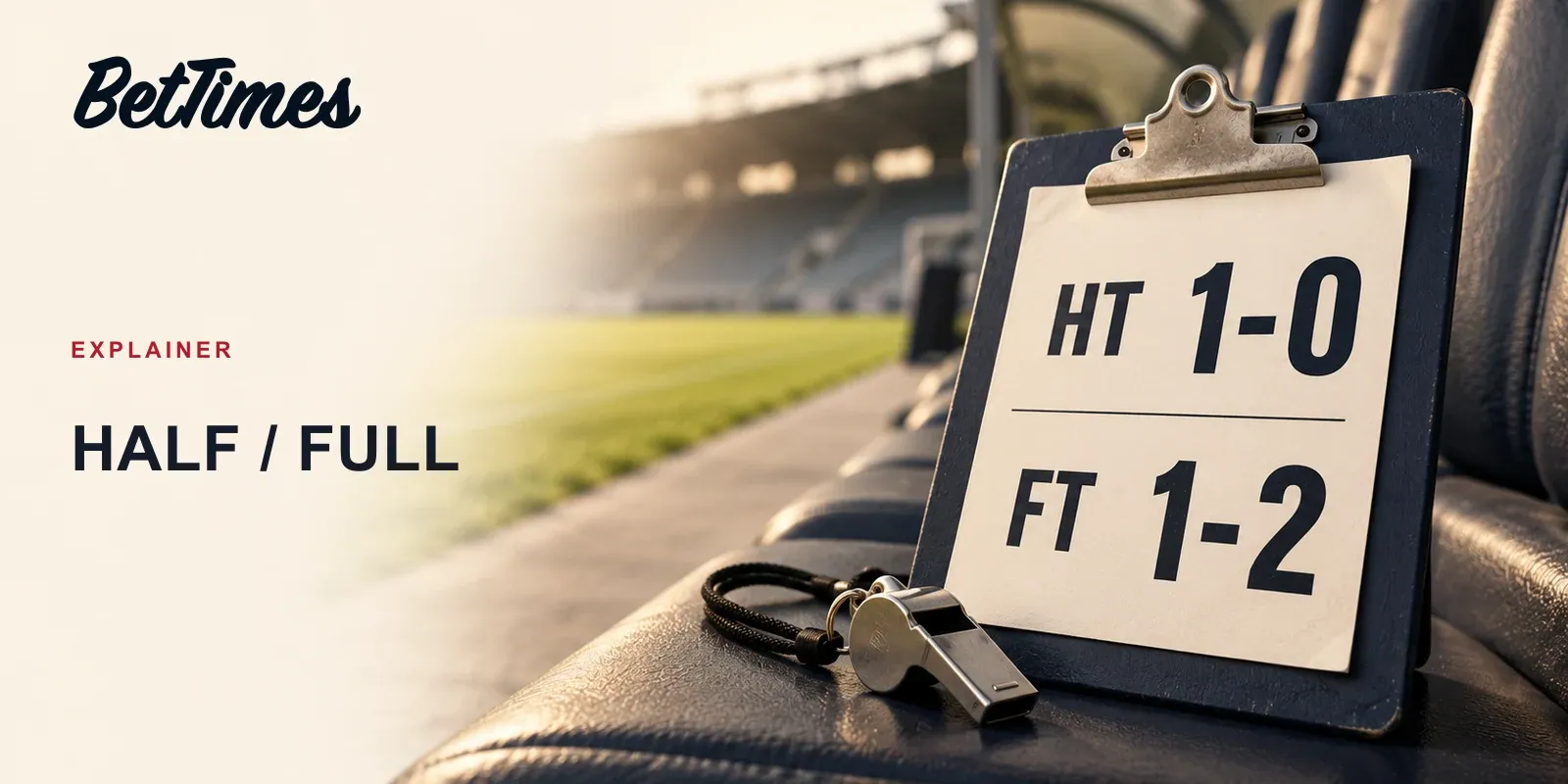
A home team leads 1-0 at the interval, then loses the match 1-2. That is H/A in the notation used here: Home at half-time, Away at full-time. A half-time/full-time bet, or HT/FT, combines those two results. Its second part concerns the whole covered match, not the second half in isolation.
Both parts of an affirmative HT/FT selection must be correct for it to win in an ordinary completed match. Getting the interval result right does not earn a partial payout on the selection. An exceptional void or adjustment is a separate rules question.
This guide is for readers decoding a receipt or checking its settlement. All matches below are invented examples, with no forecasts, current odds or suggested bets. The linked rules were reviewed on 22 October 2026. We did not place a wager or test an account; actual terms depend on the provider, product and country.
Decode the two positions in an HT/FT label
Sky Bet describes Half-time/Full-time as the match result at those two points. Its separate To Win Both Halves market instead asks whether the nominated team scores more in each individual half. The page expressly distinguishes the two markets.
Here, H means the home side, D means a draw and A means the away side. The character before the slash gives the interval outcome; the character after it gives the result when the covered match ends. H/A therefore does not mean that either side can win, and D/H is not another way to write H/D.
| Half-time outcome | Full-time: Home | Full-time: Draw | Full-time: Away |
|---|---|---|---|
| Home | H/H | H/D | H/A |
| Draw | D/H | D/D | D/A |
| Away | A/H | A/D | A/A |
These are nine possible combinations of the three interval outcomes and three final outcomes: 3 × 3 = 9. The grid lists meanings, not probabilities or nine recommended selections. A provider may display team names or different abbreviations, so establish its home/draw/away mapping before interpreting the receipt.
Full-time does not reset the score at the interval
Smarkets rule 12.5.4 defines half-time/full-time winners through the interval result and the end of regular time, with stoppage time at each boundary. The same document treats Second Half Result separately in rule 12.5.40.
To calculate a second-half-only score, subtract each side's interval goals from its full-time goals. Do not perform that subtraction for the second position of HT/FT. That position uses the cumulative result of the match.
| Half-time score | Full-time score | Second-half-only score | HT/FT result |
|---|---|---|---|
| 2-0 | 2-1 | 0-1 | H/H |
| 1-0 | 1-2 | 0-2 | H/A |
| 0-0 | 1-0 | 1-0 | D/H |
| 0-1 | 1-1 | 1-0 | A/D |
In the first row, the home side loses the second half but remains the overall winner. H/H is correct because it led at the interval and won the match. A separate requirement to win both halves fails in that example.
The second row is a comeback: the away team overturns a 1-0 deficit by scoring twice without reply after the break. H/A describes the two snapshots. The last row illustrates a different outcome: the home team wins the second half, but only draws the full match, producing A/D rather than A/H.
The scores assume completed normal-time fixtures, with home goals written first and no special settlement. They explain which condition occurred; they do not calculate promotional returns, exchange liability or a bet builder.
Added time belongs to the relevant snapshot
Betfair's football Sportsbook rules normally use 90 minutes together with officials' added time, excluding the separate extra-time period and shootout. The document also covers fixtures agreed to a different duration, so the event and market labels must be checked.
For a standard first-half snapshot, a goal at 45+2 before the interval whistle is first-half action. A 0-0 clock reading at 45:00 is therefore not enough to establish D as the first part. If the home side scores during that added time and the interval arrives at 1-0, the first part is H.
The same principle applies at the end of normal time. Suppose the fictional H/A comeback match remains 1-1 at 90:00, then the away side scores at 90+4 before the referee ends the period. The completed result is 1-2 and the second part is A, not the earlier D.
Extra time is different. If a cup match is 0-0 at half-time and 1-1 after normal time, the ordinary normal-time HT/FT result is D/D. An away goal during a subsequent extra-time period, or an away shootout victory, does not change that ticket to D/A. An expressly different period needs its own terms.
What interrupted and cancelled matches change
The Smarkets example has two clocks that should not be confused. Its general rules 6.1 and 6.3 anchor the relevant 36-hour limits to the originally scheduled start: completion for abandonment, and a postponed start for postponement. General rule 6.2 voids cancelled events. These provisions are subject to sports-specific rules.
Football rule 12.4 preserves unconditionally determined markets but otherwise voids affected markets when completion falls outside that framework. It also voids undetermined markets earlier if its data sources supply no resumption or replay information within three hours of postponement or abandonment. Later information about completion within 36 hours does not reinstate those voided bets.
Those are the named Smarkets rules, not an industry-wide waiting period. Preserve the original scheduled start, the interruption time and any restart announcement rather than starting a fresh 36-hour countdown whenever play stops.
A completed first half can determine a standalone half-time market while leaving the full HT/FT combination unresolved. If play is abandoned at 60 minutes, a correct interval prediction alone does not turn the HT/FT selection into a half-price winner or a standalone first-half bet. The relevant market's completion and void provisions still need to be applied.
Betfair's general Sportsbook introduction gives specific sports rules priority and separates Sportsbook from Exchange. Do not import Smarkets' deadlines into a Betfair ticket, or use a generic rule where the applicable football clause says something else. Our settlement guide explains how to trace the result behind an account entry.
Check both results against the accepted selection
An HT/FT check needs more than the eventual winner. Retain:
- The provider, product and complete market name, with its team-name or letter mapping.
- The confirmed interval score and the final score for the covered period, with home and away orientation unchanged.
- The accepted selection and settlement entry, including any void or adjustment explanation.
- For a disrupted fixture, the original schedule, event status, restart information and governing rule.
Goals questions can describe the same match differently. Our BTTS guide concerns goals from each side; the win-to-nil comparison concerns a victory without conceding. Neither replaces HT/FT's requirement for the interval result as well as the final result.
Frequently asked questions
Is HT/FT the winner of each half?
No. It combines the result at half-time with the result of the entire covered match. A home side leading 2-0 at the break and winning 2-1 produces H/H even though it lost the second half 0-1. Winning both halves is a separate condition.
What does D/A mean in a half-time/full-time bet?
In the notation used here, the teams are level at the interval and the away side wins the covered match. A fictional 0-0 interval followed by a 0-1 final result gives D/A. Check the provider's displayed labels; D/A and A/D describe different sequences.
Is an HT/FT bet settled at half-time if the first part is right?
The interval supplies only one required result. The full-time component still has to be resolved, subject to the applicable rules. A later abandonment does not automatically split the selection into two independently payable bets. Keep any early account credit or cash-out record separate from the final settlement explanation.
Read the full-match result, not a half's subtotal
Record the interval outcome first and the covered final outcome second. Check the provider's exception rules before grading disrupted play. This reconstructs the accepted condition without predicting a score or promising a return. Gambling involves losses, including the full amount staked, and is restricted to adults where legal. Our responsible-gambling page provides further information.