
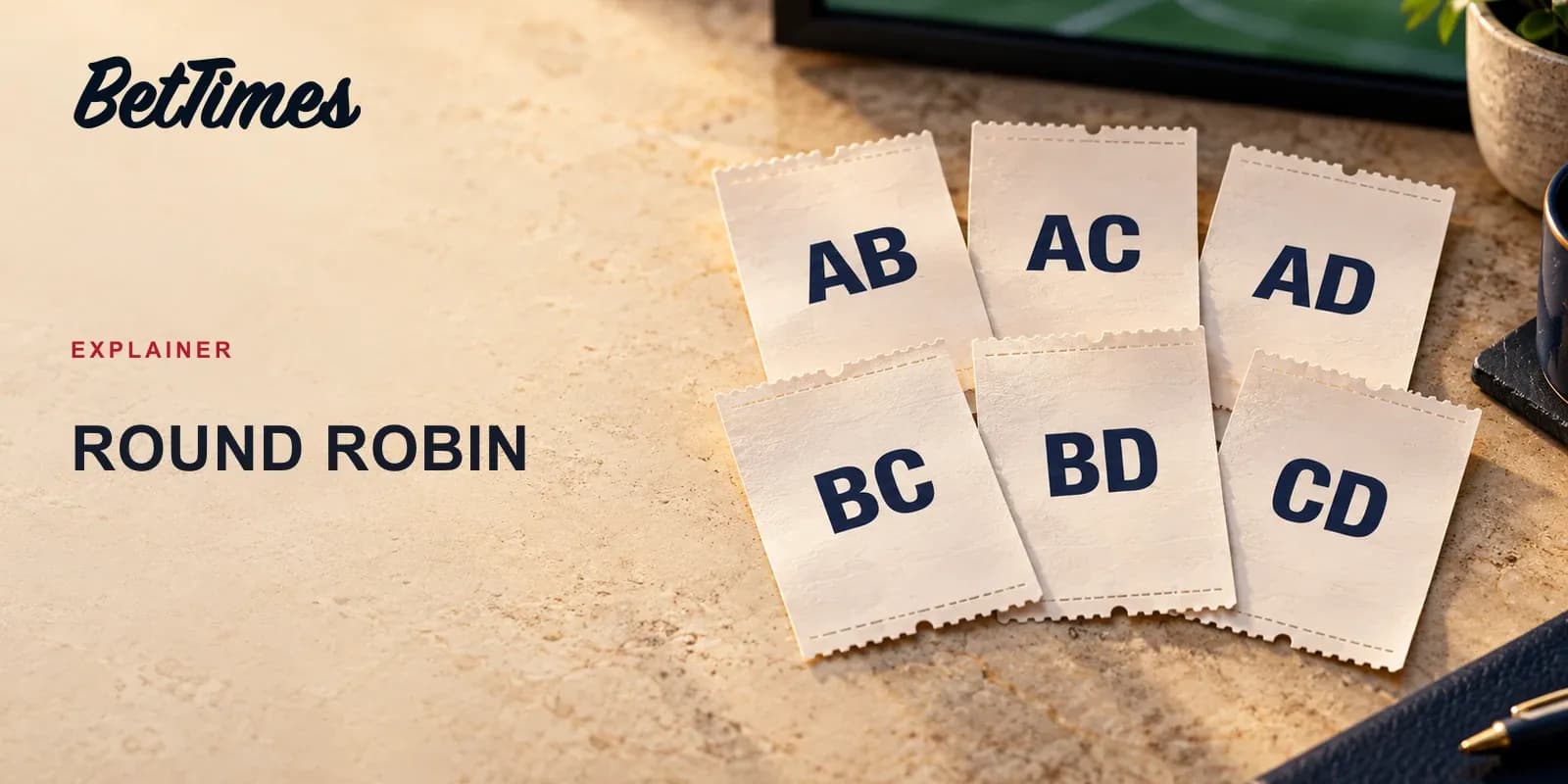
Four selections at £2 each can mean £8 in singles or £12 in a round robin of doubles. The difference is the number of funded bets. With selections A, B, C and D, the doubles are AB, AC, AD, BC, BD and CD: six lines, each requiring its own stake.
Round robin betting has more than one meaning. DraftKings' US help describes parlays built from chosen subsets of selections. Betfred's British guide uses the name for a particular ten-bet package on three selections. Identify the actual product before using a calculator; the name alone does not establish the combinations or the cost.
This guide checks the arithmetic of an accepted ticket. Operator documents were reviewed on 21 October 2026. All prices, stakes and outcomes below are invented cash-bet examples, not live offers or recommendations. No account or real-money wager was tested.
Which round robin does the ticket contain?
In DraftKings' US round-robin explanation, selecting two-pick combinations of three outcomes creates three separate parlays. Its all-combinations example adds the three-pick parlay, creating a fourth bet. The subset sizes selected determine what has been purchased.
For the ordinary separate-event model used here, AB is the same pair as BA. There is one AB double, not a second bet simply because the labels can be reversed. Each double needs both selections to win normally; a treble needs all three.
The Betfred British bet-type guide defines a different Round Robin: three doubles, one treble and three pairs of single-stakes-about bets. Each such pair contributes two funded bets, making ten in total. The single-stakes-about element reinvests a stake on the other selection when the first succeeds; it is not an ordinary independent single.
At a £1 unit, that named Betfred package costs £10. It must not be priced as three doubles costing £3, or as the four-line Trixie costing £4. Our Trixie and Patent guide explains those separate packages. The worked tables below cover selected subset parlays, not the British ten-bet product's reinvestment rules.
Count the chosen combinations before multiplying the stake
For n distinct eligible selections and a chosen line size k, the number of subsets is C(n,k) = n! / [k! × (n-k)!]. Count each unordered subset once. If several sizes are selected, add their line counts before multiplying by a uniform per-line stake.
For four selections, the six pairs are AB, AC, AD, BC, BD and CD. The four triples are ABC, ABD, ACD and BCD. ABCD is one four-selection line. These are different purchases, even when an interface groups them under one ticket.
| Chosen sizes from four selections | Component lines | Number of bets | At £2 per line, total outlay |
|---|---|---|---|
| Two only | AB, AC, AD, BC, BD, CD | 6 | £12 |
| Three only | ABC, ABD, ACD, BCD | 4 | £8 |
| Two and three | The six pairs plus four triples | 10 | £20 |
| Two, three and four | Those ten lines plus ABCD | 11 | £22 |
These counts assume every listed combination is eligible and accepted. Betfair's bet-type help describes permutation multiples and restrictions on related selections. A same-game offer or rejected combination cannot be reconstructed by blindly applying the formula to every item on screen. Use the funded lines on the final receipt.
The table fixes £2 as a per-line amount. A screen that instead divides a total budget across the lines needs a different input. In either case, reconcile the confirmed total debit with the component stakes. More combinations increase the total cost when the unit stays unchanged.
A six-double example with one losing selection
Assume A has decimal odds of 2.00, B of 1.50, C of 3.00 and D of 4.00. Buy only the six doubles, at £2 each, for £12 total. A, B and C win; D loses. Each normally winning cash line returns its stake multiplied by its two accepted decimal prices.
| Funded double | Stake | Result when A, B and C win and D loses | Gross return |
|---|---|---|---|
| AB | £2 | Both win: £2 × 2.00 × 1.50 | £6 |
| AC | £2 | Both win: £2 × 2.00 × 3.00 | £12 |
| AD | £2 | D loses | £0 |
| BC | £2 | Both win: £2 × 1.50 × 3.00 | £9 |
| BD | £2 | D loses | £0 |
| CD | £2 | D loses | £0 |
The three surviving lines return £6 + £12 + £9 = £27. That includes their stakes. Subtract the entire £12 ticket cost, including its losing lines, to obtain £15 profit. Subtracting only the £6 on winning lines would overstate the result.
Now change the outcome so that only A and B win. AB returns £6 and all other lines return zero. The ticket receives a payout but loses £6 overall: £6 returned minus £12 staked. A positive payment and a profitable ticket are different things.
If all four selections win at these invented prices, AD, BD and CD add £16, £12 and £24. Total return is £79 and profit is £67. If fewer than two win, none of these doubles pays and the full £12 is lost. These are conditional calculations, not probabilities or equally likely scenarios.
Adding trebles buys additional bets
Keeping the same four prices, £2 on each of ABC, ABD, ACD and BCD costs another £8. If A, B and C win while D loses, ABC alone returns £2 × 2.00 × 1.50 × 3.00 = £18. The other three triples lose.
Buying both pairs and triples therefore costs £20. In that particular three-winner scenario, the combined return is £27 + £18 = £45, leaving £25 profit. With only A and B successful, the same combined ticket returns £6 and loses £14. Adding a subset size changes both the possible returns and the amount at risk.
No bonus, free-bet token, tax, deduction, dead heat, void, cash-out or payout cap is included. Do not transfer these plain win/loss calculations to a ticket containing those adjustments. Our dead-heat settlement guide addresses one such change separately.
Reconstruct an unexplained settlement
Keep the accepted ticket, its product and country, every selected subset size, each component's price and stake, and the total debited. Then list each selection's settled status and sum the actual line returns. Net profit or loss is the amount returned minus the full funded outlay.
If a line contains a void selection, ask for the applicable rule rather than treating void as a loss. A reduced combination can differ from the original line, and overlapping reduced lines may still originate from separately funded bets. The ordinary count table does not decide that settlement. Preserve any operator explanation alongside the receipt.
Round robin betting does not make the selections more likely to win or guarantee recovery of the total stake. Adults should use only lawful services and never treat a combination ticket as income. If the total debit is unclear, resolve that uncertainty before committing money.
Frequently asked questions
Does a £2 round robin cost £2 in total?
Only if £2 is explicitly the total ticket stake. In this guide's four-selection doubles example, £2 is funded on each of six lines, so the outlay is £12. Confirm whether an input describes the unit or the whole budget, and compare it with the accepted debit and line breakdown.
Can a round robin pay out and still lose money?
Yes. In the invented six-double example, A and B alone produce a £6 return while the ticket cost £12. The remaining £6 is a net loss. A surviving combination does not refund the stakes on the losing lines. Deduct the complete outlay when calculating the ticket's result.
Is the British Round Robin the same as US subset parlays?
Not in the named examples reviewed here. DraftKings describes chosen parlay combinations. Betfred describes ten funded bets on three selections, including single-stakes-about pairs as well as doubles and a treble. Check the operator's definition and accepted components; neither description establishes universal rules for every country or sportsbook.