
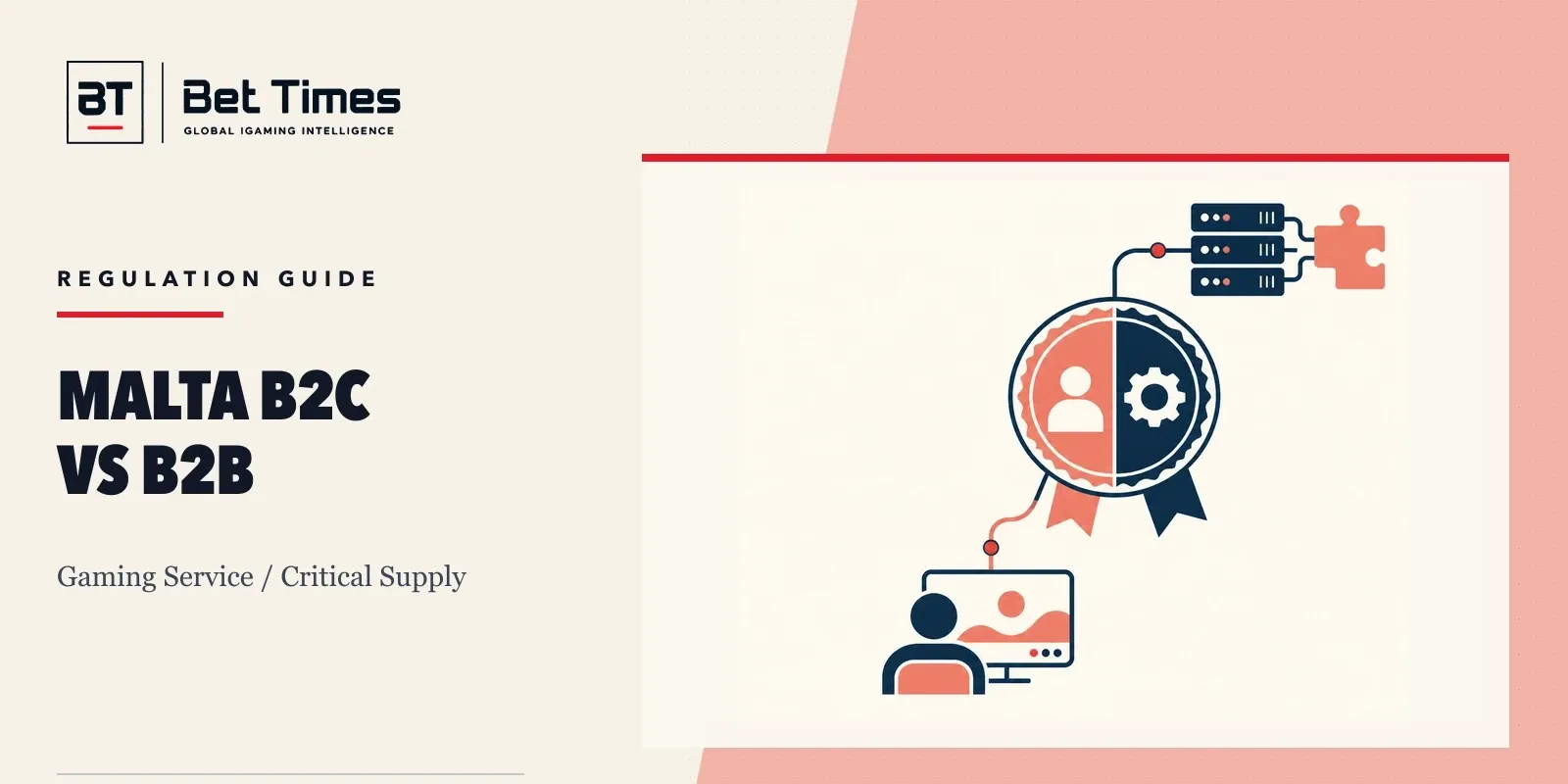
Malta's B2C Gaming Service licence covers the company offering a gaming service to players. The B2B Critical Gaming Supply licence covers critical game or platform supply to other businesses. They regulate different roles, so one permission should never be presented as a substitute for the other.
This guide is for operators, suppliers, investors, analysts and journalists resolving an MGA licence claim. It explains role, game-type, register and destination-market checks. It does not assess one company, give legal advice, or assume that Malta authorisation creates automatic access to another country's consumers.
The practical difference between B2C and B2B
The Malta Gaming Authority explains that a Gaming Service licence is the B2C permission to offer a gaming service, while a Critical Gaming Supply licence is the B2B permission to provide a critical gaming supply. The dividing line is the regulated relationship, not the familiarity of the brand.
A B2C licensee generally faces the player and provides the approved gaming service. A B2B licensee can provide game logic, a control system or other critical supply to the consumer-facing business. The B2B company may be highly visible inside an operator's product, but visibility does not make it the operator of the player account.
Some groups perform both roles through different legal entities. Others hold more than one permission on one structure. Verification should therefore begin with company names and licence records before interpreting product pages, group websites or event biographies.
B2C and B2B permissions compared
| Role | What it means | Where to verify |
|---|---|---|
| B2C Gaming Service | Offering approved gaming services to players through the licensed relationship. | Legal entity, status, game types, approved brands or URLs, and the entity named in player terms. |
| B2B Critical Gaming Supply | Supplying and managing material elements of a game, platform or control system for business customers. | Supplier entity, critical function, approval status, and which operators actually use the supply. |
| Corporate group structure | Ownership and governance relationships among operating and supply entities. | Do not transfer one entity's permission to every subsidiary or brand without evidence. |
| Destination-market permission | The separate right to target consumers in another jurisdiction. | Local licence, local entity, product scope and domain where destination-country rules require them. |
The BETTIMES guide to what an iGaming platform is maps platform components without treating the vendor as the B2C operator. The white-label gambling guide explains how a consumer brand can sit on another company's regulated and technical stack.
What the B2C Gaming Service licence covers
The MGA's B2C application page describes the Gaming Service licence for businesses offering a gaming service from Malta or through a Maltese legal entity. The authorised game types attached to the record define the approved activity more precisely than a generic online casino label.
B2C responsibilities extend beyond making games available. The licensee can be responsible for the customer relationship, player registration, funds, safer-gambling controls, complaints, reporting and other duties arising from its approved service. Exact obligations depend on the permission, products and operating model.
An operator can use third-party games, payments, identity tools and platform services while remaining the B2C licensee. Outsourcing a function does not automatically outsource regulatory accountability. Contracts and assurance records should make the allocation clear.
What the B2B Critical Gaming Supply licence covers
Critical Gaming Supply addresses material business-to-business gaming technology. Depending on the model, this can include elements that determine game results, manage essential game logic or provide a critical control environment. The supplier serves another gaming business rather than directly offering the consumer service under that permission.
The distinction is particularly important for game studios and platform providers. A supplier can hold an MGA B2B approval and distribute technology to several operators. That record supports the supplier role, but it does not prove that every operator customer is authorised in every target market.
The BETTIMES explanation of a remote gaming server shows how game logic and outcome processing can sit in supplier infrastructure. Our casino game testing guide adds the separate laboratory and production-evidence layer.
How Malta game types work
Malta classifies gaming services by game type. Type 1 generally concerns games of chance played against the house whose result is determined by a random generator, including relevant casino games. Type 2 concerns fixed-odds betting. Type 3 concerns player-to-player games where the operator takes a commission or charge, and Type 4 concerns controlled skill games under the applicable framework.
Those categories describe regulatory and risk characteristics. They should not be mapped casually from a site's navigation menu. Poker, fantasy, exchange, sportsbook and casino products can raise different questions depending on how the operator participates in the game and earns revenue.
When a record lists several game types, preserve them rather than reducing the licence to one headline category. When a website adds a new product, verify that the licence record and any required approval cover it.
How to verify an MGA licence
Use the official MGA Licensee Hub as the primary public checkpoint. Search the legal entity from the website terms and compare the result with the brand or URL being reviewed. A dynamic seal can help navigate to the record, but the record itself carries the evidence.
- Capture the exact hostname and the legal company named in the customer terms.
- Search the company in the Licensee Hub and open the current record.
- Confirm whether the permission is Gaming Service, Critical Gaming Supply or both.
- Record the status, licence number and approved game types.
- Match the listed brands and URLs to the product under review.
- Check any enforcement entry or material limitation associated with the entity.
- Add the verification date and destination-market caveat to the research record.
If the website presents only a generic MGA logo and no traceable entity, do not fill the gap with a group name. The claim remains unresolved until the player-facing entity and regulator record align.
Malta approval and destination-market access
Malta is a licensing jurisdiction and operating base, but an MGA licence is not a universal passport. A business targeting consumers in Great Britain, the Netherlands, Ontario, Sweden, Germany or Brazil can face local licensing or authorisation requirements in those markets.
This is an entity and territory problem. The Malta entity may supply technology to a locally licensed operator, operate through a locally registered group company, or avoid a market entirely. Each configuration produces a different evidence chain.
BETTIMES market profiles keep the Malta framework separate from the Great Britain market and other destination jurisdictions. That prevents an accurate statement about one licence from becoming an inaccurate global claim.
Fees, tax and compliance contributions
The MGA framework can include application and annual licence fees, compliance contributions and gaming-tax rules. These are different economic concepts. A percentage tied to revenue from players located in Malta should not be presented as the total cost of holding an MGA licence or as the effective tax rate for every international business.
The Authority has also announced changes to Malta's gaming tax and VAT framework scheduled for 1 October 2026. Current modelling should therefore state its effective date and cite the MGA reform notice rather than carrying an undated rate into future analysis.
Commercial costs such as platform fees, game revenue share, payment processing and local market taxes sit outside the licence-fee label. A total-cost comparison needs each layer separately.
Player protection and operational accountability
B2C status matters because the player-facing licensee carries consumer obligations within its approved service. Player funds, self-exclusion, complaints, account controls and responsible-gambling processes should be mapped to the legal entity that owns the relationship.
A B2B supplier can still hold important compliance duties for secure, reliable and controlled technology. Its evidence can include testing, change management, incident response and customer due diligence. Those duties do not make the supplier the player-account operator.
The BETTIMES guide to KYC in online gambling explains the customer-evidence layer, while AML in online gambling explains why risk ownership and monitoring continue after registration.
Common entity-resolution mistakes
- Calling every MGA holder an online casino operator.
- Treating a Critical Gaming Supply licence as permission to accept player deposits.
- Assuming a parent company's licence automatically covers every subsidiary and brand.
- Quoting a licence number without recording its game types or status.
- Using a Malta record as proof of destination-country market access.
- Mixing gaming tax, compliance contributions and licence fees into one unexplained rate.
- Matching a familiar brand while ignoring the company named in the customer terms.
A reusable Malta licence record
An effective record contains legal entity, company identifier, licence number, permission class, approved game types, brands, URLs, status, official record URL and check date. For B2B suppliers, add the controlled function. For B2C services, add the consumer-facing relationship and destination markets reviewed.
Keep claims proportional to the evidence. The register can establish that a licence exists and describe its scope. It cannot independently prove service quality, payment speed, control effectiveness or permission outside the recorded framework.
The BETTIMES licence directory uses those boundaries so that a B2B approval is not displayed as a generic trust badge and a B2C record is not extended beyond its authorised role.
Frequently asked questions
Is an MGA B2B licence a casino operating licence?
No. The Critical Gaming Supply licence covers an approved B2B supply role. A consumer-facing Gaming Service licence covers the B2C gaming service. One group can hold both, but the researcher should identify the exact legal entity and permission rather than treating the supplier approval as a player-account licence.
Can one company hold both B2C and B2B permissions?
A group or entity structure can contain more than one MGA permission where its activities require them. The public record should be used to verify the precise arrangement. Do not infer that every subsidiary, URL or customer relationship inherits all permissions simply because the same parent or commercial brand appears nearby.
Does an MGA licence allow an operator to serve every EU country?
No. Malta authorisation and destination-country market access are separate questions. Several European markets require their own local permission. A company may use an MGA-licensed entity for part of its operation while serving another market through a different regulated entity, or it may be unable to target that market.
What should I match in the Licensee Hub?
Match the legal entity, current status, licence number, permission type, approved game types, brands and URLs. Then compare those fields with the customer terms and hostname you observed. If only the group name or logo aligns, the licence claim has not yet been fully resolved.
Is the licence number enough to verify a site?
No. A genuine number can be copied, outdated or associated with a different entity or URL. The reliable check connects the number to the legal company, permission, game types, current status and consumer-facing domain. Save the official record link and date so another reviewer can repeat the result.
The reliable conclusion
Malta's B2C and B2B licences answer different questions. The Gaming Service licence concerns the approved player-facing service; Critical Gaming Supply concerns essential supply to gaming businesses. Verify the exact entity and game types in the Licensee Hub, then perform a separate destination-market check before describing where the business may operate.