
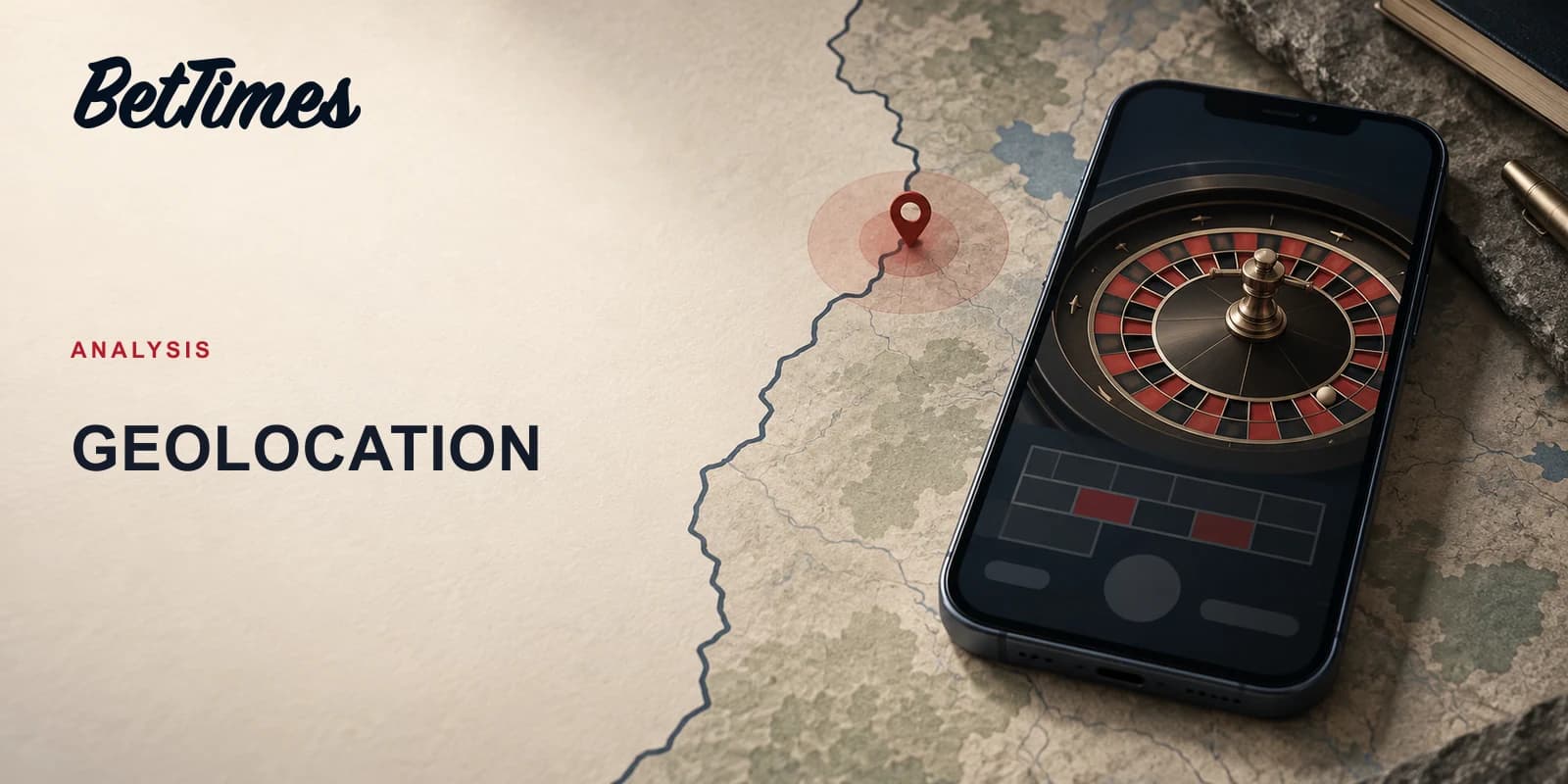
Online gambling geolocation is a control that checks whether a player is physically in a place where a particular operator may accept a wager. It is not the same as confirming the player's identity, home address or the country associated with a payment card. A regulated system may let someone register, view an account or request a withdrawal while refusing a new bet because the device's current location cannot be established inside the permitted boundary. When the evidence is uncertain, blocking the wager is generally safer than assuming the player is eligible.
This guide is for players trying to understand a location error and for operators, suppliers and researchers assessing the control behind it. It compares official material from New Jersey, Pennsylvania and Ontario with the separate technical benchmark in GLI-19 version 3.0. These examples do not create a universal gambling rule. Product availability, account functions, recheck frequency and appeal routes depend on the market, licence and approved system. Sources were checked on 28 September 2026.
Location is a wager decision, not a postal-address test
The most useful way to understand a geolocation check is as a decision about this device, this session and this wager. An operator's permission to offer online casino games does not establish that every visitor to its website can place a bet. The platform must connect the available game to the jurisdiction where play is authorized and apply the local eligibility rules. Separately, KYC checks establish who is using the account and whether other identity-related conditions are met. A correct identity record does not prove the device is physically inside a permitted area.
The distinction is particularly clear in iGaming Ontario's operator FAQ. It says residency is not a factor in whether someone can play on an authorized Ontario site: the person must physically be in Ontario. It also says players can register and manage their accounts, including deposits and withdrawals, while physically outside the province. Thus an account page that opens abroad is not evidence that betting there is authorized. Nor should a geolocation denial automatically be described as an account suspension or confiscation of funds.
In New Jersey, the Division of Gaming Enforcement's Internet and Mobile Gaming rules, section 13:69O-1.2(e) require the system to detect a patron's physical location on login and as often thereafter as the permit holder's approved submission specifies. If it detects an unauthorized area, the system must not accept wagers until the patron is in an authorized location. The rule describes New Jersey internet gaming with stated legal and reciprocal-agreement qualifications; it is not a licence to treat any other state or country as automatically eligible.
How a geolocation check works
The exact vendor and implementation may differ. As a technical reference rather than a law automatically binding every operator, GLI-19 section 2.7 describes a location service that checks a player before the first game on a device, monitors for later changes and blocks unauthorized attempts. It lists Wi-Fi, cellular and GPS as potential location data sources. Its public-network criteria also call for a location estimate with a confidence radius that fits inside the permitted boundary. That is more precise than asking whether a single map pin appears near the correct city.
An IP address can be part of the signal set, but it is a network address, not direct proof of a person's physical position. Pennsylvania's geolocation technical standard, section 809b.7 says IP location should not be the primary data source on other connections and should be disregarded for devices using mobile internet connections. A player whose IP appears to be in the state can still fail a stronger device-location check. Conversely, an out-of-state IP label need not, on its own, establish where the player is sitting.
The service compares the location evidence with an approved digital boundary, often called a geofence. GLI-19 describes boundary polygons based on regulator-approved audited maps, with location data overlaid on them. Pennsylvania's technical standard similarly requires audited boundary polygons and a controlled accuracy radius. If a reported position is near a border but its uncertainty extends across the line, a strict check may not be able to confirm that the whole confidence area is inside. The system should treat uncertainty as a failed verification rather than silently convert it into permission to wager.
| Checkpoint | What the system needs to establish | What failure does not prove |
|---|---|---|
| Account and product | The player and offered game meet the market's separate eligibility conditions | That a verified identity establishes current location |
| Device signal | The physical position can be estimated from permitted, trustworthy sources | That an IP address alone is an exact location |
| Geofence | The location and relevant accuracy area fit the authorized boundary | That a nearby map pin is enough at a border |
| Integrity | Signals have not been manipulated by a proxy, fake-location app or remote-control route | That every flagged user deliberately tried to evade a rule |
| Recheck and wager | The location remains eligible when a new wager is initiated | That login or an earlier successful check authorizes every later bet |
This table is an editorial model synthesized from the cited standards and regulations, not a single regulator's prescribed flowchart. It also leaves out other eligibility gates, such as age, self-exclusion and account status, which must be assessed independently.
When does the system check again?
There is no one global recheck interval. New Jersey's rule requires a check at login and then at the frequency in the permit holder's approved submission. Pennsylvania's final interactive-gaming regulation, section 809a.7 requires physical-location detection at login and at the frequency set in Board technical standards and approved internal controls. It also requires the system to dynamically monitor location and block unauthorized attempts during the session.
For a concrete Pennsylvania example, its section 809b.7 technical standard specifies a recheck every 20 minutes during a multi-wager session, or every 5 minutes when the player is within 1 mile of the Commonwealth border, with another proximity-based rule for a mobile connection near an excluded zone. Those are Pennsylvania-specific technical numbers, not advice about how long a player can gamble elsewhere without a new check. System configuration and approved controls still matter.
GLI-19 supplies another, explicitly separate benchmark. Section 2.7.4 calls for a check before the first game after login on a device and a further check before games following an IP-address change, after 30 minutes, or as otherwise specified by the regulator. A 30-minute GLI criterion must not be presented as overriding Pennsylvania's 20- and 5-minute example or New Jersey's approved frequency. Testing should document which rule applies to each market and event. Gaming Laboratories International's description of geolocation testing likewise asks when checks occur and whether their frequency changes near a border.
Why an apparently eligible player can be blocked
A failed check is a decision about available evidence, not a judicial finding about the player. Location services may be disabled or permission denied on the device. Wi-Fi and GPS signals may be weak or inconsistent in a building. A laptop may have fewer reliable location sources than a phone. A border may be close enough that the confidence radius cannot be placed wholly inside the authorized region. These are plausible technical causes, not a diagnosis of any particular player's error.
The same controls must address deliberate manipulation. GLI-19 section 2.7.2 discusses detection of fake-location apps, virtual machines, remote desktop programs, known VPN or proxy services, and device tampering. Pennsylvania's technical standard also calls for blocking location-data fraud and insecure or system-tampered devices. The fact that a device is flagged does not, by itself, prove malicious intent; it does explain why turning on a VPN or trying a location-spoofing tool is not an appropriate fix. These checks aim to establish physical presence, not merely to obtain an in-state-looking internet address.
For a legitimate error, first confirm that the device's location services and the operator app or browser permission are enabled. Check whether an ordinary privacy or corporate-network tool is obscuring the signal, and use the operator's documented support path rather than trying to falsify location data. If the problem persists, record the time, time zone, device, market, exact error and whether the issue happens at login or only when starting a game. Ask support what category of check failed and what compliant step could resolve it. The provider may not disclose its fraud-detection details, but it should be able to explain the allowed user action and complaint route.
What changes when a player crosses a border?
An earlier successful check does not create an unlimited pass. A phone can move, a network can change, and a long session can outlast the permitted evidence window. The relevant system should re-evaluate location according to its market-specific controls and refuse a new unauthorized wager. That is distinct from deciding the status of a stake already accepted before the move. The latter turns on the recorded event sequence and the game or sports-bet rules, not on a guess that all prior transactions disappear.
Pennsylvania's final regulation explicitly calls for dynamic monitoring throughout the session. New Jersey requires further checks under the operator's approved submission. GLI-19 adds a technical log criterion for location violations, including a timestamp, player identifier and detected location, and calls for monitoring geographically inconsistent successive plays. These records help an operator investigate an eligibility dispute. They are not a promise that a player will receive every internal fraud signal on request. Our guide to interrupted casino rounds covers the separate question of a game whose accepted stake or result is interrupted.
The service also needs to distinguish geolocation from product licensing. A player physically in a permitted area can still be denied a particular game if that game, operator, account or age group is not eligible. Conversely, a company licensed somewhere cannot simply accept remote play from everywhere. Our operator-versus-supplier licence guide explains why permission belongs to defined activities and markets, not to a globally portable brand name.
A practical geolocation audit checklist
For a player, the first question is whether the operator and product are authorized where the wager is attempted. Use the relevant regulator's operator list and the site's legal entity details. Then distinguish account access from the right to place a wager. When a check fails, keep the error, timestamp and device details; do not assume a refund, loss of account balance or criminal accusation follows automatically. If money or a settled result is disputed, preserve the transaction record and use the operator's formal support or complaint process.
For an operator or test team, a short control sample is more informative than a marketing claim that the product is “geofenced”:
- Identify the legal operator, approved product, permitted territory and versioned boundary data.
- Record the check at login, first wager, network change, timed recheck and border approach for each relevant market.
- Test a clearly inside position, a clearly outside position and an uncertain position whose confidence area reaches the boundary.
- Verify that a failed or unavailable check blocks a new wager without silently changing an already accepted transaction.
- Reconcile the decision with device evidence, timestamps, operator controls, player-facing message and incident log.
This is a proposed editorial test plan, not a certification protocol. GLI's public geolocation-testing outline explicitly examines when checks occur, whether border proximity changes the interval, and whether a user outside the territory can still access non-play account functions. Our casino game-testing guide explains why a system claim needs a defined tested configuration rather than a generic badge.
The bottom line
Online gambling geolocation is an evidence-based gate on where a wager may be placed. A verified name, home address, deposit or successful login does not replace that gate. Good implementations combine trustworthy device signals, an approved boundary, market-specific rechecks, anti-spoofing controls and a clear decision record. If a legitimate player is blocked, the useful next step is to identify which jurisdiction and which check failed, then resolve it through the operator's permitted process—not to make the connection merely appear to come from another place.
Frequently asked questions
Can I play on an Ontario-licensed site if I live outside Ontario?
iGaming Ontario says residency is not the deciding factor for play on an authorized site; the player must be physically in Ontario while playing. It also says an account can be registered and managed, including deposits and withdrawals, while the person is outside the province. Other eligibility requirements still apply, so physical presence alone is not a complete permission test.
If I can log in, does that mean my next bet is allowed?
No. Account access and wagering eligibility are separate decisions. Ontario explicitly allows some account management outside the province without allowing play there. New Jersey's rules check physical location on login and require the system not to accept a wager from an unauthorized area. A later move, network change or failed recheck can also change the decision during a session.
Is an IP address enough to prove where I am?
Not necessarily. GLI-19 describes Wi-Fi, cellular and GPS as location sources and requires a confidence area inside the permitted boundary in its technical benchmark. Pennsylvania's geolocation technical standard says IP location must not be the primary source on non-mobile connections and should be disregarded for devices using mobile internet connections. Actual implementations remain subject to local approval.
Why can a casino reject my location near a state border?
A location estimate has uncertainty, not just a dot on a map. If its accuracy or confidence area reaches outside the permitted territory or a defined buffer, the system may be unable to verify that the device is safely inside. Pennsylvania's technical standard expressly calls for more frequent checks within one mile of the border. That number is Pennsylvania-specific, not a universal buffer.
Does a VPN fix an online gambling location error?
No. A VPN can change how an internet connection appears without moving the player physically. GLI-19 and Pennsylvania's technical standard describe controls against proxies, fake-location applications and other circumvention methods. A legitimate user should check ordinary device permissions and ask the operator for an approved resolution. A failed location check does not by itself establish fraud.